 147 citations
,
January 2003 in “American journal of clinical dermatology”
147 citations
,
January 2003 in “American journal of clinical dermatology” This review discusses various forms of ichthyosis, including genetic and acquired types, detailing their characteristics, causes, and potential management strategies, but reports no new clinical results.
2 citations
,
October 1974 in “Archives of Dermatology” This case study describes a 27-year-old woman with alopecia mucinosa that persisted for 20 years despite multiple treatments, including steroids and antihistamines.
2 citations
,
August 2016 in “Journal of Investigative Dermatology”  81 citations
,
June 2012 in “European journal of human genetics”
81 citations
,
June 2012 in “European journal of human genetics” This review outlines a diagnostic framework for clinicians to distinguish different types of inherited ichthyoses and suggests further testing and treatment strategies, but reports no new clinical results.
1 citations
,
January 2008 in “SKINmed Dermatology for the Clinician” This case report describes a patient with mucous membrane pemphigoid who experienced recurrent blisters and cicatricial alopecia, showing improvement with prednisolone and dapsone treatment.
4 citations
,
January 2019 in “Indian Dermatology Online Journal” This report discusses two cases of porokeratotic eccrine ostial and dermal duct nevus and porokeratotic eccrine and hair follicle nevus, suggesting they may represent a single clinical entity, but reports no therapeutic outcomes.
1 citations
,
September 2017 in “BMJ” The man has a disease causing skin patches, thickened nerves, and mild muscle weakness.
May 2024 in “JAAD Case Reports” This case report describes a 29-year-old man with a year-long non-itchy skin eruption and hair loss, with distinct papules and plaques across his scalp, beard, body, and suprapubic regions, but no systemic symptoms or family history of autoimmune disease.
 December 2025 in “International Journal of Research in Dermatology”
 This study observed that keratosis pilaris is the most prevalent follicular keratotic disease, especially in adolescent and young adult females, and emphasized the key role of dermoscopy and histopathology in distinguishing it from other similar disorders and aiding in diagnosis.
 August 2018 in “Pediatric Dermatology”
 This case report describes a unique instance of an otherwise healthy infant with phylloid terminal hair nevus, a form of hypomelanosis without extracutaneous abnormalities.
 28 citations
,
January 2021 in “Parkinsonism & related disorders (Online)/Parkinsonism & related disorders”
28 citations
,
January 2021 in “Parkinsonism & related disorders (Online)/Parkinsonism & related disorders” This article reviews skin disorders in Parkinson's disease, highlighting the potential of skin studies and stem cell research to advance understanding and treatment of the neurodegenerative disorder, without presenting new results.
 1 citations
,
July 2015 in “British Journal of Dermatology”
1 citations
,
July 2015 in “British Journal of Dermatology” Imiquimod improved skin pigmentation in most patients with xeroderma pigmentosum and may prevent further skin cancer, but some treatments can have side effects.
November 2025 in “Indian Journal of Dermatology” This study reports a rare cluster of four patients with ectodermal dysplasia, highlighting its typical dental and dermatological manifestations and the necessity of multidisciplinary management.
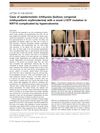 October 2011 in “Journal of dermatology”
 A man with a rare skin condition and a new gene mutation developed high calcium levels due to his treatment.
 4 citations
,
January 2015 in “Türk Patoloji Dergisi”
4 citations
,
January 2015 in “Türk Patoloji Dergisi” This review discusses the skin manifestations of endocrine diseases and reports no new clinical findings, emphasizing the importance of recognizing these signs for early diagnosis.
1 citations
,
October 2019 in “European Journal of Dermatology” There are no new clinical results reported in this discussion of pityriasis rubra pilaris diagnosis and treatment, which notes frequent treatment failures and highlights reliance on clinical and histopathological findings.
 6 citations
,
November 2011 in “Journal of Dermatological Science”
6 citations
,
November 2011 in “Journal of Dermatological Science” A new gene mutation may allow some piebaldism patients to regain skin color in white patches.
13 citations
,
September 1997 in “Archives of Dermatology” This case report describes a 5-year-old boy with a solitary patch of hair loss, potentially linked to a fungal infection after antibiotic treatment showed minimal effectiveness.
November 2025 in “JDDG Journal der Deutschen Dermatologischen Gesellschaft” This study documented a case of an 11-month-old with PKU who developed acrodermatitis enteropathica-like symptoms due to severe phenylalanine deficiency, requiring dietary adjustment to restore phenylalanine levels.
1 citations
,
March 2006 in “Journal of Cosmetic Dermatology” This case report describes a 79-year-old woman whose skin lesions were attributed to a cosmetic product, with complete resolution following mechanical removal of material and metronidazole treatment.
1 citations
,
September 2022 in “European Journal of Dermatology” This study identified a novel splice-site variant of the LAMB3 gene that may cause junctional epidermolysis bullosa, suggesting gene sequencing is essential for accurate diagnosis.
July 2022 in “European Journal of Dermatology” In this study, researchers found that patients with psoriasis had a higher probability of achieving and maintaining a clinical response using brodalumab compared to ustekinumab over 52 weeks, as measured by a multistate modelling approach based on absolute PASI scores.
12 citations
,
January 2000 in “Journal of cutaneous medicine and surgery” This case study suggests that overgrowth of microorganisms with hyperkeratosis may contribute to the induction of lichen planopilaris by disrupting the immune privilege of hair follicles.
June 2025 in “Dermatologic Surgery” This article reviews multiple noncutaneous manifestations of pityriasis rubra pilaris, such as subungual hyperkeratosis and hair loss, but reports no new clinical results.
1 citations
,
February 2023 in “Pediatric Dermatology” This case report of an infant with IPEX syndrome highlights the importance of early recognition and treatment, as the patient experienced severe symptoms and succumbed before stem cell transplantation.
 2 citations
,
April 2018 in “International Journal of Research in Dermatology”
2 citations
,
April 2018 in “International Journal of Research in Dermatology” In this study, lichen striatus was the most common linear dermatosis observed, with most lesions occurring along Blaschko’s lines, and histopathological evaluation often revealed different underlying conditions.
5 citations
,
September 1989 in “Pediatric dermatology” Persistent papular plaques on children's faces need better understanding and treatment.
 2 citations
,
January 2019
2 citations
,
January 2019 This review discusses autoimmune skin disorders, including lupus erythematosus and scleroderma, and their common treatments, reporting no new clinical results.
September 2021 in “CRC Press eBooks” This review discusses erosive pustular dermatosis of the scalp, including its characteristics, potential triggers, and its classification as a neutrophilic dermatosis, but reports no new clinical findings.
25 citations
,
January 1983 in “Archives of dermatology” This article reviews the early establishment of dermatology as a specialty in the U.S. and documents the initial descriptive errors in understanding Darier's disease, offering no new clinical data.