11 citations
,
January 2015 in “JOURNAL OF HEALTH SCIENCE” This case report details a 12-year-old boy with Lichen Spinulosus and plantar keratoderma, who responded well to topical treatments including lactic acid, urea, and betamethasone valerate.
July 2023 in “Clinical Cosmetic and Investigational Dermatology” In this case report, a 64-year-old Thai woman with a history of misdiagnosed eczema or folliculitis was ultimately found to have granular parakeratosis of the eccrine ostium, leading to significant symptom improvement once accurately diagnosed and advised to avoid excessive heat and moisture.
December 2014 in “Actas dermo-sifiliográficas/Actas dermo-sifiliográficas” Hair removal with intense pulsed light can cause rare skin lesions that are hard to fully treat.
5 citations
,
October 2012 in “Veterinary Pathology” This case study describes a Doberman Pinscher with a unique alopecic variant of chronic cutaneous lupus erythematosus that progressed to systemic lupus erythematosus, highlighting a rare autoimmune alopecia form in dogs.
 13 citations
,
July 2014 in “The Journal of Dermatology”
13 citations
,
July 2014 in “The Journal of Dermatology” Dermoscopy helped diagnose discoid lupus erythematosus in two patients without needing skin biopsies.
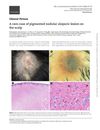
This study reported the case of a 30-year-old man with a bluish-grey scalp nodule that developed over a previously stable hairless plaque, revealing histopathological features consistent with epithelioid cell nests and spindle-shaped dermal melanocytes embedded in collagen.
13 citations
,
July 2016 in “Indian Journal of Dermatology” This report describes two Saudi brothers with dermatopathia pigmentosa reticularis who exhibited normal hair shafts despite their condition.
January 2026 in “Acta Dermato Venereologica” This source reports that four weeks of dupilumab treatment led to notable improvement in skin lesions, including multiple erythematous patches and papules on the face, back, and limbs.
 27 citations
,
July 2015 in “International Journal of Dermatology”
27 citations
,
July 2015 in “International Journal of Dermatology” This study found that skin disorders are prevalent among elderly individuals and are often associated with underlying systemic diseases.
 20 citations
,
September 2018 in “Journal of cutaneous pathology”
20 citations
,
September 2018 in “Journal of cutaneous pathology” This study found that adnexal acantholysis does not reliably distinguish pemphigus vulgaris from pemphigus foliaceus, but the level of acantholysis and degree of dyskeratosis serve as distinguishing features among acantholytic disorders.
3 citations
,
April 2011 in “Journal of the American Academy of Dermatology” This article describes a unique case of unilateral keratosis pilaris atrophicans faciei in a 19-year-old man, noting its clinical similarity to follicular mucinosis, but presents no new general findings.
 9 citations
,
August 2002 in “Current Opinion in Pediatrics”
9 citations
,
August 2002 in “Current Opinion in Pediatrics” This article discusses the roles of pediatrics and dermatology departments at Yale University School of Medicine, but reports no specific clinical results.
 23 citations
,
November 2011 in “Journal of the European Academy of Dermatology and Venereology”
23 citations
,
November 2011 in “Journal of the European Academy of Dermatology and Venereology” This study observed that in pemphigus vulgaris patients, hair loss and alopecic patches may result from anti-desmoglein autoantibody-mediated acantholysis and inflammatory changes, leading to non-scarring alopecia with potential for regrowth after treatment.
 9 citations
,
July 2010 in “British Journal of Dermatology”
9 citations
,
July 2010 in “British Journal of Dermatology” This article reports on lentiginosis observed within plaques of linear atrophoderma of Moulin and discusses its potential classification as a twin-spotting phenomenon but provides no new clinical research results.

This chapter reviews various skin disorders classified as Mendelian disorders of cornification and reports no new clinical findings, highlighting the complexity of genetics involved in inherited ichthyoses.
19 citations
,
March 2011 in “The Journal of Dermatology” This case report in a child suggests that lichen planus pemphigoides may represent a heterogeneous group of disorders, potentially triggered by conditions like varicella.
 December 2023 in “Clinical, cosmetic and investigational dermatology”
 This study found that specific dermoscopic signs, such as diameter diversity of leukotrichia and Pohl-Pinkus constrictions, were associated with progressive vitiligo, and early-stage melanin synthesis was impaired in vitiligo-associated leukotrichia.
June 2026 in “British Journal of Dermatology” This case report discusses an atypical presentation of bullous pemphigoid in a young man potentially triggered by occupational chemical exposure, highlighting diagnostic challenges and effective treatment with clobetasol propionate and prednisolone, transitioning to mycophenolate mofetil.
January 2025 in “Dermatology Online Journal” The man's hair loss and skin papules were diagnosed as atrichia with papular lesions, not alopecia areata universalis.
 3 citations
,
September 2021 in “Experimental and Therapeutic Medicine”
3 citations
,
September 2021 in “Experimental and Therapeutic Medicine” This study described the clinical characteristics of keratosis pilaris atrophicans faciei in 14 patients, noting that earlier diagnosis may enable more targeted treatment options.
 21 citations
,
November 1981 in “Archives of Dermatology”
21 citations
,
November 1981 in “Archives of Dermatology” This study hypothesizes that postinflammatory hyperpigmentation in ashy dermatosis may result from basal cell apoptosis, as evidenced by consistent histologic findings across nine patients.
4 citations
,
November 2020 in “Case reports in dermatology” This report summarizes recent cases of the rare condition erythromelanosis follicularis faciei et colli to illustrate its varied clinical presentations.
2 citations
,
January 2002 in “Clinics in Dermatology” This review details the characteristics, associations, and differential diagnoses of vitiligo and reports no new clinical findings.
 August 2025 in “International Journal of Research in Dermatology”
 This case report highlights an atypical presentation of acrodermatitis enteropathica in an 18-year-old male, exhibiting symptoms like erythrokeratoderma variabilis with a positive response to high-dose oral zinc, underscoring the importance of considering zinc deficiency in unusual skin conditions.
25 citations
,
May 1995 in “Journal of the American Academy of Dermatology” This article reports two new cases of erythromelanosis follicularis faciei in women and includes a literature review on this rarely diagnosed condition.
 4 citations
,
March 2017 in “Journal of evolution of medical and dental sciences”
4 citations
,
March 2017 in “Journal of evolution of medical and dental sciences” This study observed that pruritus and xerosis were the most common skin complaints among the geriatric population attending a dermatology clinic in Puducherry.
 April 2023 in “Journal of Investigative Dermatology”
 This study found that alopecia areata patients have higher odds of certain comorbidities like ulcerative colitis and vitiligo, while showing lower odds for conditions like hypertension and type 2 diabetes compared to healthy controls.
8 citations
,
January 2019 in “JAAD Case Reports” This article describes erosive pustular dermatosis of the scalp, emphasizing its chronic nature, potential complications, and the lack of specific diagnostic findings, but reports no new clinical results.

In this study, the authors emphasize the importance of accurately diagnosing congenital atrichia with papules—a condition marked by hair loss and papular skin lesions—differentiating it from other similar disorders to prevent unnecessary treatments and inform families about its benign but irreversible nature.
36 citations
,
January 2000 in “British journal of dermatology/British journal of dermatology, Supplement” This case study reports on a mother and daughter with ichthyosis follicularis, alopecia, and photophobia, noting consistent keratotic eruptions during the mother's pregnancies that improved postpartum.