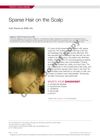
This case study describes a young girl with sparse, brittle scalp hair and multiple keratotic papules, but no systemic or familial abnormalities were found.
June 2018 in “Journal of the American Veterinary Medical Association” Three related Persian cats have a rare, likely hereditary skin condition causing hair loss and poor coat quality, with limited treatment options.
 1 citations
,
December 2022 in “Pediatric dermatology”
1 citations
,
December 2022 in “Pediatric dermatology” This case report highlighted an instance of lichen spinulosus emerging as a new cutaneous sequela in a boy following toxic epidermal necrolysis, responding to treatment with ammonium lactate.
 39 citations
,
July 2008 in “Dermatologic Therapy”
39 citations
,
July 2008 in “Dermatologic Therapy” This review provides a practical approach to diagnosing pseudopelade of Brocq and updates on treatment options but reports no new clinical results.
In this case study, a 20-year-old man with dermatitis initially misdiagnosed as caused by Herpes simplex was found to have a fungal infection, Trichophyton mentagrophytes, and successfully treated with oral terbinafine and ketoconazole products.
 5 citations
,
January 2010 in “International journal of trichology”
5 citations
,
January 2010 in “International journal of trichology” This report describes two cases of alopecia totalis treated with turban psoralen and sunlight exposure, but it provides no clinical outcome results.
2 citations
,
May 2022 in “International journal of trichology” This article reviews the condition plica neuropathica, including its manifestations, potential causes, and treatment, but it does not provide new clinical findings.
8 citations
,
November 2013 in “Vojnosanitetski pregled” This report discusses two patients with erosive pustular dermatosis of the scalp and highlights that a prompt response to topical steroids supports its diagnosis despite nonspecific histological findings.
 4 citations
,
September 2010 in “Journal of Dermatological Science”
4 citations
,
September 2010 in “Journal of Dermatological Science” This article reviews keratosis follicularis squamosa, a keratinizing disorder predominantly found in the Japanese population, but reports no new clinical results.
26 citations
,
December 1979 in “Journal of Cutaneous Pathology” This study found that trichostasis spinulosa was present in some seborrheic keratoses, indicating they may partly originate from hair follicle cells.
 2 citations
,
August 1994 in “Archives of dermatology”
2 citations
,
August 1994 in “Archives of dermatology” This article reports a case of a 19-month-old boy with scalp erythematous papules and hair loss, showing no improvement with initial treatment.
In this case report, a 74-year-old woman with progressive alopecia unresponsive to minoxidil was diagnosed with Graham-Little-Piccardi-Lassueur Syndrome, illustrating the value of interdisciplinary collaboration in primary care for accurate diagnosis and improved patient outcomes.
January 2022 in “Clinical Cases in Dermatology” This article discusses the causes and treatment options for lichen planopilaris, a scarring hair loss condition, but reports no new clinical findings.
1 citations
,
July 2018 in “JAMA dermatology” This abstract contains navigation and subscription information for JAMA Dermatology and reports no new clinical findings.
4 citations
,
October 2001 in “Mycoses” This case report describes a rare instance of dermatophytosis in a young cat caused by Microsporum gypseum, confirmed by molecular analyses to be Arthroderma gypseum.
This abstract provides contact information for Dr. Ban Kamoona at the Medical University – Sofia and contains no research findings.
 3 citations
,
January 2015 in “Dermatology Online Journal”
3 citations
,
January 2015 in “Dermatology Online Journal” This case report highlights a patient whose essential syphilitic alopecia was the only symptom of syphilis, which improved after benzathine penicillin treatment, emphasizing alopecia as a potential sign of syphilis.
18 citations
,
March 1992 in “Archives of Dermatology” This case report presents a 28-year-old man with scarring alopecia unresponsive to topical treatments, alongside a family history of keratosis pilaris and unique curly scalp hair.

This case study reports the first known instance of lichen planopilaris being associated with multiple autoimmune syndrome in a woman with hypothyroidism and Crohn's disease.
9 citations
,
September 1977 in “Journal of Small Animal Practice” In this study, gamma benzene hexachloride washes successfully resolved skin disease in guinea pigs affected by Trixacarus caviae, after confirmation via skin scrapings.
April 2002 in “Postgraduate medicine” This case report describes a 4-year-old African American boy with tinea capitis characterized by itchy, scaly patches and hair loss, diagnosed through microscopic examination after initial treatments were only partially effective.
33 citations
,
February 2011 in “International Journal of Dermatology” This study observed that orange spots and dystrophic hairs on trichoscopy may aid in diagnosing scalp sarcoidosis.
8 citations
,
January 2014 in “Indian Journal of Paediatric Dermatology” This case report describes a 4-year-old boy with congenital alopecia characterized by complete irreversible hair loss and papular lesions associated with keratin-filled cysts.
 22 citations
,
January 2009 in “Medical mycology”
22 citations
,
January 2009 in “Medical mycology” In this case report, researchers identified Arthroderma vanbreuseghemii as the cause of a familial fungal infection, which was successfully treated with itraconazole and topical terbinafine cream.
55 citations
,
May 2007 in “Australasian journal of dermatology” This case report describes the characteristic clinicopathological features of trichodysplasia spinulosa in two boys with acute lymphocytic leukemia, highlighting its resolution as immune function normalizes.
71 citations
,
January 2011 in “Orphanet Journal of Rare Diseases” This article reviews IFAP syndrome, an X-linked genetic disorder characterized by ichthyosis follicularis, alopecia, and photophobia, and reports no new clinical findings.
 October 1961 in “Archives of Dermatology”
 This report describes a case of dermatitis herpetiformis where symptoms resolved with continuous sulfapyridine therapy after persisting despite other treatments.
January 1998 in “The Nishinihon Journal of Dermatology” A 7-year-old girl was diagnosed with Netherton's Syndrome, shown by skin and hair symptoms.
8 citations
,
September 1987 in “Acta Dermato Venereologica” In this study, the researchers used structural studies and molecular calculations to suggest that the enzyme in RXLI patient hair follicles is less efficient, rather than completely inactive.
August 2020 in “OPAL (Open@LaTrobe) (La Trobe University)” This article offers dermoscopic comparisons between fibrosing alopecia and androgenetic alopecia with seborrheic dermatitis but reports no new research findings.