1 citations
,
December 2023 in “JAAD International” Mast cells may significantly contribute to central centrifugal cicatricial alopecia.
2 citations
,
October 2000 in “Journal of Investigative Dermatology” AUC and APL are distinct conditions needing careful clinical assessment.
April 2016 in “Journal of the American Academy of Dermatology” A 4-year-old girl had a rare hair disorder affecting only part of her scalp.
June 2020 in “Zenodo (CERN European Organization for Nuclear Research)” This study analyzed pediatric and adult patients with antibody deficiencies at a PID center, finding frequent severe infections and genetic mutations, with treatment primarily involving IVIG replacement therapy.
 5 citations
,
March 2009 in “Pediatric Dermatology”
5 citations
,
March 2009 in “Pediatric Dermatology” The study found that pili bifurcati causes hair to intermittently split into two branches, each with its own outer layer.
 8 citations
,
January 2015 in “International journal of trichology”
8 citations
,
January 2015 in “International journal of trichology” In this case report, the authors describe complete recovery from acute diffuse and total alopecia linked to Borrelia infection after treatment with intravenous ceftriaxone and topical clobetasol foam.
This study discovered two new species of mites in the hair follicles of squirrel monkeys from South America, potentially causing follicle damage due to secondary infection.
August 1994 in “American Journal of Veterinary Research” In this study, monoclonal antibody B72.3 showed selective immunoreactivity to specific types of normal canine epithelial cells, primarily those involved in mucin production.
 April 2018 in “Journal of Investigative Dermatology”
 In this study, researchers identified CENPV as a new CYLD interacting partner that localizes to primary cilia and regulates acetylated tubulin levels, offering insights into the pathogenesis of skin appendage tumors.
7 citations
,
February 2019 in “Anais Brasileiros de Dermatologia” 5 citations
,
January 2009 in “International Journal of Trichology” This case report documents a rare association between atopic eczema and pili annulati in two siblings from north India, an unusual finding not previously reported in the literature.
 19 citations
,
February 2016 in “Journal of The American Academy of Dermatology”
19 citations
,
February 2016 in “Journal of The American Academy of Dermatology” This study found that the presence of CD3(+) T-cells within empty follicular fibrous tracts is a reliable indicator for diagnosing diffuse alopecia areata instead of pattern hair loss.
46 citations
,
September 2010 in “Veterinary Dermatology” This retrospective study documented various skin diseases in alpacas, reporting bacterial infections as the most common, along with other conditions described for the first time.
 April 2021 in “BMJ Case Reports”
 This case report discusses a rare instance of pseudolymphomatous folliculitis in a 19-year-old man, highlighting the challenge in diagnosing PLF due to its low clinical suspicion index and variable initial clinical diagnoses.
14 citations
,
January 1998 in “Dermatology” This study found evidence that polythelia pilosa, previously excluded from classification, should be reintroduced as it marks true aberrant mammary structures in men and hirsute women.
 26 citations
,
December 2022 in “Journal of the American Academy of Dermatology”
26 citations
,
December 2022 in “Journal of the American Academy of Dermatology” This study observed that epidermal necrosis and keratinocytic ballooning are consistent histopathologic signs of monkeypox in skin lesions, reinforcing the diagnostic value of histopathologic and immunohistochemical analyses.
1 citations
,
August 2022 in “American Journal of Tropical Medicine and Hygiene” This case report describes a 29-year-old man who developed scalp abscesses due to Mycobacterium abscessus infection after receiving scalp injections for hair loss, successfully treated with antibiotics.
 7 citations
,
January 2012 in “International Journal of Trichology”
7 citations
,
January 2012 in “International Journal of Trichology” This article highlights differences in childhood alopecia areata compared to adult cases but reports no new clinical findings.
9 citations
,
February 2024 in “mBio” This study found that biliverdin beta and delta, metabolites of heme, play a critical role in Pseudomonas aeruginosa iron acquisition and cooperative behaviors, which are crucial for the bacterium's long-term infection in cystic fibrosis patients, suggesting potential targets for new therapies.
 20 citations
,
March 1985 in “Journal of The American Academy of Dermatology”
20 citations
,
March 1985 in “Journal of The American Academy of Dermatology” Genetic factors alone might not cause pemphigus vulgaris; other factors like birth complications and puberty may trigger it.
January 2022 in “Indian journal of paediatric dermatology” This case report details an unusual instance of multiple eruptive milia in an otherwise healthy 3-month-old baby, characterized by widespread distribution and believed to be idiopathic due to the absence of associated genodermatoses.
January 2013 in “Frontiers in Immunology” This study found that mouse parents with uveitis may increase their offspring's susceptibility to experimental autoimmune uveitis, affecting immune processes and the severity of the condition.
 1 citations
,
July 2014 in “Our Dermatology Online”
1 citations
,
July 2014 in “Our Dermatology Online” This article describes a rare case of alopecia with both scarring and non-scarring features, combining histologic signs of central centrifugal cicatricial alopecia with select immunologic features of alopecia areata.
 10 citations
,
June 2019 in “Case reports in dermatology”
10 citations
,
June 2019 in “Case reports in dermatology” This paper presents a case of a young male with linear and annular lupus panniculitis of the scalp, detailing trichoscopic findings and their correlation with histopathological features, but reports no new generalizable results.
January 2024 in “Indian Journal of Paediatric Dermatology” In this case report, the authors describe a rare association of alopecia universalis with frequently relapsing nephrotic syndrome in a 3-year-old girl, suggesting a possible genetic and immune-related cause, and note that tofacitinib treatment was ineffective in her case.
 15 citations
,
May 2014 in “Journal of dermatology”
15 citations
,
May 2014 in “Journal of dermatology” This review suggests the existence of a new syndrome characterized by keratosis pilaris, ulerythema ophryogenes, and monosomy 18p, emphasizing its potential utility in diagnosing monosomy 18p.
 6 citations
,
April 2015 in “Infection”
6 citations
,
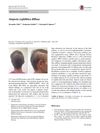
April 2015 in “Infection” This case study describes a patient with secondary syphilis, including alopecia syphilitica diffusa, whose symptoms resolved completely after treatment with benzylpenicillin following prednisolone prophylaxis.
2 citations
,
December 2007 in “Microbial pathogenesis” This study found that in mice, Bacillus anthracis infections destroy hair follicles by progressing inward from the surface and clear when inflammatory cells disperse the bacteria after 3-4 days.
7 citations
,
October 2012 in “Anais Brasileiros de Dermatologia” This case report highlights the simultaneous presence of white piedra, identified as T. inkin, and pediculosis capitis in one patient to emphasize their clinical distinctions.
1 citations
,
January 2021 in “Journal of the American Academy of Dermatology” This study found that bullous lupus erythematosus lesions in cutaneous lupus erythematosus showed distinctive histopathology with neutrophilic predominance and were associated with severe disease and higher extracutaneous involvement.