 3 citations
,
April 2010 in “The American Journal of Dermatopathology”
3 citations
,
April 2010 in “The American Journal of Dermatopathology” This study observed similar D2-40 expression in scarring and nonscarring alopecia, with some increase in scarring cases, suggesting possible Fos-dependent mechanisms, though more research is needed for definitive conclusions.
15 citations
,
October 1996 in “Archives of Dermatology” This review of alopecia areata cases at Virgen Macarena University Hospital identified a new hair regrowth pattern they term "androgenetic alopecia type" and described a unique inverse form called "sisaipho type" in three cases.
4 citations
,
February 2011 in “Annals of internal medicine” This article discusses polycystic ovary syndrome, outlining its prevalence, diagnostic criteria, and the progress made in understanding this underdiagnosed condition, but reports no new clinical findings.
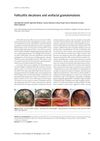 January 2018 in “Advances in Dermatology and Allergology”
 Treatment with dapsone, topical corticosteroids, and antibiotics improved the man's skin conditions.
39 citations
,
September 2018 in “American Journal of Medical Genetics Part A” This case report describes a 32-month-old girl with a newly identified pediatric disorder linked to a de novo mutation in the ODC1 gene, mirroring symptoms seen in a transgenic mouse model.
 4 citations
,
January 2020 in “Skin appendage disorders”
4 citations
,
January 2020 in “Skin appendage disorders” This case report describes a unique presentation of frontal fibrosing alopecia characterized by a hair loss pattern that resembles the Greek letter upsilon, supported by trichoscopic and histological findings.
 April 2018 in “Journal of Investigative Dermatology”
 This study identified the osteopontin-derived peptide, FOL-005, as a potential inhibitor of unwanted human hair growth by promoting catagen development without reducing stem cell numbers or showing toxicity.
 May 2026 in “Frontiers in Cell and Developmental Biology”
 This review discusses hair follicle organoids as emerging models for studying hair biology and disorders, emphasizing their promise for bridging basic research and clinical applications, but reports no new results.
45 citations
,
May 2022 in “Biomedicines” This review discusses using human follicular fluid in metabolomic analysis as a diagnostic tool and predictor of success in assisted reproductive technology for PCOS patients, reporting no new results.
519 citations
,
February 2020 in “Inflammation and Regeneration” This review discusses the diverse roles of the RANKL/RANK/OPG system in bone metabolism, the immune system, and other biological processes, emphasizing its relevance in the field of osteoimmunology, but reports no new results.
 10 citations
,
October 2014 in “Journal of Ovarian Research”
10 citations
,
October 2014 in “Journal of Ovarian Research” This study found a significant association between the IRS-2 gene variant and an increased risk of PCOS, especially in non-obese women in the Chinese population from Taiwan.
January 2002 in “HAL (Le Centre pour la Communication Scientifique Directe)” In this study, researchers characterized a dehydroepiandrosterone hydroxylating enzyme system in hair follicles similar to the liver monooxygenase system, noting its inhibition by carbon monoxide and its dependence on NADPH.
 53 citations
,
January 2012 in “Fertility and Sterility”
53 citations
,
January 2012 in “Fertility and Sterility” This study found that women with polycystic ovary syndrome have a higher risk for obstructive sleep apnea, primarily due to the prevalence of severe obesity, rather than the syndrome itself.
December 2015 in “Endocrinology and Metabolic Syndrome” This study observed that treatment with inositol, in various doses based on BMI, led to significant reductions in hair loss and symptoms of hyperandrogenism in patients with androgenetic alopecia.
2 citations
,
June 2021 in “Sultan Qaboos University medical journal” This case report presents three sisters with familial frontal fibrosing alopecia, making it the 25th documented familial case, with treatment results observed in one sister.
 5 citations
,
October 2020 in “Brain Research Bulletin”
5 citations
,
October 2020 in “Brain Research Bulletin” This study found that etifoxine pretreatment reduced neuroinflammation and improved cognitive function in LPS-induced neuroinflammation in mice, potentially through increased neurosteroid synthesis and reduced apoptosis.
 1 citations
,
January 2018 in “Journal of SAFOMS”
1 citations
,
January 2018 in “Journal of SAFOMS” This case report describes a postmenopausal woman with a rare instance of ovarian fibrothecoma exhibiting virilizing features, who presented with symptoms such as excess hair growth and clitoromegaly.
 December 2013 in “International Journal of Dermatology”
 The clinical signs of Adams-Oliver syndrome can vary greatly, even among family members.
 October 2022 in “Aesthetic Cosmetology and Medicine”
 This study reviews polycystic ovary syndrome, focusing on its hormonal and metabolic disturbances and related skin lesions, but provides no new clinical findings.
March 2026 in “Endocrine Metabolic & Immune Disorders - Drug Targets” This study found that in women with PCOS, a combination of finasteride and spironolactone significantly improved all health-related quality of life scales and reduced hyperandrogenism within four months, supporting its role alongside lifestyle measures.
12 citations
,
January 2016 in “Journal of clinical biochemistry and nutrition” In this study, combining deferasirox with sorafenib significantly reduced liver fibrosis and preneoplastic lesions in rats while also lessening adverse effects compared to sorafenib alone.
 9 citations
,
August 2013 in “Middle East Fertility Society Journal”
9 citations
,
August 2013 in “Middle East Fertility Society Journal” This study found that the hospital-based prevalence of polycystic ovarian syndrome among Omani women of reproductive age was 2.8%, similar to rates reported in other countries.
 57 citations
,
January 2003 in “Clinical and experimental dermatology”
57 citations
,
January 2003 in “Clinical and experimental dermatology” This study identified postmenopausal frontal fibrosing alopecia as a distinct form of scarring alopecia in postmenopausal women, noting a potential link with a history of bilateral oophorectomy.
2 citations
,
April 2021 in “Asian pacific Journal of Tropical Biomedicine” This study found that Origanum vulgare extract significantly ameliorated finasteride-induced liver and kidney damage in mice by improving biochemical indices, reducing inflammation, and enhancing antioxidant status in a dose-dependent manner.
March 2023 in “Oxford University Press eBooks” November 2025 in “Journal of Rangpur Medical College” In this study from Bangladesh Medical University, researchers found strong correlations between symptoms such as oligomenorrhea and amenorrhea with bilateral polycystic ovarian morphology in women with PCOS, highlighting the link between clinical symptoms and ultrasound findings in predicting the severity of the condition.
 4 citations
,
January 2016 in “International journal of reproduction, contraception, obstetrics and gynecology”
4 citations
,
January 2016 in “International journal of reproduction, contraception, obstetrics and gynecology” This study found that the FSHR Ser680Asn (rs6166) gene polymorphism is associated with an increased risk of PCOS in the examined population and could serve as a molecular biomarker for identifying risk.
28 citations
,
November 2018 in “American Journal of Medical Genetics Part A” This report describes a neurometabolic disorder linked to gain-of-function variants in the ODC1 gene, characterized by developmental delay, ectodermal abnormalities, and notable facial and neuroimaging features.
14 citations
,
February 1991 in “FEBS Letters” This study found that introducing rat ornithine transcarbamylase gene into spf-ash mice improved liver and intestinal enzyme activity and normalized some metabolic indicators.
 January 2023 in “Austin Journal of Obstetrics and Gynecology”
 This study found that in a sample of girls and adolescents aged 15–24 years, the prevalence of PCOS was 22.5% according to the Rotterdam criteria.