11 citations
,
June 2001 in “British Journal of Dermatology” This study found that asynchronous differentiation in human anagen hair follicles involves specific localization of c-Myc and interrelated genes Max and Bin1 along the inner root sheath.
April 2023 in “Journal of Drug Delivery Science and Technology” This study reported that optimized transfersomes and their gel form significantly improved transdermal delivery and hair growth promotion of minoxidil in C57BL/6 mice compared to commercial formulations.
303 citations
,
October 2000 in “Nature” This study found that RXRα plays a critical role in hair cycling and keratinocyte functions in mice, likely through its interaction with VDR in epidermal cells.
 February 2023 in “bioRxiv (Cold Spring Harbor Laboratory)”
 This study found that in adult mouse skin, somatosensory axon plasticity is highly dynamic and influenced by epithelial-neural crosstalk and intrinsic neural mechanisms.
24 citations
,
March 2008 in “Neuroscience Research” This study revealed the complex three-dimensional innervation of touch domes in cat forepaw skin, highlighting the extensive branching and unmyelinated endings associated with Merkel cell–axon complexes.
This study found that combining electrical stimulation with minoxidil had a synergistic effect on the proliferation of cultured human dermal papilla cells, potentially through enhanced activation of the Wnt/β-catenin pathway.
22 citations
,
April 2012 in “The American journal of pathology” This study found that the loss of Msx2 in knockout mice led to phenotypes similar to Peters anomaly and microphthalmia, suggesting that MSX2 plays a critical role in anterior segment development of the eye.
 January 2019 in “Proceedings for Annual Meeting of The Japanese Pharmacological Society”
 In this study, injecting Nε-(carboxymethyl) lysine into skin tissue weakened hair shaft and follicle formation, likely by inhibiting cell proliferation and migration needed for hair follicle morphogenesis.
 23 citations
,
January 2016 in “Theranostics”
23 citations
,
January 2016 in “Theranostics” In this animal study, ultrasound combined with a new microbubble formulation of minoxidil increased hair growth rates and improved follicle characteristics more effectively than minoxidil alone.
 December 2025 in “Saudi Pharmaceutical Journal”
 This study developed a nanoemulsion containing Minoxidil, which showed effective stability and significantly increased hair growth rates in pretreated mice, suggesting its potential for treating hair loss.
 November 2023 in “bioRxiv (Cold Spring Harbor Laboratory)”
 This study used a novel fluorescent tagging method in mice to observe collagen IV dynamics during hair follicle development, revealing that alterations in basement membrane turnover can influence epithelial progenitor cell behavior and organ morphology by affecting cell proliferation and movement.
 37 citations
,
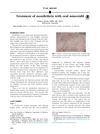
May 2016 in “JAAD case reports”
37 citations
,
May 2016 in “JAAD case reports” This abstract describes monilethrix, an autosomal dominant genodermatosis with symptoms like hair fragility and keratosis pilaris, and does not report new experimental results.
This study developed a novel, 3D-printed dissolving microneedle system for delivering minoxidil to treat hair loss, which showed pH-triggered drug release and enhanced hair regrowth in an alopecia mouse model, offering a potentially sustainable and safe transdermal therapy option.

This study developed a co-design framework using finite element analysis to optimize bubble microneedles, achieving controlled tip separation and effective drug delivery through the skin and mucosa while maintaining insertion strength.
This study found that a data-driven model using XGBoost effectively predicts individualized responses to minoxidil for androgenetic alopecia, outperforming traditional methods in accuracy and reliability.
106 citations
,
February 2014 in “eLife” This study concluded that terminal Schwann cells are essential for the maintenance and regeneration of mechanosensory lanceolate complexes at hair follicles in adult mice.

This study in adult mice found that somatosensory axons innervating Merkel cells in the skin are highly plastic, with significant remodeling in response to epithelial turnover, and that Merkel cells play a role in limiting axonal branching and promoting their maturation.
 March 2024 in “bioRxiv (Cold Spring Harbor Laboratory)”
 In this study, early prenatal treatment with Minoxidil, a lysyl hydroxylase inhibitor, partly improved cardiac outflow tract septation in Tbx1 mutant mice, suggesting that inhibiting collagen cross-linking may mitigate some effects of Tbx1 mutation associated with DiGeorge syndrome.
March 2024 in “DOAJ (DOAJ: Directory of Open Access Journals)” This study found that minoxidil nanoparticles significantly increased hair growth in mice compared to commercial minoxidil and rosemary extract, demonstrating improved delivery and follicular uptake.
 4 citations
,
September 2020 in “Cell division”
4 citations
,
September 2020 in “Cell division” In this study, XMU-MP-1 unexpectedly reduced cell proliferation and altered cell cycle progression in a model human hair follicle, possibly due to off-target kinase inhibition.
 December 2023 in “Annales Pharmaceutiques Françaises”
 This study concluded that Trilayer Dissolving Microneedles show promise in enhancing Minoxidil delivery for treating alopecia areata by improving its bioavailability and reducing side effects.
 23 citations
,
January 2011 in “International Journal of Immunopathology and Pharmacology”
23 citations
,
January 2011 in “International Journal of Immunopathology and Pharmacology” In this small study, topical minoxidil 2% was associated with an increase in normal hair shaft production in patients with Monilethrix without any reported side effects.
12 citations
,
September 1999 in “The journal of experimental zoology/Journal of experimental zoology” This study found that reducing circulating PRL levels is not necessary for the onset of winter hair growth in mink and that adrenal glands do not inhibit this process through DHEA or its metabolite Delta(5)-DIOL.
6 citations
,
June 2016 in “The anatomical record” This study found that Merkel cells in dogs are most numerous in sensory receptive areas like oral mucosa and facial skin, indicating a potential role in tactile sensation.
 March 2024 in “Frontiers in endocrinology”
 This study reports the first case of mandibuloacral dysplasia syndrome associated with MTX2 gene mutation in the Chinese population, expanding the known spectrum of MTX2 mutations.
9 citations
,
September 2022 in “Frontiers in Physics” This study found that Mueller Matrix microscopy can accurately identify, detect, and evaluate hair follicles in mouse skin tissue, suggesting its potential for skin structure research and dermatological applications.
This study found that the transcription factor Lhx2 regulates Sonic Hedgehog signaling in mouse retinal progenitor cells, mainly by controlling the expression of co-receptors essential for effective pathway activation during early retinal neurogenesis.
 November 2022 in “bioRxiv (Cold Spring Harbor Laboratory)”
 This study found that conditional deletion of Mof in mice resulted in severe defects in skin development, including compromised epidermal differentiation and hair growth, leading to perinatal lethality.
June 2026 in “YAKUGAKU ZASSHI” This study investigated the impact of container-tip design and hair density on the scalp delivery of minoxidil in topical formulations, finding that higher hair density reduced delivery, particularly with larger tip containers, indicating the importance of these factors in product design.
50 citations
,
December 2005 in “European Journal of Immunology” This study found that a specific mutation in the mouse RXRalpha gene significantly impacts immune responses and causes hair loss and skin cysts.