1 citations
,
January 2013 in “Journal of the Scientific Society” In this case report, an 18-year-old male's cheek lump initially diagnosed as a sebaceous cyst was found to be a pilomatrixoma after surgical excision and histopathological examination.
18 citations
,
February 2001 in “Der Hautarzt” This case study of a 50-year-old woman with myotonic dystrophy and multiple basal cell carcinomas suggests there could be a genetic predisposition for certain cutaneous tumors in such patients.
2 citations
,
January 2002 in “Zhiwu Yanjiu” Capitate trichomes have more endoplasmic reticulum and vacuoles, while peltate trichomes have more plastids and larger subcuticular spaces.
 10 citations
,
June 2019 in “Case reports in dermatology”
10 citations
,
June 2019 in “Case reports in dermatology” This paper presents a case of a young male with linear and annular lupus panniculitis of the scalp, detailing trichoscopic findings and their correlation with histopathological features, but reports no new generalizable results.
2 citations
,
June 2001 in “Medical Electron Microscopy” This study observed that the keratinization pattern of trichilemmal cysts in two Japanese women may originate from the proliferation of the outer root sheath in the follicular isthmus of anagen hairs.
4 citations
,
August 1991 in “The Journal of Dermatology” This case report describes a rare pedunculated follicular hamartoma on the nasal septum of a 77-year-old Japanese male, emphasizing its unique clinical and pathological features.
January 2005 in “Journal of Cutaneous Pathology” This report presents the first known case of a proliferating hybrid cyst containing both epidermoid and trichilemmal components on the scrotum of a 44-year-old man.
 September 2016 in “Journal of Dermatological Science”
 This study investigated the mechanism responsible for pili torti formation in Björnstad syndrome using a transmission electron microscope, but did not establish a definitive explanation.
20 citations
,
February 2015 in “Anais brasileiros de dermatologia/Anais Brasileiros de Dermatologia” This case report describes a 6-year-old girl diagnosed with monilethrix despite no familial history and treated with a topical minoxidil trial.
 September 2021 in “Mağallaẗ al-Muẖtar li-l-ʿulūm”
 This report describes a case of two sisters with kinky, tangled hair diagnosed using trichoscopic and microscopic methods; they were treated with topical minoxidil.
 March 2025 in “American Journal of Medical Genetics Part A”
 In this study, researchers found that mosaic PLCD1 hotspot variants, even without the recognized germline "risk allele," may be a rare but significant genetic cause of nevus trichilemmocysticus, warranting DNA testing and sensitive sequencing technologies for accurate diagnosis.
September 2020 in “Oral surgery, oral medicine, oral pathology and oral radiology” This case report describes a pilomatricoma in a 21-year-old woman, highlighting the diagnostic process and illustrating the potential for intraoral surgical access to minimize scarring.
4 citations
,
November 1999 in “PubMed” This article presents five family cases of monilethrix and reports that neither vitamins nor desquamative ointments are effective treatments, although symptoms may spontaneously regress over time.
 January 2026 in “Cosmoderma”
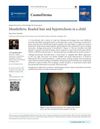
 In this clinical case study, a 9-year-old girl was diagnosed with monilethrix, a hereditary hair shaft disorder characterized by weak, beaded hair, with management focusing on minimizing hair trauma.
January 2026 in “Clinical Case Reports” This case report describes a 6-year-old girl diagnosed with the rare concurrence of monilethrix and trichorrhexis nodosa, characterized by sparse, brittle hair, who showed minimal clinical improvement with low-dose oral and topical minoxidil treatment.
 September 2022 in “TURKDERM”
 This article reports an unprecedented case of trichofolliculoma in the gluteal area, previously unreported in English literature.
 8 citations
,
November 2015 in “The American journal of dermatopathology/American journal of dermatopathology”
8 citations
,
November 2015 in “The American journal of dermatopathology/American journal of dermatopathology” The authors present a case of punctate follicular porokeratosis, suggesting it as a distinct clinical entity distinguished by keratotic lesions originating specifically from hair follicles.
 July 2025 in “Communications Biology”
 In this study, researchers used synchrotron X-ray imaging to examine rat vibrissa follicles, finding that despite variations in vibrissa length and follicle size, certain sensory structures remain consistent, suggesting specialized roles in sensory processing depending on the vibrissa type.
9 citations
,
August 2002 in “British journal of ophthalmology” This case report describes a young man diagnosed with encephalocraniocutaneous lipomatosis who had unique bilateral optic disc colobomas, a previously unreported association with this syndrome.
January 2022 in “Indian journal of paediatric dermatology” This case report details an unusual instance of multiple eruptive milia in an otherwise healthy 3-month-old baby, characterized by widespread distribution and believed to be idiopathic due to the absence of associated genodermatoses.
 17 citations
,
December 2003 in “Veterinary dermatology”
17 citations
,
December 2003 in “Veterinary dermatology” In this study, mange lesions with alopecia and crusts in masked palm civets in Japan were caused by the mite Notoedres cati.
14 citations
,
January 1998 in “Dermatology” This study found evidence that polythelia pilosa, previously excluded from classification, should be reintroduced as it marks true aberrant mammary structures in men and hirsute women.

In this case study, a 38-year-old woman with monilethrix, a hair shaft disorder causing hair fragility, was also diagnosed with androgenetic alopecia, leading the authors to emphasize the complexity in diagnosing and managing such combined hair conditions.
12 citations
,
January 2023 in “Current Oncology” This study reviewed the literature on pilomatrix carcinoma and reported that while wide local excision was the most definitive treatment, local recurrences and metastases were common.
12 citations
,
April 2004 in “PubMed” This study reports the first known case of multiple type nevus lipomatosus cutaneous superficialis in a 10-month-old girl, with the unique feature of perifollicular fibrosis.
 1 citations
,
January 2021 in “Dermatology online journal”
1 citations
,
January 2021 in “Dermatology online journal” This report describes a unique case of linear lichen planus pigmentosus on the face with histological features of lichen planopilaris, which has not been documented before.
43 citations
,
September 2001 in “Annals of Neurology” This study found that somatic mosaic mutations in the doublecortin gene may cause subcortical band heterotopia in male patients, and molecular analysis using hair roots is a useful detection method.
June 2015 in “Sonography” This case report describes a rare instance of multiple sebaceous cysts over the scrotum in a 22-year-old man, highlighting the effectiveness of ultrasound imaging for diagnosis and the need for surgical intervention in severe cases.

This study found that the FER/MLO signaling module plays a crucial role in calcium oscillations and ROS production in root hair tip growth, with the MLO15 protein regulating these processes and restoring disrupted growth and signaling in fer mutant root hairs.
21 citations
,
September 1997 in “British Journal of Dermatology” This study found that monilethrix in three unrelated European families is linked to the type II keratin gene cluster on chromosome 12q13, with no evidence of defects in type I keratins.