 April 2019 in “Journal of Investigative Dermatology”
 This study in mice found that fractional photothermolysis can improve dermal scar formation by promoting slow, organized collagen regeneration with minimal myofibroblast activation.
 January 2008 in “Yearbook of Dermatology and Dermatologic Surgery”
 One type of progenitor cell can maintain normal skin in mice.
62 citations
,
December 1966 in “Endocrinology” This study observed that injecting mice with α-MSH resulted in black hair regrowth in shaved and plucked areas, suggesting a potential link to the agent darkening hair in animals with a specific pituitary tumor.
421 citations
,
September 2003 in “Development” This study concluded that label-retaining cells in mouse epidermis differ in their sensitivity to proliferative stimuli, influencing their division and potential transdifferentiation without consistently depleting their population.
 3 citations
,
January 2015 in “Indian journal of burns”
3 citations
,
January 2015 in “Indian journal of burns” This study observed that postburn hair transplants, using follicular unit micro grafting, can effectively restore facial hair and scalp regions, with eyebrow and mustache restoration yielding the highest patient satisfaction.
 May 2018 in “European Journal of Dermatology”
 Adjusting the medication tacrolimus resolved a boy's red nail beds after a stem cell transplant.
This chapter summarizes the efficacy of NB-UVB monotherapy for vitiligo and notes that patients treated with tacrolimus showed significantly better repigmentation.
 10 citations
,
March 2015 in “PubMed”
10 citations
,
March 2015 in “PubMed” This paper demonstrates that scalp micropigmentation can effectively conceal scalp and hair deformities with high patient satisfaction, offering a non-surgical alternative cosmetic solution.
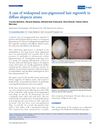 March 2019 in “Our Dermatology Online”
 A woman with severe hair loss regrew mostly white hair after treatment.
 October 2024 in “Journal of Cutaneous Immunology and Allergy”
 This case report describes a successful treatment of sarcoidal foreign body reactions caused by permanent makeup ink with local steroid injections, while also identifying the involvement of M2 macrophages in the reaction.
 January 2026 in “Journal of Hard Tissue Biology”
 This study found that red LED photobiomodulation significantly enhanced both the metabolic activity and proliferation of human placenta-derived pericytes, alongside increased expression of angiogenic markers, suggesting a potential non-invasive approach to aid tissue repair and vascular regeneration.
 April 2016 in “Journal of Investigative Dermatology”
 This study found that full thickness wounds in Lanyu pigs led to altered molecular expression and abnormal skin structure, without regenerating key epithelial cells thought to aid in skin regeneration.
103 citations
,
April 2005 in “Experimental dermatology” This study found that PGF2alpha analogues and PGE2 stimulated hair follicle activity in mice, with PGF2alpha analogues also linked to potential side effects like poliosis when used as eye treatments.
October 2022 in “Hair Transplantation” This review discusses scalp micropigmentation for hair loss and scarring and reports no clinical results; the authors highlight its use as both a standalone and adjunct treatment.
 7 citations
,
January 2013 in “The journal of investigative dermatology/Journal of investigative dermatology”
7 citations
,
January 2013 in “The journal of investigative dermatology/Journal of investigative dermatology” This study found that thymus transplantation in athymic mice resulted in T-cell-driven hair follicle depigmentation and loss, without multiorgan autoimmune disease, highlighting mechanisms of tissue-specific tolerance.
January 2020 in “Journal of Womens Health, Issues and Care” This review discusses scalp micropigmentation (SMP) for camouflaging baldness and reports no new clinical results; it aims to highlight SMP's cosmetic benefits and practical advantages over surgical hair transplantation.
July 2025 in “Dermatologic Surgery”  January 2012 in “heiDOK (Heidelberg University)”
 In this study, researchers observed that dormant TRP-2+ melanoma cells in bone marrow can interact with CD8+ T cells in tumor-bearing ret transgenic mice, potentially influencing immune responses.
 9 citations
,
June 1959 in “Archives of dermatology”
9 citations
,
June 1959 in “Archives of dermatology” This article discusses the importance of integrating clinical observations with laboratory research, emphasizing the need for clinicians to collaborate with researchers to address medical problems.
October 2022 in “Hair Transplantation” This article discusses the temporary scalp trichopigmentation procedure, detailing its unique approach compared to traditional scalp micropigmentation, and reports no new clinical findings.
 8 citations
,
March 2017 in “Journal of Cosmetic and Laser Therapy”
8 citations
,
March 2017 in “Journal of Cosmetic and Laser Therapy” In this study, researchers found that punch grafting was more effective than follicular hair transplantation for treating stable vitiligo; however, follicular hair transplantation was found to be cosmetically preferable for exposed areas like the face due to fewer side effects.
78 citations
,
August 2014 in “Anais Brasileiros de Dermatologia” This article discusses a new global consensus on the classification of vitiligo, describing histopathological findings and outlining treatment strategies, but reports no new clinical results.
40 citations
,
November 2005 in “The journal of investigative dermatology/Journal of investigative dermatology” This study suggests that different melanocyte subpopulations in hair follicles have varying patterns of apoptosis and survival during the catagen phase, which may inform models for modulating melanocyte behavior in vivo.
 20 citations
,
October 2018 in “American Journal of Clinical Dermatology”
20 citations
,
October 2018 in “American Journal of Clinical Dermatology” This article reviews drug-induced pigmentation and reports no new clinical findings, highlighting difficulty in confirming drug associations due to factors like delayed onset and polypharmacy.
August 2023 in “Zenodo (CERN European Organization for Nuclear Research)” This abstract discusses the non-invasive technique of scalp micropigmentation for hair loss, focusing on its cosmetic effects and customization options, and reports no new research findings.
 25 citations
,
March 2012 in “Journal of oncology pharmacy practice”
25 citations
,
March 2012 in “Journal of oncology pharmacy practice” This case report describes an elderly multiple myeloma patient whose hair repigmentation was associated with lenalidomide use, suggesting hair graying may be reversible.
5 citations
,
June 2012 in “Journal of Investigative Dermatology” Harris et al. describe a new mouse model for vitiligo, where interfollicular melanocytes are retained and melanocyte-targeting immune responses are simulated, aiding the development of immunomodulatory therapies.
24 citations
,
July 1994 in “Journal of Investigative Dermatology” 11 citations
,
June 2016 in “Stem Cell Research” This study found that a multicolor panel of four surface markers can identify new stem cell populations in mouse hair follicles, providing insights into stem cell diversity and gene expression discrepancies during tissue culture.
 240 citations
,
April 2011 in “Pigment Cell & Melanoma Research”
240 citations
,
April 2011 in “Pigment Cell & Melanoma Research” This review discusses the identification and characteristics of melanocyte stem cells, emphasizing their role in hair pigmentation, greying, and skin repigmentation, but reports no new research findings.