December 2025 in “Journal of the Bangladesh Agricultural University” This study documented 55 weed species at Daffodil International University, highlighting their ecological and cultural importance, with many species having recognized ethnobotanical uses such as hair growth and skin disorder treatments.
 March 2022 in “Journal of Survey in Fisheries Sciences”
 This review discusses the diverse phytochemical constituents and medicinal applications of Asteraceae family plants, noting their significance in traditional and modern medicine, but provides no new clinical results.
April 2004 in “AWHONN Lifelines” Hormonal contraception likely doesn't cause significant weight gain.
 22 citations
,
June 2004 in “Journal of The European Academy of Dermatology and Venereology”
22 citations
,
June 2004 in “Journal of The European Academy of Dermatology and Venereology” This case report identifies a novel association between Graham Little–Piccardi–Lassueur syndrome and complete androgen insensitivity syndrome, suggesting the influence of androgens in the alopecias accompanying the former may be limited.
15 citations
,
July 1975 in “British journal of dermatology/British journal of dermatology, Supplement” This article discusses aspects of Graham-Little syndrome, including follicular keratosis with cicatricial alopecia, and offers no new clinical findings.
5 citations
,
September 2021 in “Clinical case reports” This case report documents the first known instance of Graham‐Little Piccardi Lassueur Syndrome in Saudi Arabia, observed in an adult dark-skinned male.
5 citations
,
November 2015 in “International Journal of Dermatology” This article discusses a case of Graham Little–Piccardi–Lassueur syndrome in a patient with androgen insensitivity syndrome and reports no new research findings.
 2 citations
,
June 2020 in “Dermatology and therapy”
2 citations
,
June 2020 in “Dermatology and therapy” In this case report, narrowband-UVB phototherapy successfully treated a rare instance of Graham Little-Piccardi-Lassueur syndrome, a variant of lichen planopilaris, as investigated through non-invasive imaging techniques.
 1 citations
,
January 2023 in “Journal of Drugs in Dermatology”
1 citations
,
January 2023 in “Journal of Drugs in Dermatology” This review discusses Graham-Little Piccardi-Lasseur syndrome, a rare dermatosis with limited treatment options, emphasizing the importance of early diagnosis through physical exam and dermoscopy, but reports no new results.
1 citations
,
January 2019 in “Via Medica Journals” This case report describes the diagnosis and treatment challenges of Graham-Little syndrome, a rare condition involving cicatricial alopecia on the scalp, non-scarring hair loss in certain areas, and keratosis pilaris-like eruptions.
June 2026 in “The Journal of Dermatology” 
In this case report, a female patient with Graham-Little-Piccardi-Lassueur Syndrome and hidradenitis suppurativa showed significant improvement in symptoms, including hair loss and lesions, after six months of treatment with tofacitinib, with no recurrence or adverse effects over a two-year follow-up.
April 2026 in “Case Reports in Dermatology” In this case report, a woman with Graham-Little-Piccardi-Lassueur Syndrome and hidradenitis suppurativa showed significant improvements in both conditions after six months of treatment with tofacitinib, a Janus Kinase inhibitor, with no recurrence or adverse events noted during a two-year follow-up.

The researchers reported a case where treatment with tofacitinib improved both hair loss and skin lesions in a patient with Graham-Little-Piccardi-Lassueur Syndrome and hidradenitis suppurativa over six months, with no recurrence or adverse events during two-year follow-up.
January 2026 in “Forum Dermatologicum” This study reviewed cases of Graham–Little-Piccardi–Lassueur syndrome and found that topical treatments were generally ineffective, while systemic therapies like prednisone, hydroxychloroquine, and isotretinoin led to partial hair regrowth and disease stabilization, highlighting the importance of early diagnosis and systemic therapy to improve outcomes.
January 2025 in “Indian Journal of Dermatopathology and Diagnostic Dermatology” In this case report, a rare instance of Graham–Little–Piccardi–Lassueur syndrome coexisting with linear lichen planus was identified in a 35-year-old male, highlighting the condition's rarity in males, with dermoscopy aiding diagnosis through distinctive scalp and trunk lesion features.
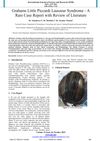 October 2023 in “International Journal of Science and Research (IJSR)”
 This paper describes Grahams Little Piccardi Lassueur Syndrome, a rare type of Lichen Planopilaris that causes different types of alopecia and distinctive skin papules, primarily affecting females aged 40 to 70, and notes the current challenges in treatment options, particularly once scarring occurs.
July 2021 in “Authorea (Authorea)” This article discusses Graham-Little Piccardi Lassueur Syndrome, a rare variant of Lichen planopilaris, but reports no clinical findings or results.
December 2020 in “Forum Dermatologicum” In this case report, a combination treatment of intralesional triamcinolone acetonide, oral acitretin, and topical clobetasol propionate showed effectiveness in reducing symptoms of Graham-Little-Piccardi-Lasseur syndrome in one patient over two months, with no new areas of hair loss observed.
November 2020 in “Acta Medica Bulgarica/Acta medica Bulgarica” This case report details two patients with Graham-Little-Piccardi-Lassueur syndrome who showed marked skin lesion improvement with corticosteroid treatment, though cicatricial scalp alopecia remained unresponsive.
 February 2016 in “Acta Medica Marisiensis”
 This case study presents what is reportedly the first association of Graham Little-Lassueur Syndrome with chronic hepatitis C, observed in a 47-year-old female patient.
July 2013 in “Indian Journal of Dentistry” This report describes a rare case of Graham-Little–Piccardi–Lassueur syndrome in a 46-year-old male, highlighting its typical features such as scarring alopecia and lichenoid follicular eruptions.
 1 citations
,
September 2015 in “Clinics in Dermatology”
1 citations
,
September 2015 in “Clinics in Dermatology” This article offers a question-by-question guide to assist clinicians in diagnosing hair shaft disorders, presenting no new clinical results.
 September 2021 in “Physiology News”
 The abstract does not provide any research findings or conclusions to summarize, focusing instead on color and logo specifications.
October 2007 in “Nature Clinical Practice Urology” September 1989 in “Drug and Therapeutics Bulletin” This article discusses the use of oral and topical minoxidil for hair growth, detailing its effects and the regulatory status of topical minoxidil in the UK, but it presents no new clinical results.
March 1942 in “The Science News-Letter” 18 citations
,
July 2016 in “Clinics in dermatology” This article discusses the interplay of skin, immunity, and nutrition, highlighting dietary and probiotic options for managing skin conditions, but reports no new clinical findings.
 8 citations
,
September 2015 in “Clinics in Dermatology”
8 citations
,
September 2015 in “Clinics in Dermatology” This article discusses how the diagnosis and management of alopecia differ significantly between adults and children, emphasizing age-specific approaches but reports no new clinical findings.
 8 citations
,
September 2017 in “Journal of Investigative Dermatology”
8 citations
,
September 2017 in “Journal of Investigative Dermatology” This study found that inhibiting the interaction between CXXC5 and Dishevelled could stimulate hair regrowth in mouse models by enhancing WNT/β-catenin signaling, suggesting a potential therapeutic strategy for hair loss involving compounds that block this interaction, such as interfering short peptides.