September 2011 in “American Journal of Transplantation” In this case report, a patient with alopecia universalis experienced hair regrowth after clinical islet transplantation, which may indicate the potential impact of immunosuppressive therapy on this autoimmune condition.
July 2025 in “Indian Dermatology Online Journal” In this case report, researchers documented a rare instance of trans-epidermal elimination of insulin formulation in a 45-year-old woman with diabetes, suggesting that insulin or its excipients may have caused a granulomatous reaction leading to skin lesions at injection sites and impaired diabetes control.
3 citations
,
October 2024 in “Cancers” In this study, 37.5% of patients with nodal or metastatic cutaneous melanoma treated with immune checkpoint inhibitors developed skin adverse events, primarily low-grade rashes, vitiligo, and other dermatological symptoms, occurring mainly after 10 weeks of treatment.
 1 citations
,
January 2014 in “Rinsho Shinkeigaku”
1 citations
,
January 2014 in “Rinsho Shinkeigaku” This case report suggests an immunological link between multifocal acquired demyelinating sensory and motor neuropathy and alopecia, with both conditions improving after treatment with intravenous immunoglobulin.
 2 citations
,
January 2021 in “Case reports in endocrinology”
2 citations
,
January 2021 in “Case reports in endocrinology” In this case report, a girl with autoimmune polyglandular syndrome type 1 experienced stabilized disease and reversal of alopecia universalis after treatment with glucocorticoids and methotrexate.
 60 citations
,
September 2013 in “Alimentary Pharmacology & Therapeutics”
60 citations
,
September 2013 in “Alimentary Pharmacology & Therapeutics” This review discusses the dermatological adverse events from immunosuppressive and anti-TNF therapy in IBD, finding increased risks of non-melanoma skin cancer and other skin conditions, and recommends regular cancer screening.
 114 citations
,
April 2004 in “International Journal of Dermatology”
114 citations
,
April 2004 in “International Journal of Dermatology” Postinflammatory hyperpigmentation causes dark skin patches and needs personalized treatment.
 2 citations
,
January 2007 in “Acta Dermato Venereologica”
2 citations
,
January 2007 in “Acta Dermato Venereologica” In this report, a case of a bullous lesion developed at the injection site in a patient treated with PEG-IFN-α-2a for chronic hepatitis C was described.
 November 2023 in “Gastroenterology”
 This case study identified non-criteria antiphospholipid syndrome as a potential underlying cause of Budd-Chiari syndrome in a patient, emphasizing the need for its consideration, especially in cases with multiple thromboemboli and thrombocytopenia.
35 citations
,
September 2011 in “The Journal of Dermatology” This article discusses the trichoscopic diagnosis of temporal triangular alopecia, but reports no new clinical results.
June 2025 in “British Journal of Dermatology” This case report details a probable severe adverse event associated with ritlecitinib for alopecia areata, highlighting risks of pulmonary emboli, infection, atrial fibrillation, and acute kidney injury despite an absence of known risk factors.
4 citations
,
October 2022 in “Current Urology” Platelet-rich plasma shows promise in reducing pain for bladder pain syndrome.
March 2024 in “International Journal of Rheumatic Diseases” This case report describes successful wound healing in a patient with chronic gout and tophaceous ulcers following platelet-rich plasma therapy, highlighting its potential effectiveness in treating non-healing wounds.
 1 citations
,
December 2021 in “JAAD case reports”
1 citations
,
December 2021 in “JAAD case reports” This review discusses recent advancements in treating alopecia areata, highlighting the promise of Janus kinase inhibitors and platelet-rich plasma therapy, but it reports no new clinical findings.
 October 2024 in “The Journal of Dermatology”
 In this study, intravenous corticosteroid pulse therapy for rapidly progressive alopecia areata showed that 74.5% of patients achieved a good response in the long-term, and a revised scoring system predicted relapse risk effectively in cases with preceding infectious symptoms.
 11 citations
,
January 2018 in “Acta dermato-venereologica”
11 citations
,
January 2018 in “Acta dermato-venereologica” In this study, oral tofacitinib showed higher efficacy and tolerability in treating refractory alopecia totalis and universalis compared to traditional treatments, achieving a 50% improvement in severity scores for 44.4% of patients over six months, with fewer adverse effects.
 2 citations
,
March 2022 in “Modern Rheumatology Case Reports”
2 citations
,
March 2022 in “Modern Rheumatology Case Reports” In this study, a case of a patient with dermatomyositis and alopecia universalis showed successful treatment with tofacitinib, suggesting potential responsiveness to janus kinase inhibitors.
November 2021 in “Transplantation direct” This case report highlights that Demodex folliculitis in an immunocompromised patient can result in severe and widespread eruptions, which were effectively treated with oral ivermectin and topical permethrin.
 October 2011 in “Journal of dermatology”
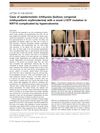
 A man with a rare skin condition and a new gene mutation developed high calcium levels due to his treatment.
20 citations
,
November 2002 in “Journal of the European Academy of Dermatology and Venereology” Lichen planopilaris may be linked to autoimmune thyroiditis.
 1 citations
,
October 2023 in “Clinical, cosmetic and investigational dermatology”
1 citations
,
October 2023 in “Clinical, cosmetic and investigational dermatology” In this report, a 35-year-old female with palmoplantar pustulosis undergoing secukinumab treatment developed alopecia areata, a rare side effect attributed to paradoxical reactions with IL-17 inhibitors; switching to tofacitinib improved both conditions.
August 2025 in “Biomedicines” In this case report, half-siblings with bullous congenital ichthyosiform erythroderma were found to have a susceptibility to Trichophyton rubrum infection, successfully treated with oral terbinafine.
 1 citations
,
January 2014 in “Hair therapy & transplantation”
1 citations
,
January 2014 in “Hair therapy & transplantation” This case study reports the first extensively interpreted instance of dystrophic telogen effluvium potentially linked to pegylated interferon and ribavirin therapy for chronic hepatitis C, characterized through clinical and trichogram analysis.
40 citations
,
August 2005 in “JEADV. Journal of the European Academy of Dermatology and Venereology/Journal of the European Academy of Dermatology and Venereology” In this case report, a 3-year-old male with IFAP syndrome showed moderate improvement in skin symptoms and corneal erosions but no change in alopecia or photophobia after 6 months of acitretin therapy.
November 2025 in “Clinics and Practice” This case report describes a rare and severe systemic reaction to red tattoo ink, including erythroderma, alopecia universalis, anhidrosis, and vitiligo, highlighting significant diagnostic and therapeutic challenges.
 9 citations
,
May 2005 in “Expert Review of Clinical Immunology”
9 citations
,
May 2005 in “Expert Review of Clinical Immunology” This article examines anticytokine therapies for autoimmune diseases, highlighting the potential of anti-interferon-γ as a universal treatment for certain conditions and noting varying effectiveness of tumor necrosis factor-α inhibitors.
 April 2023 in “Journal of Investigative Dermatology”
 This research developed new in vitro models for high-throughput screening of drugs that could protect or restore immune privilege in hair follicles, finding that Tofacitinib was effective in preventing inflammation-related marker upregulation, while Tacrolimus and αMSH worked specifically in outer root sheath keratinocytes.
2 citations
,
May 2023 in “Journal of Immunotherapy” In this case study, a 65-year-old male with hepatocellular carcinoma treated with the PD-1 inhibitor Sintilimab developed alopecia universalis alongside significant tumor regression and complete remission, highlighting a rare immune-related adverse event with effective anti-tumor outcomes.
22 citations
,
March 1999 in “International Journal of Clinical Practice” This review discusses the use of topical immunotherapy for severe alopecia areata and resistant viral warts, highlighting diphencyprone's advantages and the need for careful handling to avoid staff sensitisation; it reports no new clinical results.
 April 2023 in “Journal of dermatological treatment”
 This study reports a case of complete hair regrowth in lichen planopilaris after 12 weeks of treatment with ixekizumab, suggesting its potential as a targeted therapy.