 March 2026 in “European Journal of Medical and Health Research”
 In this case-control study, researchers observed that women with female pattern hair loss exhibited significantly lower serum IGF-1 levels than controls, while IGFBP-3 levels showed no significant difference, suggesting a potential role for IGF-1 in the condition.
 February 2024 in “Experimental Dermatology”
 In this study, researchers found that IGFBP‐rP1 levels were lower in individuals with androgenic alopecia compared to healthy controls, and subcutaneous injection of IGFBP‐rP1 showed potential in slowing hair loss progression in a mouse model by affecting the hair cycle transition.
 2 citations
,
September 2002 in “Journal of Endocrinological Investigation”
2 citations
,
September 2002 in “Journal of Endocrinological Investigation” The GH-IGF-I axis is likely involved in the hormonal imbalances seen in non-obese women with functional hyperandrogenism.
98 citations
,
November 1999 in “Dermatology Online Journal” This review discusses the effects of IGF-1 on hair follicle cell proliferation and differentiation, highlighting its roles in paracrine signaling, apoptosis prevention, and hair growth, but reports no new clinical results.
March 2025 in “European Journal of Medical Genetics” This case report suggests that tofacitinib may effectively manage symptoms of AGS7 in a patient with an IFIH1 mutation, though further studies are needed to confirm its long-term safety and efficacy.
 24 citations
,
July 1994 in “Molecular Endocrinology”
24 citations
,
July 1994 in “Molecular Endocrinology” Researchers found an RNA transcript that might help control a growth factor linked to tumor development.
The researchers reported that PEG-FGF2 conjugates, particularly Compound 6, significantly enhanced stability, proliferation, migration, and wound healing activity compared to native FGF2, despite some reduction in bioactivity near crucial binding domains.
 July 2026 in “Zenodo (CERN European Organization for Nuclear Research)”
 This study found that women with female pattern hair loss had significantly lower serum IGF-1 levels compared to controls, but no significant association between IGFBP-3 levels and hair loss severity was observed.
 49 citations
,
August 2003 in “Journal of The American Academy of Dermatology”
49 citations
,
August 2003 in “Journal of The American Academy of Dermatology” Higher IGF-1 levels in hair follicles link to better finasteride results for hair loss.
65 citations
,
September 2023 in “Cell Reports Medicine” This review examined the common side effects of FGFR inhibitors like erdafitinib, pemigatinib, and futibatinib, and detailed strategies for managing them, highlighting that proactive monitoring and appropriate interventions can effectively mitigate these toxicities.
 66 citations
,
April 1995 in “The journal of cell biology/The Journal of cell biology”
66 citations
,
April 1995 in “The journal of cell biology/The Journal of cell biology” In this study, researchers reported that a keratinocyte growth factor-Ig fusion protein could specifically detect and localize KGFRs in epithelial tissues, suggesting a method for histochemical detection of growth factor receptors.
3 citations
,
May 2019 in “Journal of Cosmetic Dermatology” This study suggests that the dipeptide Pro-Ile has FGF18-like activity, can penetrate model human epidermis, and may have potential as a cosmetic ingredient for skin and hair regulation.
55 citations
,
October 2008 in “American Journal Of Pathology” mIGF-1 in skin cells speeds up wound healing and hair growth in mice without harmful effects.
September 2016 in “Journal of dermatological science” This study suggests that FGF18 may enhance radioresistance in telogen hair follicles by inducing cell cycle arrest, potentially serving as a radioprotector against radiation-induced hair follicle damage.
 May 2024 in “Journal of Cosmetic and Laser Therapy”
 This study found that three sessions of injectable platelet-rich fibrin (i-PRF+) significantly improved hair follicle density, hair volume, and thickness, as well as patient satisfaction in women with female pattern hair loss, with only minor self-limited adverse effects reported.
 16 citations
,
August 2015 in “Protein Expression and Purification”
16 citations
,
August 2015 in “Protein Expression and Purification” This study found that recombinant human FGF9 expressed in Arabidopsis thaliana oil bodies significantly promoted the proliferation of NIH/3T3 cells.
72 citations
,
January 2012 in “Annals of Dermatology” In this study, IGF-I was shown to enhance human hair follicle growth, maintain the anagen phase, and increase expression of certain growth factors and anti-apoptotic markers.
 46 citations
,
December 2001 in “Journal of Endocrinology/Journal of endocrinology”
46 citations
,
December 2001 in “Journal of Endocrinology/Journal of endocrinology” This study found that mouse FLRG protein, a secreted glycoprotein, is expressed in certain tissues and plays a role distinct from follistatin during wound healing, suggesting different functions in vivo.
September 2025 in “Current Issues in Molecular Biology” This study highlights IGF-1's role in promoting hair follicle proliferation, vascularization, and growth, suggesting its potential as a treatment target for hair loss disorders like androgenetic alopecia, though more research on delivery methods and long-term effects is needed.
 April 2023 in “Journal of Investigative Dermatology”
 In this study, researchers discovered that fat grafting helps reduce dermal fibrosis in radiation-injured mouse skin by decreasing specific fibroblast subpopulations associated with Fra/c-Jun signaling.
66 citations
,
June 2004 in “Development” This study found that FGF signaling is necessary for the initiation of feather placode development in chicken embryos, with FGF10 being implicated as an early dermal signal in the process.
 119 citations
,
November 2014 in “Trends in Cell Biology”
119 citations
,
November 2014 in “Trends in Cell Biology” This review discusses the mechanisms and pathways of FGFR signalling and its roles in development, disorders, and therapeutic targeting, but reports no new clinical results.
 2 citations
,
July 2004 in “Proceedings of SPIE, the International Society for Optical Engineering/Proceedings of SPIE”
2 citations
,
July 2004 in “Proceedings of SPIE, the International Society for Optical Engineering/Proceedings of SPIE” This study found that multiple treatments combining NIR laser phototherapy with ICG significantly reduced inflammation and improved skin condition in acne without side effects.
2 citations
,
July 2025 in “Acta Pharmacologica Sinica” Isoginkgetin reduces inflammation in cells by blocking NF-κB activation.
July 2022 in “British Journal of Dermatology” This study found that epidermal growth factor receptor inhibitors used in cancer treatment induce a distinct inflammatory response in hair follicles, marked by immune privilege collapse and upregulation of inflammatory pathways.
 39 citations
,
March 2008 in “Journal of biological chemistry/The Journal of biological chemistry”
39 citations
,
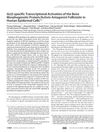
March 2008 in “Journal of biological chemistry/The Journal of biological chemistry” This study found that GLI2 plays a key role in activating follistatin, an activin/BMP antagonist, in response to hedgehog signaling in human epidermal cells, with implications for hair follicle development and basal cell carcinoma.
 June 2023 in “Medical records-international medical journal”
 This study observed that IGF-1R expression significantly decreased in basal keratinocytes of sacrococcygeal pilonidal sinus tissues, suggesting a potential role in its etiology, although further data are needed to evaluate its treatment implications.
16 citations
,
October 2013 in “Irish Veterinary Journal” This case study describes the successful use of recombinant feline interferon-omega in managing feline chronic gingivostomatitis syndrome in cats with type II diabetes, where long-acting corticosteroids are contraindicated.
January 2016 in “프로그램북(구 초록집)” This study found that growth factor cocktail treatment including FGF9, combined with microneedling, significantly improved hair density in androgenetic alopecia patients compared to treatment with regular GFC or normal saline.
 February 2025 in “Archives of Dermatological Research”
 In this study, researchers administered injectable platelet-rich fibrin (i-PRF) to 30 patients with androgenetic alopecia, finding an 80% response rate after 6 months, with improved hair density and reduced scalp symptoms, while reporting minimal adverse reactions.