1 citations
,
July 2006 in “Reviews in gynaecological and perinatal practice” This review explores various therapeutic options for managing female hirsutism, emphasizing the effectiveness of low-dose finasteride and cyproterone acetate, but it presents no new clinical results.
 10 citations
,
May 1995 in “Journal of General Internal Medicine”
10 citations
,
May 1995 in “Journal of General Internal Medicine” Most women with excessive hair growth have PCOS; treatment varies and focuses on preventing new hair, with electrolysis as the only permanent removal method.
This study found that platelet-rich plasma significantly enhanced the viability, as well as the expression of alkaline phosphatase and versican, in human hair dermal papilla cells compared to controls.
 3 citations
,
December 2022 in “npj Regenerative Medicine”
3 citations
,
December 2022 in “npj Regenerative Medicine” This review discusses the role of heparan sulfate proteoglycans in regulating stem cell fate and highlights their potential as targets for addressing hair loss, without reporting new clinical results.
 2 citations
,
March 2025 in “Archives of Dermatological Research”
2 citations
,
March 2025 in “Archives of Dermatological Research” HEV light can harm or help skin and scalp, so safe exposure guidelines are needed.
 4 citations
,
January 2011 in “Annals of Dermatology”
4 citations
,
January 2011 in “Annals of Dermatology” This article discusses the role of HR gene mutations in differentiating atrichia with papular lesions from alopecia universalis, but presents no new experimental results.
 29 citations
,
February 2017 in “International Journal of Women's Dermatology”
29 citations
,
February 2017 in “International Journal of Women's Dermatology” This article provides an endocrine perspective on evaluating and managing hirsutism but reports no new research findings.
 April 2018 in “Journal of Investigative Dermatology”
 This study found that DC-HIL+ myeloid derived suppressor cells are increased in the blood and skin of patients with cutaneous lupus erythematosus and show immunosuppressive properties.
 67 citations
,
September 2008 in “Dermatologic therapy”
67 citations
,
September 2008 in “Dermatologic therapy” This paper reviews causes of hirsutism in women and emphasizes the importance of identifying underlying conditions for risk assessment, though it reports no new clinical findings.
 10 citations
,
June 2010 in “Fertility and Sterility”
10 citations
,
June 2010 in “Fertility and Sterility” In this study, patients with polycystic ovary syndrome self-reported higher hirsutism scores compared to clinician assessments, but only clinician scores correlated with biochemical markers of hyperandrogenism.
 September 2019 in “Journal of Investigative Dermatology”
 This study found that the clinical severity of hidradenitis suppurativa, evaluated through Hurley staging, VAS, PGA, and SAHS, significantly affects patients' work absenteeism and presenteeism, with presenteeism being more prevalent.
 November 2023 in “Heliyon”
 This article reports a case of herpes zoster ophthalmicus following platelet-rich plasma treatment for androgenic alopecia and emphasizes adhering to guidelines to ensure safe outcomes.
9 citations
,
August 2021 in “Experimental dermatology” This review examines the dysregulation of innate immune barriers in the early stages of hidradenitis suppurativa and calls for further research on the role of the hair follicle and immune responses, but reports no new results.
3 citations
,
December 1982 in “Australasian journal of dermatology” This article reviews approaches to managing hirsutism but does not report new clinical findings.
296 citations
,
October 2018 in “General and Comparative Endocrinology” This review discusses the use of hair cortisol concentration as a marker for chronic stress and long-term cortisol secretion in animals, highlighting its benefits and the need for standardized sampling protocols.
January 2008 in “HAL (Le Centre pour la Communication Scientifique Directe)” This study identified complex regulatory elements and interactions involving the Hr gene and HR protein that are crucial for hair follicle formation and cycling in mammals.
 September 2024 in “Vietnam Journal of Biotechnology”
 This study found that astaxanthin effectively protected human dermal papillae cells from oxidative stress induced by hydrogen peroxide, reducing the percentage of cells expressing a stress marker significantly, suggesting potential benefits for hair loss treatment related to reactive oxygen species.
 May 2026 in “International Journal of Molecular Sciences”
 In this study, a new formulation of human placental extract showed antioxidant and neurite outgrowth activities, significantly reduced hair graying in mice, and alleviated neuropathy symptoms, suggesting potential therapeutic benefits.
3 citations
,
March 1992 in “Journal of clinical pathology” This review discusses the clinical evaluation and investigation needed for hirsute women, suggesting that most cases require minimal testing unless virilism or severe symptoms are present; no new clinical results are provided.
3 citations
,
May 2013 in “PubMed” This review discusses Hutchinson-Gilford progeria syndrome, highlighting its phenotype, pathogenesis, and its potential insights into natural aging and cardiovascular diseases, but it reports no new research findings.
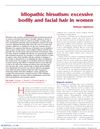 11 citations
,
February 2008 in “British journal of nursing”
11 citations
,
February 2008 in “British journal of nursing” This article reviews idiopathic hirsutism, focusing on its definition, diagnosis, causes, and treatment options, without presenting new clinical findings.
40 citations
,
November 2013 in “European journal of endocrinology” This paper reviews the treatment options for hirsutism and emphasizes the importance of diagnosing its underlying cause and considering patient perception and specific phenotypes, reporting no new clinical results.
85 citations
,
March 2008 in “Journal of Cell Science” This study created transgenic mouse models with the LMNA gene mutation common in Hutchinson-Gilford progeria syndrome, revealing skin and teeth abnormalities related to transgene expression levels.
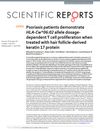 27 citations
,
April 2018 in “Scientific Reports”
27 citations
,
April 2018 in “Scientific Reports” This study found that in psoriasis patients, the K17 protein probably functions as an autoantigen, with the HLA-Cw*06:02 risk genotype strongly linked to the T cell response size.
 6 citations
,
May 2012 in “Archives of Dermatological Research”
6 citations
,
May 2012 in “Archives of Dermatological Research” This study reports a novel missense mutation in the HR gene in a 68-year-old Hungarian woman with alopecia universalis and limb deformities, suggesting a need for further research on its role in these conditions.
June 2015 in “The American journal of dermatopathology/American journal of dermatopathology” This study demonstrated that a 1-step, peroxidase-labeled conjugated antibody method provides more accurate immunoreactivity patterns in hair follicle substructures compared to the 2-step LSAB method, which may cause false-positive staining in sebaceous glands.
January 2021 in “Elsevier eBooks” This review discusses the potential of human induced pluripotent stem cells for regenerating hair follicles and developing cell-based therapies for hair loss, but it reports no new clinical results.
 16 citations
,
January 2000 in “The Journal of clinical endocrinology and metabolism/Journal of clinical endocrinology & metabolism”
16 citations
,
January 2000 in “The Journal of clinical endocrinology and metabolism/Journal of clinical endocrinology & metabolism” This study found that serum PSA levels are higher in hirsute women and can be significantly reduced by antiandrogen treatment, suggesting PSA as a marker of androgen action in females.
April 2019 in “Journal of the Endocrine Society” This case study reported that even with improved adrenal androgens and testosterone levels, treating women with AH-PCOS with glucocorticoids did not significantly improve ovulatory function or hirsutism.
January 2018 in “Elsevier eBooks” This chapter reviews Hutchinson–Gilford progeria syndrome as a model for studying aging but presents no new findings, covering its genetic basis, clinical features, and existing treatments.