 30 citations
,
August 2010 in “American Journal of Clinical Dermatology”
30 citations
,
August 2010 in “American Journal of Clinical Dermatology” This article reviews eyelash elongation as a side effect of EGFR inhibitors in cancer treatment, finding that the condition is typically not severe and may be managed by trimming.
 23 citations
,
May 1998 in “Journal of Dermatological Science”
23 citations
,
May 1998 in “Journal of Dermatological Science” This study suggests that skin sections from 4-week-old C3H mice could serve as an in vitro model for human androgenic alopecia, as minoxidil partially reverses suppressed hair follicle elongation.
 21 citations
,
October 2009 in “Biochemical Engineering Journal”
21 citations
,
October 2009 in “Biochemical Engineering Journal” This review discusses various approaches to treating alopecia, including drug therapy and hair transplantation, but reports no new research findings; the authors highlight the need for novel techniques like cell culturing.
 19 citations
,
April 2010 in “Journal of Dermatological Treatment”
19 citations
,
April 2010 in “Journal of Dermatological Treatment” This study found that partial follicular units extracted from the donor area can survive and regenerate new hairs at their original site and when transplanted, effectively creating two hair follicles from one.
 12 citations
,
November 2020 in “Journal of Dermatological Science”
12 citations
,
November 2020 in “Journal of Dermatological Science” In this study, miR-324-3p was found to promote differentiation and migration in cultured keratinocytes and is highlighted as a potential target for treating androgenic alopecia.
 5 citations
,
September 2015 in “PLoS ONE”
5 citations
,
September 2015 in “PLoS ONE” This study demonstrated that Gelfoam® histoculture supports extensive growth of both hair shafts and sensory nerves from isolated mouse whisker follicles over prolonged periods.
 1 citations
,
September 2015 in “Serbian Journal of Dermatology and Venereology/Serbian Journal of Dermatology and Venerology”
1 citations
,
September 2015 in “Serbian Journal of Dermatology and Venereology/Serbian Journal of Dermatology and Venerology” This paper presents a case of a young male with a family history, showing overlap between ulerythema ophryogenes and keratosis follicularis spinulosa decalvans, affecting both eyebrows and scalp with cicatricial patchy alopecia.
 April 2018 in “Journal of Investigative Dermatology”
 This study found that dermal white adipose tissue surrounding human hair follicles enhances proliferation, pigmentation, and hair shaft elongation in an ex vivo setting.
 53 citations
,
May 1990 in “Journal of Dermatology”
53 citations
,
May 1990 in “Journal of Dermatology” In this animal study, topical minoxidil shortened the telogen phase of hair growth cycles in rats, suggesting it may stimulate certain follicles to progress more rapidly to anagen.
 66 citations
,
May 2012 in “Scientific Reports”
66 citations
,
May 2012 in “Scientific Reports” This study demonstrated that bioengineered hair follicles reconstituted from embryonic skin cells and transplanted into hosts can restore physiological hair functions, suggesting potential applications for treating alopecia.
 June 2026 in “Scientific Reports”
 This study identified hypericin and berberine as compounds that can support hair growth by enhancing oxytocin receptor expression and acting as an oxytocin receptor agonist, respectively, potentially serving as practical alternatives to oxytocin for treating hair-loss diseases.
 15 citations
,
May 2020 in “BMC complementary medicine and therapies”
15 citations
,
May 2020 in “BMC complementary medicine and therapies” This study found that Polygonum multiflorum extract may promote hair growth by increasing anagen duration and activating dermal papilla cells in human hair follicles, as observed in cultured cell models.
 4 citations
,
December 2020 in “Journal of Dermatology”
4 citations
,
December 2020 in “Journal of Dermatology” This study suggests that impaired autophagy may be a potential mechanism contributing to androgenetic alopecia, as observed in miniaturized hair follicles from balding scalps.
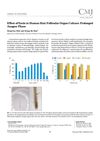 January 2026 in “Chonnam Medical Journal”
 Escin helps keep hair follicles in the growth phase longer.
 14 citations
,
November 2013 in “PloS one”
14 citations
,
November 2013 in “PloS one” This study found that transgenic mice overexpressing HGF/SF are more susceptible to UVA-induced melanoma, with melanin in the papillary dermis interacting with UVA to induce melanoma.
 24 citations
,
May 2012 in “International Journal of Dermatology”
24 citations
,
May 2012 in “International Journal of Dermatology” This review discusses the various causes and associations of eyelash trichomegaly, including congenital syndromes, acquired conditions, and drug effects, without reporting new clinical results.
 23 citations
,
July 2018 in “Journal of Cosmetic Dermatology”
23 citations
,
July 2018 in “Journal of Cosmetic Dermatology” This study describes a distinct pattern of trichoscopic features associated with chemotherapy-induced alopecia and how these features evolve through different phases of chemotherapy treatment.

This study aims to describe the trichoscopic pattern of chemotherapy-induced alopecia and its changes during different phases of chemotherapy.
173 citations
,
September 2011 in “Journal of Investigative Dermatology” IL-6 contributes to hair loss by shortening the growth phase and causing hair follicles to regress.
 November 2018 in “Skin appendage disorders”
 The document concludes that a woman has both Frontal Fibrosing Alopecia and Lichen Simplex Chronicus, a previously unreported combination of conditions.
 3 citations
,
January 2021 in “Applied sciences”
3 citations
,
January 2021 in “Applied sciences” This study found that in C57BL/6 mice, treatment with fermented red ginseng marc, a traditional polyherb formula, or a combination of both, promoted hair growth by enhancing the hair-growth cycle.
 208 citations
,
January 2013 in “Lab on a Chip”
208 citations
,
January 2013 in “Lab on a Chip” The researchers described a chip-based bioreactor platform for dynamic perfusion, which may enhance in vitro skin models by introducing mechanical shear stress and extending culture periods.
 131 citations
,
July 2009 in “Experimental Dermatology”
131 citations
,
July 2009 in “Experimental Dermatology” This review discusses the development and advances in studying trichogenic dermal cells for hair follicle morphogenesis, summarizing methods, bioassays, and molecular markers, but reports no new research findings.
 130 citations
,
January 1994 in “Differentiation”
130 citations
,
January 1994 in “Differentiation” In this study, researchers found that bulge cells in mouse hair follicles undergo transient proliferation during early anagen, indicating their role as follicular stem cells. However, another factor beyond dermal papilla proximity may be required to initiate a new anagen phase.
 109 citations
,
July 1993 in “The journal of investigative dermatology/Journal of investigative dermatology”
109 citations
,
July 1993 in “The journal of investigative dermatology/Journal of investigative dermatology” Hair color production is closely linked to the active growth phase of hair in mice and may also influence hair growth itself.
 107 citations
,
December 2013 in “International Journal of Dermatology”
107 citations
,
December 2013 in “International Journal of Dermatology” This review summarizes the anatomical and physiological aspects of human hair and its clinical significance, but does not report new research findings.
 98 citations
,
December 2003 in “The FASEB Journal”
98 citations
,
December 2003 in “The FASEB Journal” In this study, thymosin beta4 was found to stimulate hair growth in normal rats and mice by affecting key processes in the hair follicle cycle, such as stem cell migration and extracellular matrix remodeling.
 96 citations
,
April 2007 in “Journal of Investigative Dermatology”
96 citations
,
April 2007 in “Journal of Investigative Dermatology” In this study, co-grafting human keratinocytes with murine dermal papilla-enriched cells produced hair follicle-like structures, but without regular hair formation, suggesting anomalous folliculogenesis.
 75 citations
,
December 2011 in “British Journal of Dermatology”
75 citations
,
December 2011 in “British Journal of Dermatology” This review discusses female pattern hair loss, its psychological impact, and available treatments but provides no new clinical findings; the authors emphasize early intervention for better outcomes.
 58 citations
,
September 2012 in “Dermatologic Clinics”
58 citations
,
September 2012 in “Dermatologic Clinics” This article reviews current knowledge on the causes, diagnosis, and medical treatments for androgenetic alopecia, particularly in men, and reports no new findings.