3 citations
,
December 2024 in “Journal of Animal Science” In this study, researchers identified the lncRNA MSTRG.14227.1 in cashmere goats and found it inhibits the morphogenesis of secondary hair follicles by interacting with the chi-miR-433/ADAMTS3 signaling axis, affecting cashmere yield and quality.
This study mapped genome-wide copy number variations in Chinese indigenous fine-wool sheep, providing a valuable genetic resource for researching complex traits and genetic diversity in this species.
4 citations
,
December 2022 in “Al-mağallaẗ al-ʻirāqiyyaẗ li-l-ʻulūm al-bayṭariyyaẗ/Iraqi journal of veterinary sciences” This study conducted in Egypt evaluated antifungal treatments for sheep with dermatophytosis, finding that tioconazole cream, clotrimazole spray, and fluconazole capsules were effective, with tioconazole cream providing an easily applicable and highly effective topical option, achieving a 100% cure rate in the short term.
7 citations
,
September 2022 in “International journal of molecular sciences” This study identified and analyzed numerous lncRNAs, miRNAs, and mRNAs involved in hair follicle development in cashmere goats, highlighting key regulatory pathways and suggesting roles for specific RNAs in enhancing hair follicle cell proliferation.
June 2018 in “CRC Press eBooks” This article reviews congenital and developmental skin conditions in foals and reports no new clinical results; it notes that these conditions can be influenced by genetic and environmental factors.
3 citations
,
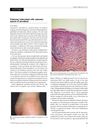
August 2017 in “Clinical case reports” A rare skin condition causes red and dark patches on the face and limbs.
 9 citations
,
July 2002 in “Journal of the European Academy of Dermatology and Venereology”
9 citations
,
July 2002 in “Journal of the European Academy of Dermatology and Venereology” This article discusses multiple minute digitate hyperkeratosis in a dermatological context and reports no new clinical findings; the authors focus on a descriptive review.
6 citations
,
January 2014 in “Genetics and Molecular Research” This study constructed a hair follicle-specific expression vector for IGFBP-5 in Inner Mongolia Cashmere goat cells, allowing for future functional genetic analyses and potential use in nuclear transfer.
5 citations
,
April 2019 in “Veterinary Dermatology” In this case series, cats infested with Lynxacarus radovskyi developed self-induced alopecia similar to flea allergic dermatitis, primarily affecting the perianal area.
2 citations
,
November 2024 in “Wildlife Society Bulletin” The researchers found that combining permethrin (44%) and fluralaner effectively reduced tick load in moose calves, as indicated by less severe hair loss, compared to untreated calves, while topical permethrin (5%) alone had no clear effect on tick load, body mass, or hematocrit.
 3 citations
,
February 2019 in “Animal biotechnology”
3 citations
,
February 2019 in “Animal biotechnology” In this study, the PLP2 gene was found to promote secondary hair follicle development in Liaoning cashmere goats, with its expression negatively regulated by melatonin and potentially affecting follicle development via the BMP pathway.
24 citations
,
June 2003 in “Journal of Structural Biology” This study suggests that varying intersheet interactions may explain the differences between the two polymorphic forms of macrofibril assembly in Merino wool and hair.
5 citations
,
February 2016 in “Sultan Qaboos University medical journal” This case report describes a patient with a severe pruritic rash and hair loss in both axillary regions, with no fluorescence under a Wood's lamp and hair follicle-centred papules observed through dermoscopy.
25 citations
,
April 2008 in “Clinical and experimental dermatology” This case series describes Erythromelanosis follicularis faciei et colli in five Indian patients, suggesting it may be more common than currently reported.
 191 citations
,
November 1959 in “Annals of the New York Academy of Sciences”
191 citations
,
November 1959 in “Annals of the New York Academy of Sciences” This article reports electron microscope studies on the structure of hair and wool, but it does not present new clinical findings.
 August 2015 in “Dermatología Argentina”
 This study reviewed 18 postmenopausal women with frontal fibrosing alopecia, noting frontotemporal hairline recession and eyebrow loss, often treated with steroids, triamcinolone, and other medications.
 November 2011 in “Advanced Materials Research”
 This study found that adding hair fibers to friction materials increased their friction coefficient stability and impact strength while decreasing wear rates, with 1% hair fiber content notably improving performance.
4 citations
,
November 2020 in “Case reports in dermatology” This report summarizes recent cases of the rare condition erythromelanosis follicularis faciei et colli to illustrate its varied clinical presentations.
2 citations
,
June 2024 in “Skin Appendage Disorders” This study identifies specific trichoscopic features such as empty follicles and perifollicular erythema in Caucasians with frontal fibrosing alopecia, which may assist in diagnosis and monitoring, but stresses the need for further research due to limited demographic data.
October 2025 in “Coloration Technology” In this study, a new delipidisation method that removes over 97% of key lipids from wool rapidly and without yellowing was reported to improve wool processing and printing quality.
 April 2023 in “Journal of Investigative Dermatology”
 This study suggests that linalool, a common allergen in personal care products, may contribute to frontal fibrosing alopecia pathogenesis by triggering immune responses and depleting hair follicle stem cells, especially in sensitized individuals.
 May 2026 in “International Journal of Drug Delivery Technology”
 This case study highlights Erythromelanosis follicularis faciei et colli as an easily overlooked pigmentary disorder characterized by a distinctive triad requiring precise diagnosis for effective patient counseling and cosmetic management.
1 citations
,
September 2020 in “Sahel Journal of Veterinary Sciences” This case report observed that nutritional adjustments improved alopecia caused by finely ground feed in a flock of sheep.
 2 citations
,
December 2019 in “Textile Research Journal”
2 citations
,
December 2019 in “Textile Research Journal” This study found that L-cystine-modified rabbit hair fibers had improved dye adsorption and spinnability, due to changes in secondary structure and surface characteristics.
 7 citations
,
December 2011 in “Elsevier eBooks”
7 citations
,
December 2011 in “Elsevier eBooks” The document concludes that early diagnosis and treatment are crucial for managing skin diseases in ferrets.
3 citations
,
December 2021 in “Proteins” This study found that straight crimp mutant wool differs from crimpy wool in the layout of cortical cells and the relative proportions of keratin and keratin-associated proteins.
 January 2025 in “Cellular and Molecular Biology”
 This study found that in Liaoning cashmere goats, overexpression of the PIP5K1A gene enhances skin fibroblast proliferation, while interference with this gene reverses melatonin-induced proliferation, and PIP5K1A regulates certain miRNA expressions, suggesting a role in improving cashmere yield and quality.
 2 citations
,
September 2022 in “Frontiers in veterinary science”
2 citations
,
September 2022 in “Frontiers in veterinary science” In this study, researchers used high-throughput sequencing to explore lncRNA interactions in cashmere goat hair follicles during embryonic development, finding lncRNAs potentially regulate genes in the Wnt and PI3K-Akt pathways related to hair follicle growth.
January 2021 in “Electronic Theses of LMU Munich (Ludwig-Maximilians-Universität München)” This study found that fibroblasts play a crucial role in scar formation during dermal development and identified N-Cadherin as a key molecule in their response, suggesting new therapeutic avenues for scar prevention.
 1 citations
,
March 2025 in “Acta fytotechnica et zootechnica/Acta fytotechnica et zootechnica”
1 citations
,
March 2025 in “Acta fytotechnica et zootechnica/Acta fytotechnica et zootechnica” This study evaluated quercetin's potential as a treatment for cats with Feline Atopic Skin Syndrome, finding it significantly reduced clinical scores in certain symptom groups like Head-and-Neck Pruritus and Miliary Dermatitis, although improvements in oxidative stress markers were not clearly significant.