 February 2016 in “DOAJ (DOAJ: Directory of Open Access Journals)”
 This study found that freeze-dried finasteride nanoparticles significantly improved the dissolution rate and pharmacokinetic parameters compared to pure drug formulations, suggesting enhanced stability and solubility for poorly water-soluble drugs.
45 citations
,
May 2002 in “International Journal of Dermatology” This case report describes a patient with systemic lupus erythematosus who developed multiple dermatofibromas while on long-term prednisone therapy.
December 2016 in “Anales del sistema sanitario de Navarra” This case study reports successful treatment of frontal fibrosing alopecia with daily 2.5mg finasteride in a 77-year-old woman.
 4 citations
,
June 2022 in “Journal of Cosmetic Dermatology”
4 citations
,
June 2022 in “Journal of Cosmetic Dermatology” This study suggests that dermal fibroblast-conditioned medium containing multi-peptide factors may stimulate hair growth by enhancing growth factor expression and β-catenin regulation in hair follicle cells.
 August 2015 in “Dermatología Argentina”
 This study reviewed 18 postmenopausal women with frontal fibrosing alopecia, noting frontotemporal hairline recession and eyebrow loss, often treated with steroids, triamcinolone, and other medications.

In this case study, a 36-year-old male with symptoms of keratosis pilaris atrophicans faciei and frontal fibrosing alopecia tested negative for a specific mutation, highlighting genetic testing's potential to improve diagnosis and treatment outcomes in these similar conditions.
14 citations
,
September 2017 in “Clinical and Experimental Dermatology” In this report, a 26-year-old man with folliculitis decalvans unresponsive to standard treatments experienced significant disease clearance after 25 months of systemic photodynamic therapy, marking the first documented use of this therapy for this condition.
 May 2019 in “Anais brasileiros de dermatologia/Anais Brasileiros de Dermatologia”
 This study reviewed 38 cases of frontal fibrosing alopecia, observing that diagnosis often occurs years after onset and is more prevalent in postmenopausal women.
18 citations
,
January 2021 in “Theranostics” This study found that actively targeted AN2728-loaded nanocarriers reduced inflammation and improved skin condition in a mouse model of psoriasiform inflammation compared to free drug and non-targeted nanoparticles.
March 2021 in “Arrow - TU Dublin (Technological University Dublin)” This study tested a folate-conjugate drug delivery system and found its cytotoxicity depends on whether the treated cells overexpress folate receptors, suggesting potential for targeted chemotherapy.
 16 citations
,
February 2010 in “Journal of the European Academy of Dermatology and Venereology”
16 citations
,
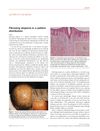
February 2010 in “Journal of the European Academy of Dermatology and Venereology” This article is a letter to the editor about fibrosing alopecia in a pattern distribution and reports no new research findings.
53 citations
,
July 2002 in “Journal of Investigative Dermatology” The Dfl mutation in mice causes poor sebaceous gland function and complete hair loss.
 May 2015 in “Journal of the American Academy of Dermatology”
 Certain drugs and supplements may contribute to hair loss in the frontal hairline in older women.
The interdisciplinary approach improved the quality of life for a Parkinson's patient and eased staff workload.
December 2023 in “JEADV Clinical Practice” This study found that dermoscopy of the axilla in patients with frontal fibrosing alopecia revealed significantly higher odds of brownish peripillary halos, suggesting a diagnostic clue for the condition in this region.
 June 2018 in “The Journal of Sexual Medicine”
 In this study, finasteride was found to significantly reduce DHT levels and affect spermatogenic markers in rats, while DA-9401 co-treatment indicated potential ameliorative effects.
 119 citations
,
November 2014 in “Trends in Cell Biology”
119 citations
,
November 2014 in “Trends in Cell Biology” This review discusses the mechanisms and pathways of FGFR signalling and its roles in development, disorders, and therapeutic targeting, but reports no new clinical results.
15 citations
,
June 2015 in “F1000Research” This study examined immune responses to Diphencyprone and found that its induced skin reactions have higher levels of negative immune regulators compared to psoriasis, suggesting differences in immune regulation may contribute to psoriasis chronicity.
January 2014 in “Journal of Central South University(Science and Technology)” This study found that poly(propylene carbonate maleate) microspheres can successfully prolong finasteride release over 42 days, showing potential for long-term sustained drug delivery.
 August 2026 in “ACTA MEDICA IRANICA”
 This study found that women with female pattern hair loss exhibited hormonal imbalances, with the Free Androgen Index being a particularly effective diagnostic marker.
 April 2018 in “Journal of Investigative Dermatology”
 This study found that Fgf20 signaling facilitates fibroblast migration and influences dermal condensate cell development during hair follicle morphogenesis by supporting cellular activities such as cell cycle exit and specific cell shape adoption.
 30 citations
,
January 2020 in “Journal of The American Academy of Dermatology”
30 citations
,
January 2020 in “Journal of The American Academy of Dermatology” This review reports no new clinical results but discusses fibrosing alopecia in a pattern distribution as a distinct scarring alopecia with characteristics of both androgenetic alopecia and lichen planopilaris.
83 citations
,
February 1991 in “Development” This study found that Fos protein expression is closely linked to epithelial cell differentiation, particularly during cornification and cell death, with overexpression observed in keratinization-blocked mutant epidermis.
 1 citations
,
January 2021 in “Journal of biological chemistry/The Journal of biological chemistry”
1 citations
,
January 2021 in “Journal of biological chemistry/The Journal of biological chemistry” This study found that loss of the folliculin protein delays transferrin receptor recycling, leading to iron deficiency and suggesting a role in the mechanisms of Birt-Hogg-Dubé syndrome.
April 2019 in “Journal of Investigative Dermatology” This study found that frontal fibrosing alopecia involves distinct molecular changes, such as downregulation of steroid and cholesterol pathways and upregulation of fibrotic and immune response genes, which may help guide treatment strategies.
 February 2018 in “The Journal of Sexual Medicine”
 In this animal study, finasteride exposure led to impaired spermatogenesis in rats, while the novel compound DA-9401, derived from three medicinal herbs, demonstrated potential in improving sperm parameters and reducing testicular apoptosis when used alone or with finasteride.
 March 2025 in “International Journal of Trichology”
 This case report describes the first observed instance of fibrosing alopecia in a pattern distribution in a child, suggesting the condition is not solely androgen dependent.
 64 citations
,
June 2009 in “Journal of The American Academy of Dermatology”
64 citations
,
June 2009 in “Journal of The American Academy of Dermatology” This article discusses frontal fibrosing alopecia, noting potential connections to lichen planopilaris, but reports no new clinical findings.
54 citations
,
November 2007 in “Actas Dermo-Sifiliográficas” Early diagnosis of frontal fibrosing alopecia is crucial to prevent permanent hair loss.
1 citations
,
August 2024 in “Expert Opinion on Drug Safety” This study analyzed data from the FDA Adverse Event Reporting System and found that finasteride had the highest reporting frequency and signal strength for drug-induced erectile dysfunction among 734 drugs, with compound preparations posing higher risks than single ingredients.