 16 citations
,
April 1978 in “Genetics Research”
16 citations
,
April 1978 in “Genetics Research” This study found that asebic mice exhibit abnormal sebaceous gland differentiation and insufficient sebum production due to defective regulation of cell processes, despite possessing normally developing sebaceous glands initially.
89 citations
,
March 1996 in “Proceedings of the National Academy of Sciences” This study found that homozygous mutant mice with a hypomorphic CD18 mutation developed a chronic inflammatory skin disease resembling human psoriasis, potentially implicating additional genetic factors in disease susceptibility.
29 citations
,
January 2003 in “Genomics” A new mouse mutation causes skin and hair issues, influenced by another gene.
This study mapped the curly mutation in mice to a specific region on chromosome 11, identifying it as a candidate model for studying human genetic hair disorders.

This study presents a two-photon imaging method to visualize low-threshold mechanoreceptor axon terminals in live mouse forepaw skin, enabling repeated high-resolution imaging to study sensory circuits during development and adulthood.
April 2019 in “Journal of Investigative Dermatology” 40 citations
,
July 1981 in “Journal of Neuropathology & Experimental Neurology” In this study, brindled mutant mice with clinical features similar to kinky hair syndrome showed marked improvement and prevention of neuronal degeneration after receiving cupric chloride injections, with timing of administration being crucial.
34 citations
,
March 2009 in “Journal of Investigative Dermatology” Proteomic analysis can identify genetic differences in mouse hair, helping understand hair defects and variations.
January 2005 in “Chinese Journal of Veterinary” This study observed that hairless mice of different strains initially grow hair but soon develop alopecia and other skin and pigmentation changes with age.
 42 citations
,
March 2010 in “Endocrinology”
42 citations
,
March 2010 in “Endocrinology” This study reports the development of the first rodent model for androgenetic alopecia, demonstrating that overexpression of androgen receptors in mice delays hair regeneration and can be used to test new treatments.
48 citations
,
August 1998 in “Developmental Biology” In this study, researchers created a mutant mouse lacking the first cut repeat in the Cux/CDP protein, resulting in curly vibrissae and wavy hair, supporting the role of Cux/CDP's DNA binding domains in gene regulation during development.
3 citations
,
October 2020 in “Journal of Investigative Dermatology” This study established that the Dct::CreERT2 mouse line is effective for targeting and studying adult melanocyte stem cells, contributing to the understanding of melanocyte biology and hair pigmentation.
3 citations
,
January 2004 in “Elsevier eBooks”  July 2026 in “Methods and Protocols”
 In this study, researchers developed a mouse model of non-healing wounds associated with streptozotocin-induced diabetes and found that it significantly delayed regenerative processes compared to healthy controls, suggesting its relevance for preclinical testing of wound regeneration drugs.
September 2025 in “Biological Procedures Online” This study presented a refined surgical protocol for a fetal mouse model that improves pregnancy success, reduces fetal loss, and allows for consistent phenotypic outcomes, enhancing research in scarless skin regeneration.
11 citations
,
August 1995 in “Journal of Investigative Dermatology”  58 citations
,
June 2006 in “Plastic and Reconstructive Surgery”
58 citations
,
June 2006 in “Plastic and Reconstructive Surgery” This study successfully developed a reproducible mouse model demonstrating fetal scarless wound healing, which may provide insights for minimizing scarring in adults.
 January 2016 in “Experimental Dermatology”
 This article in Experimental Dermatology does not include an abstract or any new research findings.
20 citations
,
April 2000 in “Experimental dermatology” This study observed that overexpression of the enzyme ODC in transgenic mice caused hair loss and skin changes similar to human papular atrichia, suggesting that ODC might be involved in a critical hair follicle function pathway.
 5 citations
,
October 2015 in “The American journal of pathology”
5 citations
,
October 2015 in “The American journal of pathology” This study found that a spontaneous deletion in the Dsg3 gene of mice leads to hypomorphic desmoglein 3 expression, resulting in severe immunodeficiency, cyclic hair loss, and wasting disease, without causing the blistering typical of pemphigus vulgaris.
 1 citations
,
August 2024 in “Transgenic Research”
1 citations
,
August 2024 in “Transgenic Research” In this study, the researchers observed that inducing and then withdrawing β-catenin expression in a bigenic mouse model caused reversible changes in skin morphology, indicating dependence on β-catenin signaling.
5 citations
,
March 2023 in “Journal of the American Association for Laboratory Animal Science” In this study, the researchers observed that both standard body and facial depilatory creams caused significant skin injury in mice, with varying effects depending on the mouse strain and exposure time, although both formulations were effective for hair removal.
 418 citations
,
September 2012 in “Nature”
418 citations
,
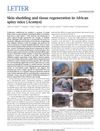
September 2012 in “Nature” This study reports the first instance of skin autotomy in mammals, specifically in African spiny mice, and suggests they may possess a greater regenerative capacity than previously understood, possibly offering insights for regenerative medicine.
17 citations
,
April 2011 in “Journal of Dermatological Science” This study reports that the transgenic expression of Dsg1 in mice rescued the severe B6-Dsg3−/− phenotype and created a syngeneic mouse model of pemphigus vulgaris, which may aid in understanding autoimmunity mechanisms.
 19 citations
,
November 2018 in “Experimental Dermatology”
19 citations
,
November 2018 in “Experimental Dermatology” This review explores the skin regeneration process in spiny mice and highlights differences from laboratory mice, focusing on potential molecular and immune system roles without reporting new experimental results.
6 citations
,
March 2007 in “BioTechniques” This study observed that PCR-based genotyping for cre-loxP mice can lead to errors due to cre-mediated recombination in non-target tissues like tails, affecting the detection of lox alleles.
4 citations
,
April 2023 in “bioRxiv (Cold Spring Harbor Laboratory)” This study presents an improved reference genome for the African spiny mouse, which may aid in understanding its tissue regeneration at the molecular level.
12 citations
,
February 2017 in “Journal of neuroscience research” This study suggests that extrasynaptic δGABA-A receptors may have a protective role in modulating the severity of catamenial-like seizures by influencing neurosteroid and benzodiazepine responses in mice.
 April 2018 in “The journal of investigative dermatology/Journal of investigative dermatology”
 This study found that in a mouse model of Focal Dermal Hypoplasia, treatment with lithium carbonate improved skin disease symptoms compared to controls, though disease severity varied and posed interpretation challenges.
76 citations
,
January 1998 in “Mammalian Genome”