 23 citations
,
April 1991 in “Journal of The American Academy of Dermatology”
23 citations
,
April 1991 in “Journal of The American Academy of Dermatology” Minoxidil solution can cause skin irritation and allergies in some users.
 19 citations
,
February 2015 in “Contact dermatitis”
19 citations
,
February 2015 in “Contact dermatitis” Avoiding certain fragrances improved the man's skin condition.
19 citations
,
February 1998 in “Cellular Immunology” Hair growth phase in mice weakens certain immune responses.
18 citations
,
April 2010 in “Archives of Dermatology” This case report describes a patient with psoriasis and alopecia universalis where psoriasis plaques supported hair growth, suggesting cytokine interaction may influence competing immune responses.
17 citations
,
October 2021 in “Journal of Cosmetic Dermatology” This review found that topical immunotherapy and light/laser therapy may achieve over 50% hair regrowth efficacy in treating extensive alopecia areata in children, with no serious side effects observed.
 17 citations
,
October 2003 in “Contact dermatitis”
17 citations
,
October 2003 in “Contact dermatitis” Glycerin in hand cream can cause allergic skin reactions.
 17 citations
,
April 2002 in “Contact Dermatitis”
17 citations
,
April 2002 in “Contact Dermatitis” Minoxidil 5% caused skin discoloration in a man using it for hair loss.
 17 citations
,
May 1998 in “Contact Dermatitis”
17 citations
,
May 1998 in “Contact Dermatitis” Minoxidil can cause pustular allergic reactions on skin.
 16 citations
,
December 2016 in “Skin appendage disorders”
16 citations
,
December 2016 in “Skin appendage disorders” This study analyzed patch test results to identify allergens causing scalp contact dermatitis, finding nickel, cobalt, and balsam of Peru among the most common in the patient population.
15 citations
,
March 2008 in “The Journal of Dermatology” In this case report, a patient with a history of discoid lupus erythematosus experienced an exacerbation of the condition after topical immunotherapy for alopecia areata, suggesting contact dermatitis as a potential trigger.
 15 citations
,
July 2002 in “Australasian Journal of Dermatology”
15 citations
,
July 2002 in “Australasian Journal of Dermatology” In this case report, two plywood mill workers developed allergic contact dermatitis due to exposure to uncured phenol-formaldehyde resin, not sawdust as initially suspected.
 15 citations
,
July 1997 in “Clinics in Dermatology”
15 citations
,
July 1997 in “Clinics in Dermatology” Traditional Chinese medications can cause skin reactions, and better testing and reporting are needed to identify allergens.
 15 citations
,
March 1996 in “Journal of The American Academy of Dermatology”
15 citations
,
March 1996 in “Journal of The American Academy of Dermatology” The book "Practical Contact Dermatitis" is useful for dermatologists but could be more user-friendly.
 14 citations
,
July 1987 in “Contact Dermatitis”
14 citations
,
July 1987 in “Contact Dermatitis” This article describes cases of allergic contact dermatitis triggered by minoxidil but provides no new clinical findings.
 13 citations
,
January 1988 in “Contact Dermatitis”
13 citations
,
January 1988 in “Contact Dermatitis” This article has no abstract and reports no new findings, focusing instead on allergic contact dermatitis reactions to topical Minoxidil documented in previous studies.
 12 citations
,
June 2010 in “Journal of dermatology”
12 citations
,
June 2010 in “Journal of dermatology” This study found that hyperpigmentation following contact immunotherapy for severe alopecia areata may indicate poor treatment responsiveness and aligns with characteristics of pigmented contact dermatitis.
 11 citations
,
August 2024 in “Nature Communications”
11 citations
,
August 2024 in “Nature Communications” In this study, researchers observed that quiescent mouse embryonic fibroblasts showed reduced glycolysis but increased TCA cycle flux and mitochondrial respiration, with these changes linked to metabolic reprogramming involving yes-associated protein inhibition and malate cycle modulation, which supports extracellular matrix protein synthesis.
 11 citations
,
October 2016 in “Pediatric dermatology”
11 citations
,
October 2016 in “Pediatric dermatology” This case study observed that three girls with alopecia experienced complete hair regrowth after avoiding balsam of Peru and related fragrances, suggesting contact allergy played a role in their hair loss.
 11 citations
,
January 2013 in “International Journal of Trichology”
11 citations
,
January 2013 in “International Journal of Trichology” This case report highlights a rare allergic reaction to 2-hydroxy ethyl meta acrylate, found in superglue, in a man who developed skin lesions from wearing a wig.
11 citations
,
January 2010 in “European Journal of Dermatology” This review discusses the Renbok phenomenon, observing normal hair growth in psoriatic lesions of patients with psoriasis and alopecia areata, and reports no new results.
 9 citations
,
March 2017 in “JAAD Case Reports”
9 citations
,
March 2017 in “JAAD Case Reports” This case report describes erosive pustular dermatosis of the scalp triggered by contact dermatitis from a glued-on hair piece, marking the first instance of this specific cause.
 9 citations
,
January 1992 in “Contact Dermatitis”
9 citations
,
January 1992 in “Contact Dermatitis” Some people using minoxidil for hair loss developed an allergic skin reaction, often related to an ingredient that helps minoxidil work better.
9 citations
,
March 1991 in “American Journal of Contact Dermatitis” In this study, 67 patients developed contact dermatitis from using minoxidil for hair loss, with patch tests suggesting it is a frequent sensitizer among topical drugs.
 8 citations
,
September 2004 in “Contact dermatitis”
8 citations
,
September 2004 in “Contact dermatitis” Avoiding dyed wigs and clothing improved severe allergic reactions in a woman treated with diphencyprone.
 6 citations
,
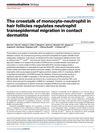
April 2025 in “Communications Biology”
6 citations
,
April 2025 in “Communications Biology” In this study, researchers used a murine model of irritant contact dermatitis to reveal that hair follicle regions serve as key sites for neutrophil transepidermal migration, which requires MMP-9 expression stimulated by dermal monocytes.
6 citations
,
January 2010 in “Journal of Biochemical and Molecular Toxicology” This study found that the ID2 gene was highly expressed in bulge-derived keratinocytes when exposed to contact sensitizers and may serve as a marker to distinguish sensitizers from irritants during in vitro testing.
 6 citations
,
November 1993 in “Contact dermatitis”
6 citations
,
November 1993 in “Contact dermatitis” Spironolactone in anti-acne cream can cause allergic skin reactions in some people.
 5 citations
,
January 2017 in “Skin appendage disorders”
5 citations
,
January 2017 in “Skin appendage disorders” In this case report, the authors linked acute psoriasiform contact dermatitis of the forehead and scalp to a low-laser light cap, identifying DMDE in the fabric as a likely cause.
5 citations
,
May 2015 in “The Journal of Dermatology” Topical corticosteroids can help treat severe alopecia areata when other treatments fail.
5 citations
,
January 2007 in “Immunopharmacology and Immunotoxicology” This study found that 17beta-estradiol enhanced allergy responses in certain age groups of female mice and inhibited thymus involution and regeneration after contact hypersensitivity.