1 citations
,
May 2007 in “Chinese Medical Journal” This case report describes a 24-year-old woman with a rare giant cerebriform pigmented nevus on the scalp, which was identified as a giant congenital intradermal nevus based on clinical and pathological findings.
1 citations
,
April 2021 in “Annals of Otology Rhinology & Laryngology” This report highlights the diagnosis of a giant congenital blue nevus with secondary cutis verticis gyrata in a 20-year-old Asian male, underscoring the need for clinicopathologic correlation due to overlapping features with cerebriform intradermal nevi.
 March 2026 in “Scientific Journal”
 This case study reported a 15-year-old girl with a nevus sebaceus of Jadassohn, where a secondary neoplasm potentially developed into either pigmented trichoblastoma or pigmented basal cell carcinoma, highlighting the importance of early recognition and evaluation of such lesions for effective management.
 July 2024 in “International Journal of Dermatology Venereology and Leprosy Sciences”
 This review highlights the increasing use of trichoscopy, a noninvasive and well-tolerated diagnostic tool, to aid in the accurate diagnosis and management of various pediatric hair and scalp conditions, such as alopecia and other abnormalities.
 6 citations
,
July 2015 in “International Journal of Dermatology”
6 citations
,
July 2015 in “International Journal of Dermatology” This study observed that multiple familial trichoepitheliomas commonly presented with a cribriform histopathological tumor pattern, differentiating them from solitary trichoepitheliomas.
 January 2018 in “Springer eBooks”
 Different races and genders have unique skin and hair issues, requiring specialized care and more research for effective treatment.
 21 citations
,
September 2015 in “Journal of the European Academy of Dermatology and Venereology”
21 citations
,
September 2015 in “Journal of the European Academy of Dermatology and Venereology” This review examines the diagnostic significance of yellow and orange colors in skin lesions and concludes that their role is often underrepresented in the literature.
 1 citations
,
January 2013 in “Elsevier eBooks”
1 citations
,
January 2013 in “Elsevier eBooks” The document reviews various hair and nail disorders, their causes, and treatments, emphasizing the need for proper diagnosis and the link between nail changes and systemic diseases.
January 2026 in “Annals of Dermatology” This review outlines evidence-based strategies for diagnosing pediatric hypopigmented disorders and emphasizes distinguishing vitiligo from self-limiting conditions through a systematic clinical approach; no new results are reported.
 September 2017 in “Pediatric Dermatology”
 The document concludes that an experimental drug may help wound healing in Epidermolysis Bullosa, links Hydroa vacciniforme to EBV, discusses diagnosing hair loss disorders, finds many children with eczema have allergies, reviews the safety of a skin medication in children, notes side effects of a Duchenne's treatment, and identifies a marker for pediatric mastocytosis.
 3 citations
,
January 2010 in “Elsevier eBooks”
3 citations
,
January 2010 in “Elsevier eBooks” The document describes various skin conditions, their features, and treatments but lacks detailed study size information.
 4 citations
,
October 2012 in “Expert Review of Dermatology”
4 citations
,
October 2012 in “Expert Review of Dermatology” Dermoscopy greatly improves melanoma diagnosis and reduces unneeded surgeries.
 106 citations
,
December 2015 in “Journal of The American Academy of Dermatology”
106 citations
,
December 2015 in “Journal of The American Academy of Dermatology” This article reviews common pitfalls in biopsy site selection and technique that can lead to misdiagnosis of various skin conditions, highlighting the importance of proper biopsy practices for improving diagnostic accuracy.

This study reviewed and reclassified 37 cases of primary scarring alopecia using histological methods to achieve more accurate diagnoses within subtypes like lupus erythematosus and lichen planopilaris.
 29 citations
,
January 2007 in “American Journal of Clinical Dermatology”
29 citations
,
January 2007 in “American Journal of Clinical Dermatology” This article reviews the social and functional impact of eyebrow loss and highlights the limited treatment options compared to scalp alopecia, but reports no new clinical results.
 January 2017 in “Springer eBooks”
 The document explains various skin conditions and their treatments.
 157 citations
,
August 2010 in “Lupus”
157 citations
,
August 2010 in “Lupus” This review discusses the various common, rare, and unusual skin manifestations of lupus erythematosus and highlights the importance of accurate diagnosis, but it reports no new clinical results.
 December 2016 in “British Journal of Dermatology”
 The meeting highlighted the importance of genetic testing and multidisciplinary approaches in pediatric dermatology.
8 citations
,
May 2024 in “Diagnostics” This survey investigated how well an AI chatbot could generate dermoscopic language reports for dermatologists and found that participants were equally satisfied with its responses across scenarios, despite lower performance in diagnosing SCC and inflammatory dermatoses.
 3 citations
,
October 2021 in “Clinical, Cosmetic and Investigational Dermatology”
3 citations
,
October 2021 in “Clinical, Cosmetic and Investigational Dermatology” This review discusses the epidemiology, risk factors, clinical features, and management of scalp melanomas, highlighting their high mortality rates and specific challenges in diagnosis and treatment; it reports no new research findings.
August 2025 in “American Journal of Dermatopathology” In this study, researchers presented cases of cellular neurothekeoma in three male family members with early-onset in infancy, suggesting a potential genetic component and inheritance pattern, which deviates from the typical presentation seen mostly in women between 20–30 years.
May 2005 in “Journal of the American Academy of Dermatology” 25 citations
,
March 2021 in “Australasian Journal of Dermatology” This case study reports a 70-year-old man with treatment-resistant pityriasis rubra pilaris achieving complete clinical remission with ustekinumab, adding to evidence supporting biologic therapy when TNF inhibitors are unsuitable.
February 2009 in “Journal of the American Academy of Dermatology”  25 citations
,
January 2005 in “Pediatric Dermatology”
25 citations
,
January 2005 in “Pediatric Dermatology” This article discusses the use of methotrexate for treating generalized pustular psoriasis in a 2-year-old child, providing a specific case study but reporting no new clinical results.
 21 citations
,
January 2005 in “Pediatric Dermatology”
21 citations
,
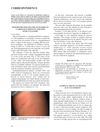
January 2005 in “Pediatric Dermatology” An 8-year-old girl with vitiligo developed extra hair growth on her knee after using tacrolimus ointment.
 16 citations
,
January 2005 in “Pediatric Dermatology”
16 citations
,
January 2005 in “Pediatric Dermatology” This brief report describes a case of Fox-Fordyce disease in a prepubertal girl but reports no new clinical findings.
 14 citations
,
January 2005 in “Pediatric Dermatology”
14 citations
,
January 2005 in “Pediatric Dermatology” This case report describes a child with hypopigmented mycosis fungoides successfully treated with UVA1 light therapy.
 12 citations
,
January 2005 in “Pediatric Dermatology”
12 citations
,
January 2005 in “Pediatric Dermatology” Fox Fordyce disease might be more common in prepubertal girls than thought and can be managed with treatment.
 9 citations
,
January 2005 in “Pediatric Dermatology”
9 citations
,
January 2005 in “Pediatric Dermatology” This report details the clinical presentation and management of cutaneous mastocytosis in Indian children and provides no new experimental findings.