 May 2026 in “Zenodo (CERN European Organization for Nuclear Research)”
 In this study, researchers described ONCO-NK-TRANSITION-GM1, a cancer therapy that's manufacturable with current pharmaceutical methods, showing a 60-80% complete response rate across various cancer types and costing $50 per dose, providing a more accessible alternative to existing treatments.
1 citations
,
August 2025 in “Frontiers in Pharmacology” This review discusses advancements in using dissolving microneedle systems for transdermal delivery of traditional Chinese medicine, highlighting potential benefits for simplifying application, enhancing safety, and increasing efficacy, and underscores its possible impact on modernizing traditional medicine practices.
13 citations
,
February 2025 in “Nature Communications” In this study, a deep neural network model called regX was developed to prioritize driver regulators for cell state transitions by incorporating gene-level regulation and interactions, showing potential therapeutic targets in type 2 diabetes and hair follicle development when applied to single-cell multi-omics data.
April 2026 in “SSRN Electronic Journal”  November 2023 in “Journal of medical and health studies”
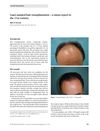
 In this study, combining low-level laser therapy with microneedling showed statistically significant improvement in hair growth for three adult patients with androgenetic alopecia over three months, suggesting it may be a promising management approach.
 11 citations
,
June 2005 in “Journal of Cosmetic Dermatology”
11 citations
,
June 2005 in “Journal of Cosmetic Dermatology” Lasers in hair transplantation show promise but are not yet standard, with current methods causing some side effects and needles still being preferred for creating recipient sites.
 1 citations
,
August 2021 in “Dermatologic Surgery”
1 citations
,
August 2021 in “Dermatologic Surgery” This study reviewed 31 men with androgenetic alopecia who underwent hair transplantation using a robotic recipient site creation device, finding it to be as fast and consistent as manual methods and demonstrating high safety and patient satisfaction.
 November 2019 in “Hair transplant forum international”
 This study found that the SketchAndCalc tablet application offers an easy, rapid, and accurate method for measuring recipient areas in hair restoration, particularly excelling in accuracy for long and narrow shapes.
 June 2024 in “International Journal of Nanomedicine”
 This review outlines recent progress in CRISPR/Cas9 genome editing, discussing its structure, mechanisms, and the use of genetic, chemical, and physical strategies to enhance precision and reduce off-target effects despite some persistent challenges for clinical application.
 June 2022 in “Authorea (Authorea)”
 This review discusses various methods for delivering CRISPR/Cas9 for gene editing in vitro and in vivo, highlighting delivery as a major challenge but reports no new experimental results.
December 2024 in “Clinical and Experimental Dermatology” This study found that patients with central centrifugal cicatricial alopecia preferred shared decision-making with their doctors regarding treatment management.
 2 citations
,
November 2016 in “PubMed”
2 citations
,
November 2016 in “PubMed” This report describes the use of a robotic system in hair restoration surgeries, showing that it reduces physician fatigue and variability in graft extraction while achieving high patient satisfaction and rapid healing.
4 citations
,
August 2020 in “bioRxiv (Cold Spring Harbor Laboratory)” This study developed the iCOUNT tool, which provides insights into stem cell behavior by tracking cell division events and molecular consequences in human and mouse neural stem/progenitor cells.
 October 2022 in “ACS Applied Materials & Interfaces”
 This study reports that the newly developed SA-Ca(II) hydrogel has tunable mechanical properties, high biocompatibility, and potential applications in wearable protections and stimuli-responsive electronics.
March 2026 in “Materials Today Chemistry” Smart microneedles improve hair loss treatment by delivering drugs precisely with fewer side effects.
October 2025 in “Bioactive Materials” This review highlights the potential of microneedle technology in traditional Chinese medicine as a promising transdermal delivery system for skin diseases, showcasing improved efficacy and reduced side effects of TCM ingredients while discussing the challenges of its clinical application.
4 citations
,
February 2023 in “Frontiers in Oncology” In this study, Nano-Pulse Stimulation Therapy successfully cleared up to 91% of melanoma tumors in mice with less skin damage compared to cryoablation, which cleared up to 66% of tumors.
November 2006 in “評価・診断に関するシンポジウム講演論文集” This study found that KSR1 is essential for v-Ha-ras-mediated skin tumor formation in mice but not for MT-driven mammary tumor genesis, suggesting its potential as a therapeutic target in Ras/MAPK signaling.
 27 citations
,
September 2017 in “Journal of Investigative Dermatology Symposium Proceedings”
27 citations
,
September 2017 in “Journal of Investigative Dermatology Symposium Proceedings” This article discusses central centrifugal cicatricial alopecia, noting its prevalence in women of African descent and highlighting the need for further genetic research to improve treatment options; it reports no new clinical results.
 October 2021 in “Journal of Investigative Dermatology”
 In this research, investigators used in vitro models to study the Merkel cell-neurite complex and reported that mechanical stimulation, similar to gentle touch, can induce molecular changes that are potentially relevant to hair growth, thus contributing to the understanding of its underlying mechanisms.
November 2025 in “Indian Journal of Dermatology” This research guide explores the diverse types, functions, benefits, and considerations of home-based dermatology devices, emphasizing their convenience, cost-effectiveness, and privacy benefits, while also warning of potential risks like improper use and limited effectiveness compared to professional treatments.
44 citations
,
September 2016 in “American Journal Of Pathology” This study identified a subpopulation of neural crest-derived progenitor cells in human corneal endothelial tissue from normal and Fuchs endothelial corneal dystrophy donors, which may have potential for future cell therapy development.
5 citations
,
December 2016 in “Microscopy Research and Technique” This study suggests that prenatal infusion of epidermal neural crest stem cells may improve certain neural markers and reduce cortical injury in a mouse model of methylazoxymethanol-induced malformations.
 March 2014 in “Journal of The American Academy of Dermatology”
 Reflectance confocal microscopy can noninvasively diagnose onychomatricoma by showing unique features different from healthy nails or nail fungus.
 March 2024 in “Journal of Cosmetic Dermatology”
 This study found that pretreating concentrated growth factor with a 640 nm laser increased CD34+ stem cell activation and improved hair growth outcomes in androgenetic alopecia patients compared to non-pretreated CGF.
 5 citations
,
September 2012 in “Dermatology Online Journal”
5 citations
,
September 2012 in “Dermatology Online Journal” This manuscript discusses methods to address challenges in follicular unit extraction for hair transplantation, without presenting new clinical findings.
 September 2014 in “Hair transplant forum international”
 This article discusses the role of automated devices in hair transplantation and reports no new clinical results.
 4 citations
,
March 2013 in “InTech eBooks”
4 citations
,
March 2013 in “InTech eBooks” Confocal Laser Scanning Microscopy (CLSM) is a useful tool for studying how drugs interact with skin and diagnosing skin disorders, despite some limitations.
2 citations
,
March 2025 in “Nanoenergy Advances” This review examines recent advances in bioelectronic nanogenerators for anti-cancer therapy, highlighting various transducing strategies such as photodynamic therapy and electrical stimulation, while also discussing the potential mechanisms for tissue repair and the challenges that lie ahead.
 March 2026 in “Journal of Nanotheranostics”
 This review highlights how nanotechnology enhances CRISPR-Cas9's potential for cancer treatment by improving delivery and stability, addressing key challenges like immunogenicity and delivery inefficiencies, and discusses recent advancements in stimuli-responsive nanoplatforms for precise genome editing.