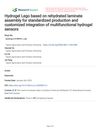
This study introduced a rapid rehydration approach for creating customizable, multifunctional hydrogel sensors, enabling precise detection of surface deformations and easy integration of layers, highlighting its potential for standardized and adaptable manufacturing of wearable devices.
 425 citations
,
January 2021 in “SN Applied Sciences”
425 citations
,
January 2021 in “SN Applied Sciences” This article highlights the versatility and potential of alginate and its derivatives in tissue engineering applications, discussing their properties, modification techniques, and various uses in enhancing tissue healing, bone regeneration, and cell growth.
In this study, researchers developed a method using stencils to create controlled stiffness gradients in alginate hydrogels, revealing that stiffer regions within the gels promote deeper invasion by breast cancer cells, facilitating the study of mechanosensitive cellular behaviors.
14 citations
,
September 2025 in “Gels” This review reports that sodium alginate-based hydrogels show promise in biomedical applications due to their biocompatibility and versatility, but challenges such as mechanical strength and stability remain, highlighting the need for continued research to facilitate their clinical transition.
8 citations
,
February 2025 in “Molecules” This study investigated a gelatin-based bioink for 3D bioprinting a simplified skin model, finding that a formulation with 15% gelatin and 150 mM calcium chloride supported a homogeneous distribution of viable cells over 14 days, showing promise for drug evaluation applications.