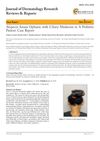
 July 2025 in “Journal of Dermatology Research Reviews & Reports”
 In this case study, a 10-year-old girl with infantile ophiastic alopecia areata and ciliary madarosis showed excellent hair and eyelash regrowth after 56 days of treatment involving oral corticosteroids, topical minoxidil, and clobetasol hair lotion, following an initial diagnosis and psychological evaluation.
January 2024 in “Skin Appendage Disorders” This article discusses ciliary madarosis as a transient condition secondary to IAC, emphasizing the value of physical and trichoscopic evaluations for diagnosis and prognosis; it does not report new clinical results.
 October 2022 in “Ophthalmic Plastic and Reconstructive Surgery”
 This case report describes a 7-year-old boy who developed telogen effluvium resulting in unilateral ciliary madarosis nine weeks after COVID-19 infection, with no other causes identified.
 36 citations
,
January 2012 in “International Journal of Trichology”
36 citations
,
January 2012 in “International Journal of Trichology” This review discusses madarosis, its diverse causes, and suggests follicular unit transplantation as a useful treatment for scarring types, but reports no new clinical results.
1 citations
,
January 2014 in “Indian journal of dermatology, venereology, and leprology” Papular mucinosis can cause eyebrow hair loss, but treatment can lead to regrowth.
 7 citations
,
July 2011 in “Survey of Ophthalmology”
7 citations
,
July 2011 in “Survey of Ophthalmology” This guide provides a comprehensive approach to diagnosing periocular hair disorders, which can range from benign conditions to those posing serious health risks.
1 citations
,
December 2019 This study found that bimatoprost eye drops significantly increased eyelash length, thickness, pigmentation, and the number of eyelashes per follicle in rabbits within one month.
November 2025 in “Journal of Clinical Medicine” This review article explores the potential systemic nature of alopecia areata, highlighting the association with ocular abnormalities and suggesting that shared pathogenic pathways may lead to eye symptoms occurring at younger ages than usual.
 19 citations
,
August 2011 in “Facial Plastic Surgery Clinics of North America”
19 citations
,
August 2011 in “Facial Plastic Surgery Clinics of North America” This article discusses the use of hair transplantation as a reconstructive method to restore hair in various areas affected by defects, highlighting its advantages in providing natural-looking restoration.
 15 citations
,
May 2005 in “Seminars in Plastic Surgery”
15 citations
,
May 2005 in “Seminars in Plastic Surgery” This article details techniques for eyebrow and eyelash reconstruction surgery with hair follicular unit transplantation but reports no new clinical results; the author describes the advantages over other methods.
 18 citations
,
March 2011 in “Archives of ophthalmology”
18 citations
,
March 2011 in “Archives of ophthalmology” This review of periocular tinea in children found that eyelash loss and prolonged misdiagnosis are common, highlighting the need for considering fungal infections in cases refractory to standard treatments.
 June 2023 in “GSC Advanced Research and Reviews”
 This review covers the history, symptoms, and treatment progress for Hutchinson-Gilford Progeria Syndrome, noting that while no cure exists, understanding its molecular mechanism may improve future treatment strategies.
 12 citations
,
December 2018 in “Clinical Ophthalmology”
12 citations
,
December 2018 in “Clinical Ophthalmology” This review summarizes clinical trials and comparative studies showing that latanoprostene bunod 0.024% is effective and safe for reducing intraocular pressure in patients with open-angle glaucoma or ocular hypertension, detailing its mechanism and side effects while considering its therapeutic role.
 11 citations
,
January 2013 in “Ocular Surface”
11 citations
,
January 2013 in “Ocular Surface” This review summarizes the ophthalmic complications of common periocular aesthetic treatments but reports no new clinical findings, emphasizing the importance of recognizing potential side effects.
 10 citations
,
December 2015 in “Clinics in Dermatology”
10 citations
,
December 2015 in “Clinics in Dermatology” This review highlights the eye and skin manifestations of endocrine-related metabolic diseases but provides no new clinical results.
 October 2024 in “Open Repository of the University of Porto (University of Porto)”
 Pharmacists play a crucial role in improving treatment outcomes and staying updated on various health conditions.
2 citations
,
January 2018 in “International Journal of Trichology” This case report describes trichothiodystrophy in two sisters with only hair fragility, illustrating the condition's variable presentation and the importance of regular monitoring for potential associated impairments.
26 citations
,
January 2018 in “Skin appendage disorders” This review summarizes existing studies on toxic agents that can cause alopecia, with thallium and colchicine having the most established links, while others like botulinum toxin A need further investigation.
1 citations
,
December 2019 in “Clinical ophthalmology” This study found that bimatoprost eye drops increased eyelash length, thickness, pigmentation, and the number of eyelashes per follicle in rabbits, without causing inflammation.
2 citations
,
October 2023 in “Cosmetics” This study found that applying 0.005% latanoprost topically to eyelashes significantly increased their length and darkened their color in healthy volunteers over three months, without causing any side effects or changes in intraocular pressure compared to a placebo.
 April 2024 in “Pharmaceuticals”
 This review highlights the clinical usefulness of bimatoprost in lowering intraocular pressure for glaucoma patients and its promising results in promoting hair growth for conditions like alopecia, with research also exploring potential new applications and delivery systems.
 1 citations
,
July 2023 in “Nature communications”
1 citations
,
July 2023 in “Nature communications” This study found that deleting the Mof gene in mouse skin leads to severe defects in skin cell self-renewal, differentiation, and hair follicle growth, indicating that MOF is crucial for mitochondrial and ciliary gene expression and essential for skin development.
 April 2018 in “Journal of Investigative Dermatology”
 In this study, researchers identified CENPV as a new CYLD interacting partner that localizes to primary cilia and regulates acetylated tubulin levels, offering insights into the pathogenesis of skin appendage tumors.
12 citations
,
October 2001 in “British Journal of Ophthalmology” This paper suggests intralesional cidofovir as a potentially effective treatment for SCC with no systemic toxicity observed, but surgical excision remains the standard for its curative outcomes and thorough evaluation.
 45 citations
,
September 2012 in “Life Sciences”
45 citations
,
September 2012 in “Life Sciences” This study observed that Aconiti Ciliare Tuber extract may promote hair growth in mice by activating the Wnt/β-catenin signaling pathway.
 November 2022 in “bioRxiv (Cold Spring Harbor Laboratory)”
 This study found that conditional deletion of Mof in mice resulted in severe defects in skin development, including compromised epidermal differentiation and hair growth, leading to perinatal lethality.
 29 citations
,
December 2017 in “Molecular therapy”
29 citations
,
December 2017 in “Molecular therapy” This study found that enzyme replacement therapy in mice with a severe form of classical homocystinuria improved metabolic patterns and alleviated many clinical symptoms.
July 2025 in “OPAL (Open@LaTrobe) (La Trobe University)” The research found that topical maslinic acid stimulates hair growth in mice, comparable to minoxidil, by inducing anagen phase acceleration and activating pathways such as Wnt/β-catenin, Notch, and MAPK; a potential link to cilia activity was also explored.
 December 2012 in “Journal of undergraduate research in Alberta”
 This study suggests that primary cilia may enhance the proliferation of skin-derived precursors when combined with lithium chloride and platelet-derived growth factor, potentially targeting them for stem cell-based therapies.

This article discusses the various skin side effects associated with targeted cancer therapies like tyrosine kinase inhibitors and EGF-R inhibitors but provides no new clinical findings.