 December 2024 in “Animals”
 In this study, researchers found that RORA directly regulates the expression of the Bnip3 gene, which is crucial for hair follicle stem cell health, using rat HFSCs as a model. They propose that targeting RORA could modulate HFSC status.
 10 citations
,
April 2020 in “Clinics in Dermatology”
10 citations
,
April 2020 in “Clinics in Dermatology” This case report describes a girl in China with biotinidase deficiency confirmed by genetic mutations, whose skin and hair symptoms improved with biotin therapy.
 August 2023 in “Natural Resources for Human Health”
 This paper offers a detailed overview of B vitamins, detailing their importance for energy, cognition, and metabolism, conditions leading to their deficiencies, symptoms of deficiencies, and the foods rich in these essential nutrients.
5 citations
,
June 2022 in “Biophysical Journal” This study used a probabilistic Boolean network model to explore hair follicle cell fate regulation and predicted that varying TGF-β levels, in coordination with BMP and TNF, can influence either apoptosis or cell proliferation during different follicle growth stages.
1 citations
,
September 1993 in “Archives of Disease in Childhood” This article discusses the importance of considering biotinidase deficiency in differential diagnosis for patients with certain neurological and dermatological symptoms, as timely treatment with biotin is crucial to prevent severe consequences.
 176 citations
,
January 2003 in “Journal of Investigative Dermatology”
176 citations
,
January 2003 in “Journal of Investigative Dermatology” This review summarizes the roles of bone morphogenetic proteins in the development and regulation of normal and diseased skin, but it does not provide new clinical results.
12 citations
,
March 2013 in “The American journal of dermatopathology/American journal of dermatopathology” This article reports on three new cases of Birt–Hogg–Dubé Syndrome and emphasizes the role of genetic analysis in its diagnosis due to clinical challenges.
 76 citations
,
May 2011 in “Cell death and differentiation”
76 citations
,
May 2011 in “Cell death and differentiation” This study found that the enzyme A20 helps regulate EDAR-induced NF-κB signaling in mice, preventing ectodermal abnormalities like disheveled hair and assuring proper skin and appendage development.
12 citations
,
September 2011 in “BMJ Case Reports” This case report describes a 2-month-old male with biotinidase deficiency whose seizures and skin symptoms improved dramatically with oral biotin supplementation.
4 citations
,
May 2023 in “Pigment Cell & Melanoma Research” In this study, researchers found that deleting the Bmi1 gene in murine melanocytes caused premature hair greying and loss of melanocyte lineage cells, highlighting BMI1's role in protecting melanocyte stem cells from stress and oxidative damage.
 April 2023 in “Journal of Investigative Dermatology”
 This study found that short-term NB-UVB treatment significantly reduced anxiety levels in psoriasis patients, but not depression.
10 citations
,
August 2023 in “The EMBO Journal” This study explored the epigenetic mechanisms of dermal fibroblast progenitor differentiation and found that the repressive chromatin profile from H3K27me3 prevents these progenitors from reforming skin in allograft assays, despite their multipotent potential.
 August 2021 in “Journal of medical science and clinical research”
 This case report describes an 11-month-old infant with Biotinidase deficiency who exhibited multifocal seizures, neuroregression, alopecia, and skin issues, highlighting prompt diagnosis and the dramatic clinical response to biotin treatment.
 211 citations
,
October 2001 in “The FASEB Journal”
211 citations
,
October 2001 in “The FASEB Journal” This study found that the BMP antagonist noggin induces hair growth in postnatal skin by neutralizing BMP4's inhibitory activity, potentially mediated by changes in Shh expression.
 April 2018 in “Journal of Investigative Dermatology”
 This study found that BMP signaling is involved in regulating melanogenesis, pigment transfer, and melanocyte migration, contributing to our understanding of skin pigmentation mechanisms.
7 citations
,
November 2007 in “Differentiation” This study found that NF-κB's p65/RelA subunit can directly activate hair keratin genes, suggesting a new role in hair formation that may inform the understanding of ectodermal dysplasias.
 18 citations
,
December 2009 in “Canadian Journal of Animal Science”
18 citations
,
December 2009 in “Canadian Journal of Animal Science” This study reports that BMP2 expression in goat skin is higher during late telogen and early anagen phases, indicating a potential role in hair follicle regeneration.
 June 2023 in “British journal of dermatology/British journal of dermatology, Supplement”
 This case report describes a 15-year-old girl with features of Becker naevus syndrome, highlighting the importance of DNA analysis from skin to confirm the diagnosis after 9 years of symptoms.
 10 citations
,
December 2017 in “Chemosphere”
10 citations
,
December 2017 in “Chemosphere” In this study, BPA rapidly increased dendritic spine and synapse densities in cultured rat hippocampal neurons, with involvement of estrogen receptors and ERK1/2 and p38 pathways, but disrupted dihydrotestosterone's effects on synaptic plasticity.
May 2020 in “The journal of investigative dermatology/Journal of investigative dermatology” This study reported that specific inhibition of the classical complement pathway with BIVV009 prevented C3 deposition along the dermal-epidermal junction in bullous pemphigoid, reflecting its potential efficacy.
January 2022 in “International journal of dermatology and venereology” This case study reports a 36-year-old man with KID syndrome caused by an N14Y GJB2 mutation, expanding the mutation spectrum of this condition in the Chinese population.
December 2025 in “International Journal of Molecular Sciences” This study found that an aqueous extract of Bacopa procumbens improved motor function and preserved neuronal structure in a mouse model of Parkinson's disease, suggesting its neuroprotective potential.
 April 2010 in “The Journal of Urology”
 This study found that ureteroileal anastomosis with direct intraluminal visualization had a 4.2% stricture rate, which compares favorably to other techniques with rates between 3.5% and 11.1%.
7 citations
,
June 2020 in “npj regenerative medicine” This study found that GDNF promotes hair formation and skin wound repair by enhancing the self-renewal and differentiation of bulge stem cells in mice.
September 2023 in “World Rabbit Science” In this study using Angora rabbits, researchers found that the FRZB gene inhibits hair follicle development by modulating the Wnt/β-catenin signaling pathway, affecting the expression of various genes related to this pathway and altering cell proliferation and apoptosis.
 18 citations
,
August 2015 in “Biochemical and Biophysical Research Communications”
18 citations
,
August 2015 in “Biochemical and Biophysical Research Communications” This study found that the XEDAR receptor can activate the non-canonical NF-kB pathway involving p100 processing, which is regulated by interactions with TRAF proteins and specific kinases.
 59 citations
,
April 2016 in “Cell Reports”
59 citations
,
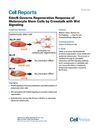
April 2016 in “Cell Reports” This study demonstrated that EdnrB signaling promotes melanocyte stem cell proliferation and differentiation, enhancing hair and epidermal melanocyte regeneration, especially under conditions of active Wnt signaling.
 3 citations
,
June 2021 in “PLOS ONE”
3 citations
,
June 2021 in “PLOS ONE” This study found that topical application of the BRAF inhibitor vemurafenib improved wound healing and promoted hair follicle regeneration in a diabetic murine model.
11 citations
,
June 2023 in “Journal of Cellular Biochemistry” This study suggests that BRAF inhibitors, particularly Encorafenib and Dabrafenib, may have potential applications in wound healing by targeting specific proteins involved in the healing process in murine models.
 65 citations
,
June 2003 in “EMBO journal”
65 citations
,
June 2003 in “EMBO journal” This study reports that overexpressing the BMP antagonist noggin in mice inhibits eyelid opening by reducing apoptosis and delaying cell differentiation in the eyelid epithelium.