 February 2021 in “IP Indian journal of clinical and experimental dermatology”
 This report presents a rare case of trichoadenoma occurring in the vulva, adding to the limited instances documented in medical literature.
22 citations
,
February 2000 in “Journal of the American Academy of Dermatology” Eosinophils are not a reliable marker for diagnosing alopecia areata.
4 citations
,
December 2017 in “Journal of zoo and wildlife medicine” This study proposes that seasonal alopecia and reproductive changes in six female fossas at the San Diego Zoo may be linked to hormonal changes associated with reproductive activity.
6 citations
,
January 2011 in “European Journal of Dermatology” This article discusses monilethrix, a rare human hair dysplasia caused by mutations in hair keratins, but reports no new clinical findings.
February 2024 in “Therya notes” In this case report, researchers documented the first instance of alopecia in a bat from Veracruz, México, specifically in an individual of Artibeus jamaicensis, likely caused by a thoracic injury leading to an infection.
June 2011 in “European Journal of Pediatric Dermatology” This study diagnosed an 11-year-old girl with initial androgenetic alopecia and monilethrix after observing unique hair shaft abnormalities and skin conditions, unlike her affected parents.
1 citations
,
January 2008 29 citations
,
February 1989 in “Journal of Cutaneous Pathology” This case report identifies a new type of hair matrix tumor called "rippled pattern trichomatricoma," distinguished by its unique cell arrangement and differentiation features.
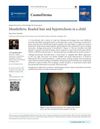 January 2026 in “Cosmoderma”
 In this clinical case study, a 9-year-old girl was diagnosed with monilethrix, a hereditary hair shaft disorder characterized by weak, beaded hair, with management focusing on minimizing hair trauma.
35 citations
,
May 2006 in “Journal of Investigative Dermatology” Monilethrix involves multiple genes affecting hair structure, including DSG4 mutations.
 29 citations
,
January 2003 in “Dermatology”
29 citations
,
January 2003 in “Dermatology” This study suggests a new subtype of alopecia, termed 'acute diffuse and total alopecia of the female scalp' (ADTAFS), characterized by acute and total hair loss in women with a favorable recovery profile.
 January 2015 in “Turkiye Klinikleri Journal of Dermatology”
 This case report highlights a 34-year-old woman with traction alopecia, where diagnosis was clarified by the presence of peripilar keratin sheaths, a useful dermoscopic clue.
 June 2026 in “Institutional Repositories DataBase (IRDB)”
 Crickets have genetically controlled hair plates that help them sense and move their antennae.
3 citations
,
January 2021 in “Veterinary dermatology” This study describes a rare form of congenital alopecia in domestic short hair cats, characterized by hair shaft defects and follicular dystrophy similar to those seen in certain mutant mouse strains.
4 citations
,
October 2001 in “Mycoses” This case report describes a rare instance of dermatophytosis in a young cat caused by Microsporum gypseum, confirmed by molecular analyses to be Arthroderma gypseum.
May 2025 in “Apollo Medicine” This study found that trichoscopy can be a helpful, noninvasive tool for identifying specific patterns that correlate with the clinical activity and severity of alopecia areata, enhancing its diagnosis and monitoring.
January 2022 in “Clinical Cases in Dermatology” This review discusses prevention, diagnosis, and treatment strategies for traction alopecia but presents no new clinical findings; the authors emphasize early intervention to prevent permanent hair loss.
1 citations
,
April 2018 in “Journal of Investigative Dermatology” The Trichodysplasia spinulosa virus protein can cause abnormal hair growth in mice.
5 citations
,
June 1993 in “Pediatric dermatology” Monilethrix Syndrome causes fragile, beaded hair that breaks easily and needs early diagnosis for better care.
September 2021 in “CRC Press eBooks” This article discusses trichotillomania and trichoteiromania, focusing on their clinical presentation, main trichoscopic features, and similarities in hair loss patterns but reports no new research findings.
January 2025 in “Dermatology Online Journal” The man's hair loss and skin papules were diagnosed as atrichia with papular lesions, not alopecia areata universalis.
21 citations
,
January 2010 in “International journal of trichology” This report on two Indian male siblings with monilethrix highlights trichoscopy's role in diagnosing this condition, which can be complicated by early-onset androgenetic alopecia.
3 citations
,
March 2021 in “Indonesia Medicus Veterinus” This case report describes successful treatment of anaplasmosis in a Kintamani mix dog with doxycycline, ivermectin, vetadryl, and Livron b-plex, leading to improved activity, hair growth, appetite, and tick eradication.
33 citations
,
March 1996 in “Veterinary Quarterly” This report describes effective treatment of demodicosis in ferrets using amitraz, marking the first known cases in this species.
 60 citations
,
August 2008 in “Human molecular genetics online/Human molecular genetics”
60 citations
,
August 2008 in “Human molecular genetics online/Human molecular genetics” This study suggests that a position effect disrupting TRPS1 expression may be linked to hypertrichosis in both Ambras syndrome in humans and a similar phenotype in Koa mice.
19 citations
,
July 1997 in “British Journal of Dermatology” This study successfully developed and characterized a monospecific monoclonal antibody, LHTric-1, that specifically localizes to the pre-cortical region of the hair follicle and can aid research on hair and nail formation.
3 citations
,
January 2017 in “Dermatology online journal” This case report describes the diagnosis of monilethrix in a 2-year-old boy using trichoscopy, highlighting its rarity and the challenge of diagnosing it without a family history.
 19 citations
,
October 2009 in “Bioorganic & Medicinal Chemistry Letters”
19 citations
,
October 2009 in “Bioorganic & Medicinal Chemistry Letters” This study found that a thyroid hormone receptor ẞ subtype-selective thyromimetic was effective in promoting hair growth in mouse and monkey models when applied topically.
1 citations
,
January 2018 in “Journal of Cosmetics Dermatological Sciences and Applications” This study observed that a targetoid polycyclic concentric hair regrowth pattern appeared in some male patients with alopecia areata following treatment, indicating a positive sign of recovery despite unclear etiopathogenesis.
April 2023 in “Journal of Investigative Dermatology” Trichohyalin in hair can trigger immune attacks in alopecia areata.