 11 citations
,
April 2015 in “International Journal of Cosmetic Science”
11 citations
,
April 2015 in “International Journal of Cosmetic Science” This study found that topical adenosine significantly increased the ratio of thick hairs and contributed to global improvement in Japanese men with androgenetic alopecia compared to niacinamide, with no observed adverse events.
January 2023 in “The Egyptian Journal of Hospital Medicine” This review discusses the use of dutasteride for treating androgenetic alopecia and reports no new clinical results.
 2 citations
,
January 2018 in “Annals of Dermatology”
2 citations
,
January 2018 in “Annals of Dermatology” This review discusses the potential association between androgenetic alopecia and metabolic syndrome, and notes AGA might be linked to arterial stiffness; it reports no new clinical findings and calls for further research.
 62 citations
,
January 2003 in “Dermatology”
62 citations
,
January 2003 in “Dermatology” This review suggests that androgenetic alopecia may be exacerbated by exposure to ultraviolet radiation and proposes considering it as a photoaggravated condition requiring photoprotection.
24 citations
,
February 2011 in “The American journal of pathology” This study found that AIRE, a usually nuclear protein, is expressed in the cytoplasm of human epidermal and follicular keratinocytes and associates with the intermediate filament protein cytokeratin 17, potentially impacting ectodermal abnormalities in APECED syndrome.
 September 2025 in “International Journal For Multidisciplinary Research”
 This study observed that patients with androgenetic alopecia in a western Indian population had a significantly higher prevalence of metabolic syndrome compared to a matched control group, suggesting that individuals with this type of hair loss may benefit from screening for metabolic syndrome.
 July 2021 in “Journal of Dermatology and Dermatologic Surgery”
 This study suggests an association between metabolic syndrome and androgenic alopecia severity, though this association was not statistically significant.
 September 2021 in “CRC Press eBooks”
 This article discusses alopecia areata incognito, highlighting its diffuse hair loss pattern and favorable response to steroid treatment, but it reports no new clinical data.
September 2022 in “Dermatology and therapy” This review discusses the pathological factors and comorbidities associated with androgenetic alopecia and reports no new clinical results, emphasizing the need for improved understanding and treatment in clinical practice.
 1 citations
,
April 2020 in “Magnetic Resonance in Medical Sciences”
1 citations
,
April 2020 in “Magnetic Resonance in Medical Sciences” This study aimed to determine if MRI can assess anatomical changes in the scalp caused by androgenetic alopecia, but it reports no new clinical results.
 157 citations
,
July 2001 in “British Journal of Dermatology”
157 citations
,
July 2001 in “British Journal of Dermatology” In this study, the prevalence of androgenetic alopecia among Korean men and women was found to be lower than in caucasians, with Korean men showing more frontal hairline preservation and a higher incidence of 'female pattern' hair thinning.
 14 citations
,
March 2014 in “Journal of The European Academy of Dermatology and Venereology”
14 citations
,
March 2014 in “Journal of The European Academy of Dermatology and Venereology” This study found that androgenetic alopecia in asymptomatic young men was associated with increased arterial stiffness, as measured by the cardio-ankle vascular index.
 September 2025 in “Journal of Cutaneous Medicine and Surgery”
 This expert panel review developed consensus recommendations for managing androgenetic alopecia in Canadian adults, endorsing seven interventions like oral and topical medications and platelet-rich plasma.
 June 2023 in “Skin Research and Technology”
 In this study, researchers used high-resolution MRI to distinguish anatomical differences in the scalp and hair follicles between tertiary androgenetic alopecia and severe alopecia areata, identifying subcutaneous tissue layer thickness as a key discriminative factor with high diagnostic value.
 1 citations
,
May 2013 in “Journal of the Egyptian Women's Dermatologic Society (Print)”
1 citations
,
May 2013 in “Journal of the Egyptian Women's Dermatologic Society (Print)” In this study, women with androgenetic alopecia showed higher cholesterol levels and carotid artery thickness, suggesting a potential link between female AGA and cardiovascular disease.
1 citations
,
March 2022 in “Irish Journal of Medical Science” This study suggests that the Gabrin sign and hypertension in male patients are associated with a worse prognosis for COVID-19.
 December 2024 in “Indian Journal of Dermatology Venereology and Leprology”
 Atypical male hair loss may not respond to usual treatments.
 March 2024 in “International journal of pharmaceutical sciences and drug research”
 In this review, the authors explored current and novel treatment options for androgenetic alopecia, noting both FDA-approved pharmacologic treatments like Minoxidil and Finasteride and various non-pharmacologic and surgical methods, including hair transplantation and scalp micro-pigmentation.
 1 citations
,
May 2012 in “Hair transplant forum international”
1 citations
,
May 2012 in “Hair transplant forum international” This article reviews the genetic and androgenic factors influencing the development of androgenetic alopecia and reports no new findings; the authors highlight a need for further research into the underlying mechanisms.
October 2018 in “International Journal of Research in Dermatology” In this study, androgenetic alopecia patients had a significantly higher prevalence of metabolic syndrome and related metabolic disorders compared to those without the condition.
 31 citations
,
October 2010 in “Journal of the European Academy of Dermatology and Venereology”
31 citations
,
October 2010 in “Journal of the European Academy of Dermatology and Venereology” The authors concluded that some patients clinically diagnosed with telogen effluvium may actually have alopecia areata incognita, suggested by the presence of dystrophic hairs and development of alopecia patches.
 July 2019 in “Journal of Investigative Dermatology”
 This article previews a Journal of Investigative Dermatology quiz on diagnosing male androgenetic alopecia and offers no new research results.
 February 2021 in “Journal of The American Academy of Dermatology”
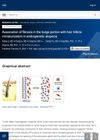
 This study observed that fibrosis occurs in the bulge region of hair follicles affected by androgenetic alopecia and is correlated with the hair miniaturization process.
November 2025 in “ACS Omega” This study found that compounds from *Tectona grandis* leaves showed moderate inhibition of steroid 5α-reductase, a factor in androgenetic alopecia, and exhibited anti-inflammatory properties by inhibiting nitric oxide and pro-inflammatory cytokines IL-1β and IL-6 in vitro, suggesting potential dual-action benefits for AGA management.
This review discusses the genetic and hormonal factors involved in androgenetic alopecia but reports no new research findings.
 7 citations
,
March 2020 in “Lasers in Medical Science”
7 citations
,
March 2020 in “Lasers in Medical Science” LLLT is a safe, promising hair loss treatment, but more research needed.
 October 2012 in “Faculty Opinions – Post-Publication Peer Review of the Biomedical Literature”
 Six new genes linked to early hair loss were found, which also surprisingly connect to Parkinson's disease and lower fertility.
 2 citations
,
June 2020 in “Skin Research and Technology”
2 citations
,
June 2020 in “Skin Research and Technology” This study found that scalp thickness and hair follicle depth were reduced in individuals with androgenetic alopecia, and MRI signal intensity was higher compared to those without the condition.
 March 2012 in “Faculty Opinions – Post-Publication Peer Review of the Biomedical Literature”
 Hair loss can be an early sign of prostate enlargement.
 47 citations
,
December 2000 in “Archives of Dermatological Research”
47 citations
,
December 2000 in “Archives of Dermatological Research” This study found that women with androgenetic alopecia showed higher levels of certain hormones and lower levels of sex hormone-binding globulin than healthy controls, potentially linking these factors to alopecia severity.