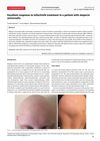
July 2024 in “Journal of Controlled Release” In this study, researchers developed topical tofacitinib-loaded cationic lipid nanoparticles, which improved absorption and targeted hair follicles in an ex vivo pig ear model, showing promise in treating alopecia areata by reducing symptoms through the JAK/STAT pathway.
 May 2024 in “Journal of cosmetic dermatology”
 In this retrospective study, oral tofacitinib treatment for at least 6 months improved scalp hair loss in 69.1% of alopecia areata patients, with patchy AA cases responding better compared to other subtypes, and no significant adverse effects were reported.
 2 citations
,
November 2023 in “Acta dermato-venereologica”
2 citations
,
November 2023 in “Acta dermato-venereologica” This study involving 126 patients found that tofacitinib has high effectiveness and an acceptable safety profile for treating alopecia areata, with a 33.8% complete response rate at 24 weeks and sex as an independent risk factor for outcomes.
5 citations
,
October 2022 in “British Journal of Dermatology” This study reports that two phase III trials demonstrated the effectiveness of the oral Janus kinase inhibitor baricitinib at 2 mg or 4 mg daily for treating severe alopecia areata in adults, marking a potential advance in managing this condition.
 3 citations
,
September 2022 in “Journal of Drug Delivery Science and Technology”
3 citations
,
September 2022 in “Journal of Drug Delivery Science and Technology” This study reported that encapsulating minoxidil in transferosomes and transethosomes can enhance skin permeability and drug retention compared to its conventional formulation, potentially increasing efficacy in androgenic alopecia treatment while reducing side effects, especially when transethosomes contain oleic acid.
24 citations
,
August 2022 in “International Journal of Pharmaceutics” Glycyrrhizin nanocarriers effectively deliver baicalin to hair follicles, promoting hair growth and offering a promising alopecia treatment with fewer side effects.
 8 citations
,
June 2022 in “Frontiers in Medicine”
8 citations
,
June 2022 in “Frontiers in Medicine” This study found that tofacitinib is an effective and more tolerable treatment than systemic corticosteroids for moderate-to-severe alopecia areata, and its combination with corticosteroids may offer improved efficacy.
14 citations
,
July 2021 in “Anais brasileiros de dermatologia/Anais Brasileiros de Dermatologia” This study found that alopecia areata patients had higher baseline interleukin levels, which significantly decreased with tofacitinib treatment, though this change did not correspond to disease severity improvement.
365 citations
,
March 2021 in “Frontiers in Bioengineering and Biotechnology” This review discusses the potential of nanocarriers to enhance transdermal drug delivery and the combination of these carriers with physical methods, but it reports no new experimental results.
February 2020 in “Zagazig University Medical Journal” In this study, 40 alopecia areata patients applied a combination of adapalene gel and mometasone furoate cream for 6 months, leading to 35% achieving full hair regrowth, though 85% experienced mild side effects like irritation.
 27 citations
,
September 2018 in “Medicines”
27 citations
,
September 2018 in “Medicines” This study reported that oleic acid-based nanovesicles improve follicular delivery and reduce side effects of minoxidil compared to traditional MXD lotions.
 223 citations
,
September 2018 in “Rheumatology”
223 citations
,
September 2018 in “Rheumatology” This review examines clinical data on the efficacy and safety of JAK inhibitors used for immune-mediated conditions beyond rheumatoid arthritis, highlighting their potential therapeutic roles in various inflammatory diseases.
1 citations
,
January 2018 in “Springer eBooks” The book helps doctors understand and treat alopecia areata.
 102 citations
,
December 2017 in “The journal of investigative dermatology. Symposium proceedings/The Journal of investigative dermatology symposium proceedings”
102 citations
,
December 2017 in “The journal of investigative dermatology. Symposium proceedings/The Journal of investigative dermatology symposium proceedings” This review discusses the role of immune privilege collapse in the pathogenesis of alopecia areata, emphasizing the potential for therapeutic manipulation of hair bulb immune privilege to offer new treatment options, and reports no new results.
 48 citations
,
November 2017 in “Journal of the American Academy of Dermatology”
48 citations
,
November 2017 in “Journal of the American Academy of Dermatology” Tofacitinib 2% ointment helped hair regrow in 3 out of 10 patients with alopecia areata, but caused side effects like scalp irritation and raised cholesterol in some.
 78 citations
,
March 2017 in “JAMA Dermatology”
78 citations
,
March 2017 in “JAMA Dermatology” Tofacitinib helped regrow hair in people with severe alopecia, but side effects occurred and benefits stopped after treatment ended.
March 2017 in “Current dermatology reports” Topical JAK inhibitors can effectively treat alopecia areata and vitiligo by modulating immune responses.
355 citations
,
January 2017 in “Journal of the American Academy of Dermatology” This review reports no new results and highlights existing research suggesting JAK inhibitors may be effective in treating inflammatory skin conditions like alopecia areata, atopic dermatitis, psoriasis, and vitiligo.
 222 citations
,
September 2016 in “JCI insight”
222 citations
,
September 2016 in “JCI insight” This research overview highlights that although JAK inhibitors show promise as potential treatments for alopecia areata based on recent insights into the disease mechanism, their efficacy has not yet been thoroughly evaluated in a systematic manner.
95 citations
,
July 2015 in “European journal of pharmaceutics and biopharmaceutics” This review discusses the application of lipid nanoparticles for enhancing drug delivery through hair follicles and reports no new clinical results, emphasizing the potential role of sebum-like lipids in this context.
 94 citations
,
September 2014 in “Therapeutic Delivery”
94 citations
,
September 2014 in “Therapeutic Delivery” This review describes recent advances in using nanoparticles for drug delivery to hair follicles, with potential applications in treating skin diseases such as alopecia and acne, but reports no new findings.