2 citations
,
January 2017 in “Indian Dermatology Online Journal” This case report describes a rare instance of dermographic urticaria triggered by an 810 nm diode laser for hair removal, with symptoms managed effectively by pre-treatment with levocetirizine.
 8 citations
,
July 1990 in “Archives of Dermatology”
8 citations
,
July 1990 in “Archives of Dermatology” This case report details a fixed-drug eruption in a woman linked to the use of dextromethorphan, marking it as a previously unreported skin reaction to this medication.
 9 citations
,
April 2016 in “Australasian journal of dermatology”
9 citations
,
April 2016 in “Australasian journal of dermatology” This study suggests that adding imiquimod to diphenylcyclopropenone treatment significantly improves outcomes for alopecia areata patients who initially do not respond to diphenylcyclopropenone alone.
65 citations
,
May 2006 in “Journal of Investigative Dermatology” This study found that dexamethasone significantly reduced ERα mRNA levels and increased aromatase mRNA and activity in cultured human hair follicle dermal papilla cells, suggesting a glucocorticoid-dependent mechanism for estradiol action.
1 citations
,
May 2022 in “European Journal of Dermatology” This study found that while no predictive factors for response to vismodegib were identified, longer treatment duration was associated with a lower risk of relapse in basal cell carcinoma patients.
 4 citations
,
January 2009 in “Indian Journal of Dermatology, Venereology and Leprology”
4 citations
,
January 2009 in “Indian Journal of Dermatology, Venereology and Leprology” This archived website overview discusses Bioline International's role in reducing the knowledge gap by hosting peer-reviewed journals from developing countries but presents no new research findings.
2 citations
,
May 2024 in “International Journal of Medical Arts” This study found that topical DPCP was more effective for hair regrowth in resistant alopecia areata compared to anthralin, with both treatments having similar safety profiles.
1 citations
,
January 2017 in “International journal of trichology” This case report suggests that topical diphenylcyclopropenone (DPCP) may be beneficial for treating both alopecia areata and verruca vulgaris, although it is not typically a first-line therapy.
 January 2026 in “Zenodo (CERN European Organization for Nuclear Research)”
 This paper discusses ethosomal drug delivery systems, highlighting their improved ability to enhance skin penetration and increase therapeutic effectiveness in treatments like acyclovir for herpes labialis and minoxidil for androgenic alopecia compared to standard formulations.
June 2017 in “Journal of the American Academy of Dermatology” The new cream is safe and effective for mild to moderate atopic dermatitis.
 June 2026 in “International Journal of Innovative Technologies in Social Science”
 This source describes clascoterone, a new topical treatment for acne vulgaris that blocks androgen receptors to reduce sebaceous gland activity and inflammation, offering a lower risk of systemic side effects compared to oral treatments.
 August 2023 in “European journal of dermatology/EJD. European journal of dermatology”
 This study reported that therapeutic make-up significantly improves the long-term quality of life for patients with facial dermatoses, showing a sustained benefit one year after application, particularly in younger patients.
36 citations
,
May 2005 in “BMC dermatology” This study found that topical diphenylcyclopropenone was effective in treating severe alopecia areata but had a high relapse rate and was often accompanied by side effects like eczema and lymphadenopathy.
20 citations
,
December 2006 in “Archives of dermatology” 9 citations
,
March 2008 in “British Journal of Dermatology” This article describes a case of hypertrichosis potentially induced by using efalizumab but provides no new clinical study results.
 23 citations
,
July 2008 in “British journal of dermatology/British journal of dermatology, Supplement”
23 citations
,
July 2008 in “British journal of dermatology/British journal of dermatology, Supplement” This review discusses the use of contact sensitizers for topical immunotherapy in dermatological conditions such as alopecia areata and viral warts, but it reports no new clinical findings.
November 2024 in “Journal of Investigative Dermatology” Bimekizumab quickly improves psoriasis symptoms and skin at the molecular level.
 34 citations
,
October 2024 in “Clinical Cosmetic and Investigational Dermatology”
34 citations
,
October 2024 in “Clinical Cosmetic and Investigational Dermatology” This review discusses azelaic acid's mechanisms and uses in dermatology, noting its effectiveness in treating conditions like rosacea, acne, and melasma, but reports no new clinical results.
18 citations
,
September 1979 in “DMW - Deutsche Medizinische Wochenschrift” In this study, Diane was reported to effectively treat acne, seborrhoea, androgenic alopecia, and mild hirsutism in hirsute women, with its effectiveness influenced by the severity and duration of the condition.
 7 citations
,
July 1990 in “Journal of the American Academy of Dermatology”
7 citations
,
July 1990 in “Journal of the American Academy of Dermatology” This case report describes a patient who developed severe alopecia and a rash after increasing captopril dosage, which resolved upon discontinuing the medication.
3 citations
,
February 2023 in “Journal of Investigative Dermatology” Ch55 may help reduce skin scarring and fibrosis.
February 2022 in “Institutional Repositories DataBase (IRDB)” This case study describes a unique instance of unilateral steroid-induced rosacea-like dermatitis likely due to long-term localized use of topical corticosteroids, emphasizing the need for careful application and thorough histopathological analysis.
 September 2009 in “Annales D Endocrinologie”
 This article reviews the clinical signs, diagnostic approaches, and treatment options for hyperandrogenism in women, focusing on hirsutism and specifies that cyproterone acetate is effective for severe cases, but reports no new clinical results.
In this laboratory study, researchers developed and tested two in vitro models to simulate atopic dermatitis using HaCaT cells, finding that azithromycin displayed epithelial-strengthening properties in one model, potentially offering insights for future research on skin disease interventions.
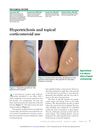 February 2022 in “Cleveland Clinic Journal of Medicine”
 This case report observed hypertrichosis on the left forearm of an 80-year-old woman, possibly linked to her previous use of the topical steroid betamethasone butyrate propionate for dermatitis.
 3 citations
,
September 2020
3 citations
,
September 2020 This study found that the medication dyclonine has a potent inhibitory effect on the TRPV3 channel, effectively rescuing cell death and alleviating pruritus symptoms in a mouse model with gain-of-function TRPV3 mutations, suggesting potential for treating skin inflammation.
10 citations
,
April 1964 in “Journal of the American Geriatrics Society” This article reviews triamcinolone acetonide as an intramuscular long-acting steroid therapy for dermatologic disorders but reports no new clinical results.
November 2025 in “Journal of Investigative Dermatology” Dithranol reduces inflammation in alopecia areata by lowering certain immune responses.
 17 citations
,
January 2009 in “Nippon Ishinkin Gakkai Zasshi”
17 citations
,
January 2009 in “Nippon Ishinkin Gakkai Zasshi” This case report details a 10-year-old boy diagnosed with kerion celsi caused by Microsporum gypseum, successfully treated with itraconazole over 4.5 months.
September 2026 in “Portuguese Journal of Dermatology and Venereology” In this review, the researchers discuss the potential effectiveness of azelaic acid peels for treating acne vulgaris, melasma, and other skin conditions, while acknowledging that the precise role of these peels in dermatology is not yet fully established due to limited studies.