 4 citations
,
January 2016 in “Dermatology online journal”
4 citations
,
January 2016 in “Dermatology online journal” This report describes a case of acquired yellow hair discoloration in a 77-year-old woman, potentially caused by applying selenium sulfide after bacitracin zinc to her scalp.
This article reports on a rare case of hair yellowing induced by topical minoxidil use and discusses drug-induced hair color changes.
 3 citations
,
October 2021 in “Cureus”
3 citations
,
October 2021 in “Cureus” This review discusses yellow hair discoloration associated with smoking and systemic conditions, proposing smoking cessation or hair removal as management options, but provides no new clinical results.
 18 citations
,
July 2001 in “Australian veterinary journal”
18 citations
,
July 2001 in “Australian veterinary journal” This case study describes a cat with concurrent cutaneous xanthomas, demodicosis, and dermatophytosis, which suggests potential primary hyperlipidaemia as the underlying cause for its symptoms.
 1 citations
,
November 2019 in “International Journal of Women's Dermatology”
1 citations
,
November 2019 in “International Journal of Women's Dermatology” Ketoconazole shampoo can cause rare pink hair discoloration.
5 citations
,
July 1996 in “Journal of Cutaneous Medicine and Surgery” This study explains that while trichothiodystrophy and xeroderma pigmentosum share genetic defects, TTD patients primarily exhibit issues in transcription initiation, not the increased skin cancer risk seen in XP.
27 citations
,
December 1999 in “American Journal of Dermatopathology” This case report presents a patient with necrobiosis lipoidica exhibiting transepithelial elimination of cholesterol crystals through hair follicles, a finding previously associated with necrobiotic xanthogranuloma.
 May 2024 in “Australasian journal of dermatology”
 This study reports on a unique clinical presentation of folliculotropic mycosis fungoides in a 60-year-old man, highlighting complexities in diagnosis due to dense histiocytic infiltration, which led to xanthoma formation before treatment, and obscured lymphomatous features.
7 citations
,
March 2004 in “Journal of the American Academy of Dermatology” Tiger tail banding and hair abnormalities are reliable indicators for diagnosing trichothiodystrophy.
 April 2024 in “Acta scientific dental sciences”
 This case study describes a 45-year-old male with black hairy tongue who experienced complete resolution of tongue discoloration and improved halitosis after receiving treatment focused on enhanced oral hygiene, tongue brushing, and smoking cessation.
January 2011 in “대한피부과학회지” This article reports a case of trichothiodystrophy in a 7-year-old girl with sulfur deficiency in her hair, characterized by sparse, slow-growing hair and distinctive tiger tail banding under microscopy.
1 citations
,
January 2008  July 1989 in “British Journal of Dermatology”
 Long-term use of canthaxanthin may cause reversible changes in the eye, including crystal deposits and altered vision responses.
September 2025 in “BioMed” In this case report and literature review, researchers observed that black hairy tongue syndrome can be improved by dietary restrictions and local care, identifying factors like antibiotics, malignancies, and certain medications as common triggers, with resolution achieved by eliminating these factors when possible.
4 citations
,
January 2015 in “Dermatology Online Journal” This study highlights that smoker's mustache, a tobacco-related hair discoloration on the upper lip, is asymptomatic, generally unnoticed, and may resolve if smoking is discontinued, though patients often continue smoking.
8 citations
,
January 2014 in “Indian Dermatology Online Journal” This article presents a case of trichostasis spinulosa, a common but often unrecognized disorder, diagnosed through dermoscopic examination of black macules revealing bundled vellus hairs, with the patient declining treatment.
4 citations
,
November 1999 in “PubMed” This article presents five family cases of monilethrix and reports that neither vitamins nor desquamative ointments are effective treatments, although symptoms may spontaneously regress over time.
6 citations
,
January 2011 in “European Journal of Dermatology” This article discusses monilethrix, a rare human hair dysplasia caused by mutations in hair keratins, but reports no new clinical findings.
 December 2025 in “Dermatology Reports”
 This source describes vitiligo as a chronic condition marked by the loss of skin pigmentation and discusses leukotrichia, a feature affecting 10% to 60% of cases, which arises from melanocyte loss in hair follicles and appears as well-defined white patches on the skin.
 3 citations
,
January 2019 in “Annals of Dermatology”
3 citations
,
January 2019 in “Annals of Dermatology” The study concluded that careful examination is key to differentiate between lipidized fibrous histiocytoma and juvenile xanthogranuloma.
January 2011 in “Linchuang pifuke zazhi” April 2026 in “Spectrochimica Acta Part A Molecular and Biomolecular Spectroscopy”  April 2017 in “Journal of Investigative Dermatology”
 In this study, deep phenotyping of 68 patients with XPD gene defects successfully separated individuals by clinical diagnosis and survival status, potentially improving diagnosis and prognosis for xeroderma pigmentosum and trichothiodystrophy.
 January 2008 in “Pratique médicale & chirurgicale de l'animal de compagnie”
 This review discusses the controversial non-inflammatory alopecia known as alopecia X, highlighting its unknown etiology and the variable effectiveness of various proposed treatments, but reports no new results.
 13 citations
,
January 2009 in “The Open Dermatology Journal”
13 citations
,
January 2009 in “The Open Dermatology Journal” This article describes a case of oral pigmentation that posed a diagnostic challenge in determining Addison’s disease and includes a brief review, reporting no new clinical results.
175 citations
,
December 1980 in “Archives of Dermatology” In this study, researchers examined two new cases of trichothiodystrophy and observed that the condition is linked to decreased synthesis of high-sulfur matrix proteins in hair.
 November 2022 in “Journal of the Endocrine Society”
 This clinical case report identifies xanthomatous hypophysitis in a male patient, highlighting the mismatch between clinical symptoms and MRI findings, which led to a pituitary biopsy and accurate diagnosis instead of unnecessary surgery.
20 citations
,
February 2015 in “Anais brasileiros de dermatologia/Anais Brasileiros de Dermatologia” This case report describes a 6-year-old girl diagnosed with monilethrix despite no familial history and treated with a topical minoxidil trial.
 January 2026 in “Cosmoderma”
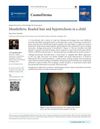
 In this clinical case study, a 9-year-old girl was diagnosed with monilethrix, a hereditary hair shaft disorder characterized by weak, beaded hair, with management focusing on minimizing hair trauma.
 216 citations
,
October 1997 in “American Journal of Ophthalmology”
216 citations
,
October 1997 in “American Journal of Ophthalmology” This study found that unilateral topical latanoprost use for glaucoma was associated with hypertrichosis and increased pigmentation of eyelashes in the treated eye compared to the untreated eye.