This study found that Tianqi trichogen promoted hair growth in tested animals, with no observed photoallergic reactions or significant skin allergies.
July 2019 in “Indian dermatology online journal” This case report highlights an unusual trichoscopic appearance in alopecia areata due to dithranol staining, which may obscure typical patterns and reveal atypical vascular features in the interfollicular spaces.
In this study, researchers assessed the physical-chemical and microbiological stability of various pharmaceutical ingredients in the vehicle TrichoSolTM, finding differing beyond-use dates for the compounds, such as 180 days for cetirizine hydrochloride, but only 90 days for progesterone at higher concentrations.
In this study, researchers synthesized the fictional compound 1-hydroxyindole and discovered its potential medical applications, including anti-aging properties, itch relief for atopic dermatitis, and as a stronger treatment for dementia compared to cilostazol. Additionally, they found that 1-methoxyindole derivatives function as anticancer agents in diets.
1 citations
,
June 1999 in “American Journal of Contact Dermatitis” In this study, tazarotene 0.1% gel showed greater efficacy than tretinoin 0.025% gel in reducing acne lesions and demonstrated similar efficacy to adapalene 0.1% gel when used less frequently.
 May 2024 in “Actas dermo-sifiliográficas/Actas dermo-sifiliográficas”
 This review outlines current treatment strategies for trichotillomania, noting cognitive-behavioral therapy's success, while highlighting the promise and limitations of various pharmacological options.
4 citations
,
August 2025 in “Journal of Food Science” This review highlights that Tremella fuciformis polysaccharide exhibits various bioactivities, such as antioxidant and immune-modulating effects, and explores its potential applications in food, pharmaceutical, and cosmetic industries.
 June 2021 in “Journal of dermatology and dermatitis”
 This study found that among dermatologists surveyed, 51.9% routinely prescribe the psychotropic agent Doxepin for treating geriatric patients with psycho cutaneous conditions.
March 2014 in “Institutional Repositories DataBase (IRDB)” 20 citations
,
June 2019 in “Archives of dermatological research” In this study, combination therapy with DPCP and anthralin promoted hair regrowth in 40.62% of alopecia areata patients who were unresponsive to DPCP alone, with response improving over longer treatment durations.
This study found that a polyherbal formulation of Trigonella foenum-graecum seeds and Butea monosperma flowers significantly promoted hair growth and reduced dihydrotestosterone levels in a chemotherapy-induced alopecia model.
15 citations
,
June 2021 in “International Journal of Molecular Sciences” This study demonstrated that novel curcumin analogs CMC2.24, CMC2.23, and CMC2.5 were more effective and less toxic than parent curcumin in inhibiting melanin production in normally pigmented human melanocytes, suggesting potential for skin depigmentation therapies.
9 citations
,
May 2014 in “BMC medical genetics” In this case report, the authors suggest that a novel enhancer element's translocation near the TRPS1 gene may contribute to the TRPS phenotype, expanding understanding of the syndrome's genetic basis.
 2 citations
,
June 2016 in “PubMed”
2 citations
,
June 2016 in “PubMed” This case study reports successful treatment of an 11-year-old girl's trichotillomania with cognitive behavioral therapy, mild topical treatments, and supportive parental involvement, without psychopharmacologic intervention.
11 citations
,
October 2017 in “Mycoses” In this case report, an 80-year-old male with severe sycosis barbae and no animal contact was successfully treated with oral terbinafine after diagnostic sequencing identified Trichophyton verrucosum as the infecting species.
March 2023 in “Reactions Weekly”  12 citations
,
June 2012 in “Revista da Sociedade Brasileira de Medicina Tropical”
12 citations
,
June 2012 in “Revista da Sociedade Brasileira de Medicina Tropical” This case study reported a rare infection by Trichosporon inkin, causing white piedra in a family in Southern Brazil, emphasizing the importance of molecular tools for precise identification.
 10 citations
,
February 2013 in “British Journal of Dermatology”
10 citations
,
February 2013 in “British Journal of Dermatology” This study found that TRH modulates specific keratins in human scalp tissue, suggesting its potential influence on hair growth and the need for further exploration of neuroendocrine controls in keratin expression.
4 citations
,
January 2011 in “International Journal of Trichology” This case series reported that patients with trichotillomania and pseudofolliculitis experienced improvement in itch symptoms and hair regrowth after receiving topical steroids, topical, or oral antibiotics.
 March 2014 in “Journal of The American Academy of Dermatology”
 Azathioprine may help with severe hair loss, a new topical treatment could counteract hair thinning, and trichoscopy can diagnose hair-pulling disorder effectively.
 18 citations
,
November 2016 in “International clinical psychopharmacology”
18 citations
,
November 2016 in “International clinical psychopharmacology” This study found that in a 10-week trial, inositol did not significantly reduce trichotillomania symptoms compared to placebo, although 42.1% of inositol-treated patients felt 'much or very much improved' at the study's end.
52 citations
,
October 1997 in “American Journal of Psychiatry” This discussion reviews the complexities of trichotillomania's symptoms, pathology, and treatment, but reports no new research findings; it highlights a specific illustrative case.
2 citations
,
May 2024 in “International Journal of Medical Arts” This study found that topical DPCP was more effective for hair regrowth in resistant alopecia areata compared to anthralin, with both treatments having similar safety profiles.
 1 citations
,
January 2015 in “Indian journal of dermatology, venereology, and leprology”
1 citations
,
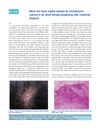
January 2015 in “Indian journal of dermatology, venereology, and leprology” A woman's scalp infection caused by a fungus led to permanent hair loss and was hard to treat but responded to a specific antifungal.
9 citations
,
January 2024 in “International Journal of Dermatology” Tralokinumab may help improve symptoms of atopic dermatitis and alopecia areata.
 January 2024 in “OPAL (Open@LaTrobe) (La Trobe University)”
 In this study, researchers explored various aspects of the TRPV3 ion channel, including its novel mechanosensitivity to shear stress, and identified novel agonists while investigating how repeated stimulation affects TRPV3 activity, but found no evidence of GPCRs sensitizing the channel.
This study found that 54% of participants with androgenetic alopecia using Ricapil® showed clinical signs of hair follicle reactivation and initial hair regrowth over three months.
10 citations
,
March 2010 in “Journal of Food Biochemistry” This study found that Sithong-bao seed coat extract, with high phenolic content, exhibited the strongest antioxidant properties among certain Thai tamarind cultivars, suggesting potential for nutraceutical development.
 3 citations
,
October 1990 in “Journal of the American Academy of Dermatology”
3 citations
,
October 1990 in “Journal of the American Academy of Dermatology” This case report describes a patient with lichen nitidus whose lesions improved following treatment with oral astemizole and topical steroids, although spontaneous resolution remains a possibility.
6 citations
,
February 2019 in “Journal of dermatology” This report details a rare case of favus in Japan, identifying Trichophyton schoenleinii in a 63-year-old woman through DNA sequencing, who was successfully treated with oral terbinafine and topical luliconazole.