September 2018 in “CRC Press eBooks” This review explores the trichoscopic features of dark scalp, particularly the brown honeycomb pigment network, and its variations in different types of alopecia, but it presents no new clinical findings.
 September 2025 in “Egyptian Journal of Dermatology and Venerology”
 This case study described the diagnosis of a trichofolliculoma in a 56-year-old woman, emphasizing its dermoscopic features and histological aspects that confirmed the tumor type, with no recurrence observed after excision.
8 citations
,
June 2010 in “Plastic & Reconstructive Surgery” This study found that complete surgical resection and multidisciplinary management were crucial for treating proliferating trichilemmal tumors, though malignant cases showed recurrence and mortality risks.
91 citations
,
December 2000 in “The journal of cell biology/The Journal of cell biology” This study reports that expressed mouse type Ia and type IIa trichocyte keratins were successfully assembled into intermediate filaments in vitro, while also suggesting that disulfide bond cross linking enhances their stability.
6 citations
,
March 2018 in “The American journal of dermatopathology/American journal of dermatopathology” This study found that immunohistochemistry can effectively distinguish between tricholemmoma and basal cell carcinoma, with BerEP4 and CD34 serving as key differentiators.
54 citations
,
September 1999 in “PubMed” This study suggests that immunostaining for Keratin 15 may be a useful tool for differentiating between basal cell carcinoma and trichoepithelioma.
116 citations
,
April 1986 in “The journal of cell biology/The Journal of cell biology” This study reports that a 190,000 molecular weight protein, identified as trichohyalin, may play a matrix role in the development of inner root sheaths in hair follicles.
 September 2016 in “Journal of The American Academy of Dermatology”
 This case study identified the condition as Monilethrix in a 17-year-old female, characterized by a beaded hair appearance and linked to a genetic cause.
1 citations
,
December 1997 in “Archives of dermatology” This report describes a case of trichostasis spinulosa, a condition with pruritic, black papules on the face caused by keratotic plugs with embedded vellus hairs.
 18 citations
,
July 2018 in “Skin appendage disorders”
18 citations
,
July 2018 in “Skin appendage disorders” This review discusses trichoscopic features of hair disorders in individuals with dark skin phototypes and reports no new clinical results; the authors emphasize the need for more specific diagnostic criteria for these populations.
27 citations
,
October 2002 in “International Journal of Dermatology” This study presents a microscopic analysis of the pruritic variant of trichostasis spinulosa in two patients and reviews existing literature, reporting no new clinical results.
86 citations
,
August 2000 in “Pigment cell research” This study observed that melanogenesis in human hair follicles is linked to anagen phases, with melanocyte activity and enzyme expression being region-specific to the nascent bulb.
1 citations
,
December 2022 in “Skin Appendage Disorders” This review highlights that trichofolliculomas can resemble certain skin cancers, emphasizing the importance of recognizing their clinical features to avoid unnecessary surgery; it reports no new clinical results.
8 citations
,
July 2004 in “Journal of morphology” This study explored the structure and keratin composition of marsupial hairs, finding similarities in keratin localization to hairs in placental mammals, and highlighting potential roles of trichohyalin and transglutaminase during hair development and shedding.
 May 2017 in “InTech eBooks”
 This article describes various hair and scalp examination techniques, including noninvasive, semi-invasive, and invasive methods, noting that trichoscopy is a simple, well-accepted, noninvasive technique for evaluating hair loss patients and monitoring treatment.
8 citations
,
January 2014 in “Indian Dermatology Online Journal” This article presents a case of trichostasis spinulosa, a common but often unrecognized disorder, diagnosed through dermoscopic examination of black macules revealing bundled vellus hairs, with the patient declining treatment.
December 2025 in “Y HOC TP HO CHI MINH” This study found that Trichoscope can effectively reveal clinical features of alopecia areata and androgenic alopecia, making it a useful tool for diagnosis and monitoring.
24 citations
,
June 2003 in “Journal of Structural Biology” This study suggests that varying intersheet interactions may explain the differences between the two polymorphic forms of macrofibril assembly in Merino wool and hair.
 6 citations
,
July 2015 in “International Journal of Dermatology”
6 citations
,
July 2015 in “International Journal of Dermatology” This study observed that multiple familial trichoepitheliomas commonly presented with a cribriform histopathological tumor pattern, differentiating them from solitary trichoepitheliomas.
April 2026 in “Spectrochimica Acta Part A Molecular and Biomolecular Spectroscopy”  1 citations
,
April 2015 in “Current problems in dermatology”
1 citations
,
April 2015 in “Current problems in dermatology” The document concludes that the trichogram is a useful tool for diagnosing hair loss and suggests semi-organ cultures for practical trichological research.
1 citations
,
January 2022 in “Anais brasileiros de dermatologia/Anais Brasileiros de Dermatologia” In this study, authors reported that reflectance confocal microscopy may aid in diagnosing trichofolliculoma by identifying specific features correlated with histopathology that can be difficult to discern with other methods.
 April 2019 in “Journal of Investigative Dermatology”
 This study reported that gain-of-function mutations in TRPV3 lead to hair loss in mice by disrupting inner root sheath keratinocyte differentiation, ultimately causing follicular keratinocyte stem cell exhaustion and permanent follicle disruption.
 3 citations
,
October 1990 in “Journal of the American Academy of Dermatology”
3 citations
,
October 1990 in “Journal of the American Academy of Dermatology” This case report describes a patient with lichen nitidus whose lesions improved following treatment with oral astemizole and topical steroids, although spontaneous resolution remains a possibility.
 October 2023 in “Indian dermatology online journal”
 This report describes a case study of a 23-year-old female exhibiting multiple trichodiscomas, a type of benign tumor of the hair follicular discs common in familial cases and potentially linked to Birt-Hogg-Dube syndrome, though genetic testing was not performed due to financial constraints.
 131 citations
,
July 2009 in “Experimental Dermatology”
131 citations
,
July 2009 in “Experimental Dermatology” This review discusses the development and advances in studying trichogenic dermal cells for hair follicle morphogenesis, summarizing methods, bioassays, and molecular markers, but reports no new research findings.
 September 2022 in “bioRxiv (Cold Spring Harbor Laboratory)”
 This study applied a new RGB trichrome stain to human skin samples, revealing distinct structural staining in normal tissues and potential proteoglycan-rich zones in hair follicles.
 November 2023 in “International surgery journal”
 In this case study, a 69-year-old male with a neck swelling was diagnosed with a trichilemmal cyst, highlighting the importance of complete surgical excision for lesions with proliferative or malignant potential.
37 citations
,
April 1977 in “Journal of Cutaneous Pathology” This study found that specific histologic features in skin biopsies can help support a diagnosis of traumatic alopecia (trichotillomania), but not all markers are distinct to the condition.
 5 citations
,
January 2014 in “Journal of Cutaneous and Aesthetic Surgery”
5 citations
,
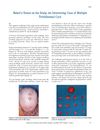
January 2014 in “Journal of Cutaneous and Aesthetic Surgery” A woman had 13 non-cancerous cysts on her scalp successfully removed in one surgery.