 16 citations
,
July 2015 in “Journal of Molecular Structure”
16 citations
,
July 2015 in “Journal of Molecular Structure” This study comprehensively compared different crystalline forms of finasteride, including the new finasteride DMF solvate hemihydrate, to better understand their structural characteristics and intermolecular interactions.
 1 citations
,
September 2023 in “Molecules (Basel. Online)”
1 citations
,
September 2023 in “Molecules (Basel. Online)” This source highlights that while plant sterols show potential benefits and applications in various industries, significant research gaps, including their complex structures and mechanisms, hinder their broader use, emphasizing the need for innovative sources and sustainable methods for their study.
 66 citations
,
February 2010 in “CrystEngComm”
66 citations
,
February 2010 in “CrystEngComm” Made 8 minoxidil samples; 1 cocrystal, 7 salts formed.
5 citations
,
January 2024 in “Crystals” This study characterized the crystal structures and supramolecular architectures of new salts made from 2,4-diaminopyrimidine and different dicarboxylic acids, revealing subtle differences in crystal packing and hydrogen-bonding patterns, particularly influenced by sulfur atom interactions, through Hirshfeld analysis and enrichment ratios.
January 2003 in “Dialnet (Universidad de la Rioja)” This study isolated highly pure oleanolic and maslinic acids from olive milling residues, exploring their chemical reactions, including the formation of finasteride precursors.
This chapter discusses phase transitions in various pharmaceutical examples and does not present any new research findings.
 19 citations
,
July 2006 in “Acta crystallographica”
19 citations
,
July 2006 in “Acta crystallographica” This study determined that previous reports mistakenly identified different polymorphs of furosemide and finasteride, which are actually identical, due to incomplete data collection in single-crystal X-ray diffraction analysis.

This article examines how digital technologies, drawing on Marshall McLuhan's concept of media as an "extension of man," transform design thinking by creating new possibilities without replacing it, emphasizing the need for a hybrid, reflective practice in design.

In this article, the author explores how digital technologies can expand the cognitive and creative capabilities of designers, noting that while technology transforms design thinking, it does not replace it but rather opens up new possibilities and requires a hybrid, reflective practice.
 47 citations
,
September 2015 in “Journal of Drug Delivery Science and Technology”
47 citations
,
September 2015 in “Journal of Drug Delivery Science and Technology” This article reviews various strategies, primarily developed by the Turin University Pharmaceutical Technology group, for increasing entrapment efficiency of hydrophilic molecules in nanoparticulate systems and reports no clinical results.
 41 citations
,
March 2007 in “Steroids”
41 citations
,
March 2007 in “Steroids” This article reviews recent advances in the synthesis of oxasteroids and reports no new experimental results.
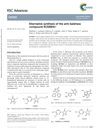 4 citations
,
January 2014 in “RSC Advances”
4 citations
,
January 2014 in “RSC Advances” A new, less toxic and more efficient method to create the anti-baldness compound RU58841 was developed in 2014.
 December 2025 in “npj Breast Cancer”
 In the phase 3 CAPItello-291 trial, capivasertib combined with fulvestrant significantly increased progression-free survival in patients with advanced breast cancer with specific genetic alterations, but the authors highlight that managing side effects like diarrhea, rash, and hyperglycemia is crucial for optimizing treatment adherence and outcomes.
 November 2016 in “Therapeutic Delivery”
 New drugs for Alzheimer's and rheumatoid arthritis advanced, a Zika vaccine is in development, and there were business deals in anesthesia and oncology.
 8 citations
,
February 2025 in “Swiss Medical Weekly”
8 citations
,
February 2025 in “Swiss Medical Weekly” This study observed that integrating best practices for anabolic androgenic steroid users into Swiss primary care is feasible and well-accepted, though current doping laws hinder adequate medical care for this population.
 1 citations
,
January 2018 in “International Journal of Web Based Communities”
1 citations
,
January 2018 in “International Journal of Web Based Communities” This study explored the motivations behind 'bro-science' YouTube videos on baldness, finding that posters aim to communicate product benefits, share research and experiences, and create a community around shared solutions.
 January 2026 in “Drug Delivery and Translational Research”
 This study investigated the integration of crystal engineering and microneedle technology for androgenetic alopecia treatment, finding that microneedles loaded with newly developed Kopexil multicomponent crystals reduced drug diffusion rates in vitro compared to standard formulations.
 April 2024 in “Journal of pharmacy & pharmacognosy research”
 This study used in silico analysis to identify 4-[2-(4-nitrophenyl)ethylcarbamoyl]benzenesulfonyl as a potential inhibitor of the EGFR mutant associated with NSCLC, highlighting the need for further in vitro and in vivo validation.
 January 2023 in “Austin Journal of Obstetrics and Gynecology”
 This study found that in a sample of girls and adolescents aged 15–24 years, the prevalence of PCOS was 22.5% according to the Rotterdam criteria.

This study identified a genetic locus associated with rhabdomyosarcoma susceptibility in mice and found that specific differentiation markers are linked to the regression of basal cell carcinoma.
August 2026 in “Ebers Papyrus” This study concluded that allele-specific PCR (AS-PCR) is more reliable than tetra-primer ARMS-PCR for genotyping the SNP rs1998076 due to better stability and interpretability.

This review explores the synthesis and potential of azasteroids as novel drugs, discussing challenges in their production and reporting no new clinical results.

This article discusses the issues with the name "polycystic ovary syndrome" and proposes a new naming system to better reflect the condition's complex hormonal and metabolic abnormalities.
 11 citations
,
April 2021 in “Advanced synthesis & catalysis”
11 citations
,
April 2021 in “Advanced synthesis & catalysis” This study reports that the dye peri-xanthenoxanthene (PXX) can act as an efficient photocatalyst for various radical reactions, including complex dual catalytic processes and the synthesis of an investigational drug intermediate.
1 citations
,
May 2025 in “Journal of the Indian Chemical Society” 5 citations
,
September 2023 in “Clinical Endocrinology” This study suggests revising PCOS diagnostic criteria to integrate the polymenorrhoea subcategory due to shared metabolic dysfunctions with oligomenorrhoea.
June 2026 in “ACS Applied Polymer Materials” This study reports a method for fabricating biofunctional polymer fibers by using DNA-programmable cell-free protein synthesis integrated through solution blow spinning, enabling in situ protein production and potential applications in respirators, sampling swabs, and other advanced materials.
February 2022 in “Journal of Innovative Science and Engineering (JISE)” This review discusses synthetic piezoelectric polymers within the smart polymer family, detailing their applications in various medical fields, but reports no new experimental results.
1 citations
,
November 2022 in “Diagnostics” This case report identifies a 32-year-old woman with undiagnosed PHPT-1a who exhibited complete pseudo-anodontia and persistent patchy alopecia areata, suggesting these may be new nonclassical features of a GNAS pathogenic variant.
May 2023 in “Pharmaceuticals” In this in silico study, researchers analyzed nonsynonymous SNPs in the LIPH gene linked to hypotrichosis and identified three potentially harmful variants (W108R, C246S, and H248N) out of 215 total, using sequence- and architecture-based bioinformatics techniques to differentiate between harmful and benign SNPs.