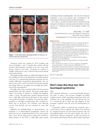
September 2022 in “Indian Journal of Paediatric Dermatology” This case report documents the first confirmed mutation-proved instance of Clouston syndrome in a large Chinese-Malaysian family, linked to the c.263C>T (A88V) mutation in the GJB6 gene, with no available treatment but highlighting the importance of genetic counseling.
 4 citations
,
February 2014 in “Journal of the European Academy of Dermatology and Venereology”
4 citations
,
February 2014 in “Journal of the European Academy of Dermatology and Venereology” Early diagnosis of hair tourniquet syndrome saved a baby's toe from being lost.
8 citations
,
December 1997 in “International Journal of Dermatology” This case report describes a 30-year-old man's scleroderma-like skin changes and segmental thrombosis in the left leg, along with elevated blood sugar and advised weight management and limb care.
September 2024 in “Clinical Case Reports” This case report highlights a rare presentation of APS-1 in a 28-year-old Pakistani male with cardiovascular and pulmonary symptoms, illustrating the importance of early recognition and multidisciplinary management for improved patient outcomes.
 4 citations
,
December 2013 in “The Journal of Dermatology”
4 citations
,
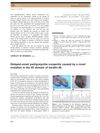
December 2013 in “The Journal of Dermatology” This letter to the editor discusses a case of delayed-onset pachyonychia congenita linked to a new mutation in keratin 6b but presents no new research findings.
10 citations
,
November 2018 in “The Italian Journal of Pediatrics/Italian journal of pediatrics” This case report identifies a mutation in the TRPS1 gene, leading to the diagnosis of trichorhinophalangeal syndrome type I in a young girl and her family, highlighting the importance of detailed clinical and family history for proper diagnosis.
This review discusses loose anagen hair syndrome in children, characterized by non-scarring alopecia and increased hair shedding, and reports no new results; topical minoxidil may be used as a treatment.
April 2016 in “Journal of the American Academy of Dermatology” A 4-year-old girl had a rare hair disorder affecting only part of her scalp.
30 citations
,
January 2013 in “Human Mutation” This study identified a homozygous frameshift mutation in the HOXC13 gene associated with pure hair and nail ectodermal dysplasia in a consanguineous Syrian family, suggesting crucial roles for HOXC13 in hair and nail development.
Low vitamin C caused bleeding and corkscrew hair, resolved with vitamin C treatment.
December 2010 in “Elsevier eBooks” This article discusses the clinical manifestations of systemic lupus erythematosus and their potential mechanisms, but reports no new experimental results.
September 2007 in “The American Journal of Gastroenterology” This case report describes a 37-year-old Filipino man with Cronkhite-Canada syndrome who improved after receiving nutritional support and medical treatment, despite the typically poor prognosis of the condition.

This study explored a mother and daughter with loose anagen hair syndrome linked to wooly hair, identifying an intronic variant in the KRT71 gene that affects hair keratin splicing, thus broadening the spectrum of KRT71-related disorders.
3 citations
,
February 2021 in “Pediatric rheumatology online journal” This case study described a 16-year-old girl with systemic lupus erythematosus and trisomy X, suggesting that these patients might be at higher risk for avascular necrosis and osteoporosis.
 260 citations
,
July 2010 in “Cell”
260 citations
,
July 2010 in “Cell” This study identifies mutations in the SRD5A3 gene as a cause of a new type of congenital disorder of glycosylation, impacting mental, ophthalmologic, and cerebellar functions.
33 citations
,
February 2011 in “International Journal of Dermatology” This study observed that orange spots and dystrophic hairs on trichoscopy may aid in diagnosing scalp sarcoidosis.
8 citations
,
July 2015 in “International Journal of Dermatology” This study reports that a homozygous A1103G mutation in DSG 4 is responsible for localized autosomal recessive hypotrichosis in a 2-year-old Chinese girl, resulting in reduced DSG 4 expression and hair defects.
2 citations
,
January 1989 This article discusses the history and understanding of Tay syndrome, recognizing it as a distinct condition related to ichthyotic erythroderma, mental retardation, and brittle hair but reports no new clinical results.
 21 citations
,
October 1980 in “Gastroenterology”
21 citations
,
October 1980 in “Gastroenterology” This report is the first to associate Cronkhite-Canada syndrome with multiple myeloma, describing regenerative pseudopolyps in a 58-year-old woman rather than true adenomatous polyps.
 1 citations
,
April 2016 in “Journal of The American Academy of Dermatology”
1 citations
,
April 2016 in “Journal of The American Academy of Dermatology” This study found that patients with androgenetic alopecia experienced more severe symptoms than those with alopecia areata, influencing their quality of life differently based on various patient characteristics.
 11 citations
,
January 2020 in “BMC pediatrics”
11 citations
,
January 2020 in “BMC pediatrics” This case report identified two new SLC39A4 mutations in twin patients with acrodermatitis enteropathica, suggesting that different mutations in this gene may lead to varying clinical manifestations of the disorder.
22 citations
,
July 2006 in “Annals of The Royal College of Surgeons of England” This case report aims to raise physician awareness about 'toe-tourniquet' syndrome, which can lead to digit loss if not promptly treated, and to prevent its misdiagnosis as child abuse.
September 2021 in “Pediatrics in review” This case study describes a 7-month-old boy diagnosed with keratitis-ichthyosis-deafness syndrome due to a de novo GJB2 gene mutation, highlighting the challenges in treatment and eventual fatal outcome due to severe complications.
12 citations
,
May 2006 in “Journal of Neurology Neurosurgery & Psychiatry” Neuromyotonia and morphoea can occur together in the same body areas.
 5 citations
,
May 2011 in “European Journal of Medical Genetics”
5 citations
,
May 2011 in “European Journal of Medical Genetics” This case report describes a 44-year-old patient with late-onset partial lipodystrophy, mental retardation, epilepsy, ichthyosis, and glomerulonephritis, linked to a 10 Mb duplication of chromosome region 5q31.3-5q32.1.
 January 2007 in “Revista del Centro Dermatológico Pascua”
 This case report describes a 2-year-old boy diagnosed with trichothiodystrophy, characterized by fragile hair, intellectual damage, diminished fertility, and short stature.
 12 citations
,
October 2016 in “Anais Brasileiros de Dermatologia”
12 citations
,
October 2016 in “Anais Brasileiros de Dermatologia” This review discusses the increasing reports of frontal fibrosing alopecia, a form of scarring alopecia, and its potential link to autoimmune disorders, but reports no new clinical results.
1 citations
,
November 2022 in “Diagnostics” This case report identifies a 32-year-old woman with undiagnosed PHPT-1a who exhibited complete pseudo-anodontia and persistent patchy alopecia areata, suggesting these may be new nonclassical features of a GNAS pathogenic variant.
 November 2025 in “Clinical Cosmetic and Investigational Dermatology”
 In this case study, a 46-year-old woman with tattoos and a history of hypothyroidism developed autoimmune-like symptoms, highlighting the importance of distinguishing ASIA syndrome from other immune disorders and assessing potential adjuvant exposure.
2 citations
,
May 2023 in “Indian Journal of Dermatology Venereology and Leprology” A new genetic mutation in the CAST gene may link PLACK syndrome to alopecia areata.