10 citations
,
November 2009 in “Pigment cell & melanoma research” This study by Pérez-Oliva et al. explored how Mahogunin Ring Finger-1 (MGRN1) affects melanocortin-1 receptor (MC1R) signaling, suggesting that MGRN1 competitively inhibits Gαs binding to MC1R, influencing pigment production.
![Synthesis and In Vitro Study of 17β-[N-Ureylene-N,N′-Disubstituted]-4-Methyl-4-Aza-5α-Androstan-3-Ones as Selective Inhibitors of Type I 5α-Reductase](/images/assets/d19df8a7-8de6-4430-8a0d-4ffa1f502985/small/15608.jpg) 5 citations
,
February 1997 in “Bioorganic & Medicinal Chemistry”
5 citations
,
February 1997 in “Bioorganic & Medicinal Chemistry” This study found that among 17 beta-(N-ureylene-N,N'-disubstituted)-4-azasteroids, those with an N'-phenyl moiety were the most effective inhibitors of human type I 5 alpha-reductase.
 4 citations
,
January 2014 in “RSC Advances”
4 citations
,
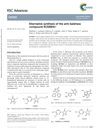
January 2014 in “RSC Advances” A new, less toxic and more efficient method to create the anti-baldness compound RU58841 was developed in 2014.
 2 citations
,
November 2022 in “IP Indian journal of clinical and experimental dermatology”
2 citations
,
November 2022 in “IP Indian journal of clinical and experimental dermatology” This study observed that specific dermoscopic features, such as altered pigmentary network and yeast invasion of hair follicles, along with certain histopathological features, assist in diagnosing pityriasis versicolor.
2 citations
,
May 2019 in “International Journal of Molecular Sciences” This study suggests that in gp91phox-knockout mice, tranexamic acid administration led to brown hair by increasing MGRN1 and collagen XVII levels, while the retention of black hair appears to rely on the gp91phox/ROS/IL-1β/TGF-β pathway.
March 2021 in “Research Square (Research Square)” This study analyzed the structure and dynamics of ketoconazole, revealing how its molecular characteristics, such as spin-lattice relaxation time and chemical shift anisotropy, are influenced by π-π stacking interactions and different carbon site environments.
 April 2012 in “KSBB Journal”
 This study suggests that specific structural features of minoxidil analogs, such as hydrophobic and hydrogen bond field contributions, are key to enhancing lysyl hydroxylase inhibitory activity, which could inform future hair growth treatments.
 August 2010 in “Springer eBooks”
 Hormonal contraceptives are effective for teens but require careful consideration of side effects and individual health.
 111 citations
,
August 2002 in “Journal of Medicinal Chemistry”
111 citations
,
August 2002 in “Journal of Medicinal Chemistry” This study reports that 2-(1-Adamantyl)-4H-thiochromen-4-on-6-O-sulfamate is the most potent steroid sulfatase inhibitor identified so far, exhibiting 170-fold higher activity than the lead compound estrone sulfamate.
 17 citations
,
May 1998 in “Steroids”
17 citations
,
May 1998 in “Steroids” This study constructed a model to predict finasteride's inhibitory activity on 5α-reductase type 2 and calculated that a 1 μM plasma concentration, after 50 mg administration, matches prostate inhibition levels.
 3 citations
,
June 2020 in “Developmental Cell”
3 citations
,
June 2020 in “Developmental Cell” This study observed that in chicken skin, large-scale differences in gene expression between feathered and scaly skin are controlled by enhancer-driven uniform expression, while small-scale differences within individual feathers are associated with chromatin looping.
1 citations
,
March 2024 in “Pediatric Dermatology” This research describes three neonatal cases of nasal tip injuries resembling hypoxic damage, which healed with significant scarring, and calls for further investigation into the condition's causes and treatment.

This report details a refined hair transplantation method called direct no-shave follicular unit excision (DNS FUE), which avoids donor-site shaving and minimizes follicular trauma while yielding high patient satisfaction.
 June 2025 in “Natural Product Communications”
 This study successfully synthesized novel cercidin analogues from Cercidophyllum japonicum, confirming their structure via NMR data. The researchers suggest these compounds could facilitate future antibiotic development by advancing structure-activity-relationship studies.
July 2014 in “Acupuncture & electro-therapeutics research” This study observed that certain changes in facial "heart representation areas," like eyebrow hair whitening and loss, are associated with cardiovascular issues and may correspond with increased Cardiac Troponin I levels.
 November 2025 in “Journal of Medicine and Health Technology”
 In this study, researchers found that none of the participants were color blind and reported varying lengths of index and ring fingers among them, exploring a possible link between these finger length ratios and sex-influenced gene expression.
 17 citations
,
February 2019 in “Journal of steroid biochemistry and molecular biology/The Journal of steroid biochemistry and molecular biology”
17 citations
,
February 2019 in “Journal of steroid biochemistry and molecular biology/The Journal of steroid biochemistry and molecular biology” This study found that manipulating AKR1D1 expression in human liver cells effectively regulates glucocorticoid clearance and receptor activation, highlighting its role in liver-specific steroid hormone regulation.
 3 citations
,
February 2019 in “Disease Markers”
3 citations
,
February 2019 in “Disease Markers” This study reports that a lower 2D:4D finger length ratio is significantly associated with higher disease activity and reduced spinal mobility in females with ankylosing spondylitis, but not in males.
January 2004 in “Zhōnghuá yàoxué zázhì” This study successfully synthesized finasteride using a method that avoids expensive reagents and column chromatography, achieving a higher yield than previously reported.

The document concludes that scientists created various steroids with different properties, including a more effective semi-synthetic vitamin D.
101 citations
,
April 2013 in “Science” This study describes how feather pigmentation in birds is regulated by melanocyte distribution, differentiation, and patterned agouti expression, contributing to diverse and adaptive color patterns.
31 citations
,
February 2007 in “Journal of Structural Biology” Oxidation changes the structure of hair protein filaments, causing them to compact and rearrange.
24 citations
,
July 2014 in “British Journal of Anaesthesia” Long surgeries can cause temporary hair loss due to pressure on the scalp.
23 citations
,
October 2007 in “International journal of cancer” This study reports that hair from women with breast cancer showed a unique X-ray diffraction feature, potentially offering a non-invasive method for detecting the disease.
8 citations
,
July 2002 in “X-Ray Spectrometry” In this study, researchers found a correlation between x-ray patterns and the element composition of human hair, with certain metal roles in the hair matrix considered.
5 citations
,
December 1996 in “Biochemical and Biophysical Research Communications” In this study, keratin genes mHa1 and mHb4 were unable to form an extensive keratin network in one cell line, altering endogenous keratin distribution, but showed better integration in another cell line.
3 citations
,
December 2017 in “Clinical and Experimental Dermatology” In this case study, researchers observed reversible scalp hair loss associated with centrifugal lipodystrophy, potentially linked to altered leptin expression in inflamed adipose tissue.
2 citations
,
May 2020 in “Molecules” This paper describes the synthesis of (16S,20S)-3β-hydroxy-5α-pregnane-20,16-carbolactam from tigogenin without presenting new experimental results.
January 2026 in “Advanced Healthcare Materials” This study introduces a new multiaxial bioreactor system that uniformly stretches tissue-engineered skin grafts and improves skin tissue maturation through enhanced cellular distribution and environmental monitoring.
 November 2025 in “Journal of Skin and Sexually Transmitted Diseases”
 In this case study, researchers reported a rare instance of trichofolliculoma on the scalp in a 31-year-old male with constriction band syndrome, marking the first known association with amniotic band syndrome.