 February 2025 in “Animals”
 In this review, researchers examined the molecular diversity and expression patterns of major skin appendage proteins, like keratins and EDC proteins, in tetrapods, highlighting recent findings in reptiles and birds and identifying knowledge gaps for future research.
 January 2025 in “Pharmacology & Pharmacy”
 This study explores how applying fundamental physics in microgravity environments could potentially double the bioavailability of space pharmaceuticals by excluding substrate concentrations during preparation, though results require validation through future experiments or clinical trials.
 November 2023 in “Scientific Reports”
 In this study, researchers used NIH hairless mice to uncover genetic markers associated with hair loss and identified a Lama3 point mutation as a potential genetic contributor, creating a mutant mouse model that may advance the study of androgenetic alopecia.
February 2022 in “Fibers” This study found that a sucrose-based crosslinker can effectively straighten hair and maintain durability in high humidity and through repeated washings without affecting the hair's tensile properties or causing surface damage.
7 citations
,
January 2012 in “International Journal of Trichology” This report describes three patients with distinct conditions who exhibited rectangular-patterned occipital alopecia areata associated with their respective medical cases.
 31 citations
,
March 2011 in “Dermatologic Surgery”
31 citations
,
March 2011 in “Dermatologic Surgery” This study classified hairline contours in Asian women and concluded that their refined hair transplantation techniques may help correct wide foreheads with M-shaped or rectangular hairline contours.
 5 citations
,
October 2021 in “Indian Journal of Plastic Surgery”
5 citations
,
October 2021 in “Indian Journal of Plastic Surgery” This paper suggests that using semiconical blades and coronal slits in hair transplantation may reduce vascular damage compared to other techniques, potentially offering optimal slit creation.
 1 citations
,
February 2021 in “Journal of Cosmetic Dermatology”
1 citations
,
February 2021 in “Journal of Cosmetic Dermatology” In this study, mathematical analysis suggested that a 30°-sapphire blade caused the least tissue injury during hair restoration, while a rectangular blade caused the most.
 2 citations
,
May 1998 in “Dermatologic Surgery”
2 citations
,
May 1998 in “Dermatologic Surgery” This study observed that rhomboid minigraft techniques in hair restoration surgery improved graft stability and reduced complications compared to traditional rectangular minigrafts.
2 citations
,
December 2022 in “Archives of Dermatological Research” In this study, researchers developed a new classification system for anterior hairline types among Asian males without androgenetic alopecia, finding MM, RM, and ML to be the most common types.
36 citations
,
December 2004 in “British Journal of Dermatology” This case study reports a peculiar variant of an epidermal cyst in a patient, featuring unique characteristics like brownish, lumpy contents resembling bone marrow.
4 citations
,
April 1989 in “The Journal of Dermatology” This study observed in mouse skin that trichohyalin granules in hair follicles transform into filamentous structures as inner root sheath cells differentiate and cornify.
 30 citations
,
April 2017 in “Journal of structural biology”
30 citations
,
April 2017 in “Journal of structural biology” This study suggests that human keratin fiber matrix has a well-defined nano-scale grainy structure rather than being amorphous, with grain size influenced by chemical treatments, temperature, humidity, and follicle-level factors.
3 citations
,
August 2024 in “The Journal of Cell Biology” This study demonstrated that in live rodents, actin filaments adjust their structure to facilitate membrane transfer between cellular compartments with different biophysical properties.
1 citations
,
January 2001 in “PubMed” This study proposes that the terminal tuft structure in sensory nerve endings, involving Schwann cell processes and axon fingers, potentially plays a role in mechano-electric transduction in rats.
29 citations
,
February 1989 in “Journal of Cutaneous Pathology” This case report identifies a new type of hair matrix tumor called "rippled pattern trichomatricoma," distinguished by its unique cell arrangement and differentiation features.
January 2003 in “Linchuang pifuke zazhi” This study used atomic force microscopy to image surface structures of human epidermal melanocytes, hair follicle amelanotic melanocytes, and mouse melanoma cells, revealing differences in branch structure and granule distribution.
 April 2018 in “Journal of Investigative Dermatology”
 This study found that keratin filament networks in SG1 cells of mice undergo dynamic changes during cornification, impacting the barrier function of the stratum corneum.
36 citations
,
January 1994 in “Cell and Tissue Research” 56 citations
,
November 1958 in “The Journal of Cell Biology” This study used electron microscopy to identify a distinct dendritic cell in the human epidermis, similar to the melanocyte, with unique structural features and variable melanin content.
30 citations
,
November 1992 in “The Journal of Dermatology” This review discusses the roles of filaggrin and trichohyalin in keratinocyte differentiation and reports no new results; the authors introduce possible hybrid granules in tongue epithelia.
11 citations
,
June 1974 in “Journal of Cutaneous Pathology” In this study, electron microscopy of follicular mucinosis showed severe cytoplasmic degeneration in hair follicles, with myelin figures and onion-like lamellar structures, but no indications of mucin release through degeneration or degradation were found.
7 citations
,
May 1978 in “Acta Dermato Venereologica” This case report details a 36-year-old man with atypical necrobiosis lipoidica on his face, characterized by annular lesions and prominent giant cells without clear granuloma formation.
 March 2026 in “Dermatopathology”
 In this case report, a rare instance of a primary cutaneous granular cell tumor with prominent overlying terminal hair growth in an adult is described, highlighting the importance of recognizing atypical presentations to accurately diagnose similar uncommon neoplasms.
13 citations
,
January 2001 in “Pediatric dermatology” This study reports pseudopili annulati in a dark-haired Chinese girl, identifying the unique appearance and structural characteristics of her hair without finding abnormalities in the cuticle and cortex.
25 citations
,
October 2002 in “The journal of investigative dermatology/Journal of investigative dermatology” This study characterized the mouse profilaggrin gene, finding it structurally identical to its human counterpart, and noted differences in protein-coding regions that could impact epidermal differentiation.
January 2006 in “Dianzi xianwei xuebao” This study observed that ultrastructural changes like lamellar bodies and electron-dense granules in the stratum corneum may aid in the early diagnosis of Netherton syndrome.
31 citations
,
November 1991 in “Brain Research” Aδ-LTMRs have complex synapses with glycine, while Aβ-LTMRs have simpler ones.
This study details the presence of two types of cysts in rhino mouse skin, with utricles derived from hair canals and deeper cysts from hair root sheath epithelium.
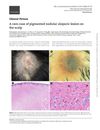
This study reported the case of a 30-year-old man with a bluish-grey scalp nodule that developed over a previously stable hairless plaque, revealing histopathological features consistent with epithelioid cell nests and spindle-shaped dermal melanocytes embedded in collagen.