 8 citations
,
March 2021 in “Medicina-lithuania”
8 citations
,
March 2021 in “Medicina-lithuania” This review discusses the use of platelet-rich plasma for treating female androgenetic alopecia, reporting that it shows high patient satisfaction and improved quality of life in affected women.
1 citations
,
August 2022 in “Journal of Drugs in Dermatology” This study found that the efficacy of platelet-rich plasma in treating androgenetic alopecia is higher with increased frequency of sessions, chemically-activated PRP, double centrifugation, and whole-head application, among younger and female patients.
5 citations
,
June 2010 in “Universitas Psychologica” This study found that progesterone implantation in castrated male rats mitigated stress-induced increases in corticosterone levels and protected against spatial memory impairment and increased exploratory behavior.
 December 2015 in “Vascular Pharmacology”
 Prasugrel is better than clopidogrel at preventing heart damage and improving blood flow in small heart vessels during heart artery procedures.
January 2010 in “Acta Universitatis Medicinalis Nanjing” This study found that progesterone increased the survival of newborn neurons and enhanced spatial learning and memory in adult male mice, independent of neuron production changes.
 February 2018 in “InTech eBooks”
 This review discusses the role of platelet-rich plasma therapy in various cosmetic procedures, finding potential benefits in improving tissue homeostasis if harvesting standards are maintained, but reports no new clinical results.
 May 2015 in “Hair transplant forum international”
 This article contains no research findings; it reports on an online discussion about platelet-rich plasma (PRP) and opinions shared during a conference.
 January 2019 in “Springer eBooks”
 PRP may help with hair loss and improve hair quality with few side effects, but more research is needed.
 25 citations
,
January 2017 in “Steroids”
25 citations
,
January 2017 in “Steroids” This study found that the progesterone metabolite 3α-THP increased the proliferation and gene expression of human glioblastoma cells, suggesting a role in tumor progression.
 8 citations
,
June 2019 in “Scientific Reports”
8 citations
,
June 2019 in “Scientific Reports” This study found that the retinoid receptor and PPAR pathway are involved in hair follicle miniaturization in androgenetic alopecia, alongside androgen receptors.
 September 2025 in “Journal of Maxillofacial and Oral Surgery”
 This study found that combining PRP with concentrated growth factors was more effective than PRP alone in promoting hair regrowth for patients with androgenetic alopecia.
17 citations
,
October 2023 in “Molecules” In laboratory and artificial skin model experiments, this study found that plant-derived PDRN from Korean ginseng effectively promoted skin cell regeneration and strengthened the skin barrier, suggesting a sustainable alternative to animal-derived PDRN.
 January 2024 in “Frontiers in endocrinology”
 This study found that women treated with GnRHa for central precocious puberty had a higher prevalence of polycystic ovary syndrome in adulthood compared to those with isolated premature thelarche.
 18 citations
,
March 2022 in “Drug design, development and therapy”
18 citations
,
March 2022 in “Drug design, development and therapy” This review examines the definition, classification, mechanism, clinical efficacy for hair regrowth, and potential adverse effects of platelet rich plasma, but does not present new experimental results.
May 2024 in “International journal of molecular sciences” This review synthesizes evidence on platelet-derived bioproducts like PRP and PRF, highlighting their role in tissue regeneration and their benefits in aesthetic medicine applications such as hair restoration, scar treatment, and wound healing.
May 2020 in “Journal of the Dermatology Nurses’ Association” This study concluded that using a multimedia patient education tool may improve patient comprehension of platelet-rich plasma treatment for androgenetic alopecia in a dermatology practice.
March 2026 in “Journal of Cosmetic Dermatology” This review discusses platelet-rich plasma therapy for androgenic alopecia and reports no clinical results; the authors emphasize the need for standardized protocols and large-scale studies to confirm its long-term efficacy.
 10 citations
,
January 2012 in “International Journal of Trichology”
10 citations
,
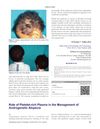
January 2012 in “International Journal of Trichology” PRP helps hair growth in common hair loss disorder.
1 citations
,
January 2016 This review discusses the diverse applications of platelet-rich plasma in tissue repair, aesthetic medicine, and hair restoration, but reports no new clinical results.
April 2025 in “Russian Pediatric Journal” This review discusses the application of PRP therapy in pediatric settings and highlights the current lack of sufficient data for its widespread clinical use.
 January 2024 in “International Journal of Scientific Research in Science and Technology”
 This review analyzes Platelet-Rich Plasma therapy for facial aesthetics, discussing its principles, efficacy, safety, and future research directions, but reports no new clinical results.
 September 2022 in “British Dental Journal”
 Platelet-rich fibrin is becoming popular for medical and cosmetic uses like hair growth and natural fillers.
 April 2021 in “Journal of Investigative Dermatology”
 This review assesses platelet-rich plasma therapy for androgenic alopecia in women and found it may improve hair thickness and quality, but more studies are necessary to confirm its psychological benefits.
9 citations
,
September 2024 in “Frontiers in Endocrinology” This study found that intrauterine PRP infusion is a safe and effective treatment for patients with refractory thin endometrium and implantation failures, with the improvement primarily driven by the angiogenic cytokines in PRP.
 January 2013 in “Otorhinolaryngology clinics : an international journal”
 This review examines platelet-rich plasma's applications in aesthetic surgery and reports no new clinical results; the authors highlight its growing use and potential as a therapeutic modality.
 46 citations
,
May 2018 in “Dermatologic Surgery”
46 citations
,
May 2018 in “Dermatologic Surgery” In this study, subdermal platelet-rich plasma injections significantly increased hair count and shaft caliber in individuals with androgenetic alopecia, with monthly treatments potentially offering greater benefits.
 April 2016 in “The journal of investigative dermatology/Journal of investigative dermatology”
 The researchers reported that disrupting the RPGRIP1L gene in mice impaired desmosome function, causing skin blistering, and their findings suggest that PKCβII inhibition could help treat pemphigus.
20 citations
,
December 2013 in “PTR. Phytotherapy research/Phytotherapy research” This study found that ginsenoside Rg3 up-regulates vascular endothelial growth factor expression in human dermal papilla cells and mouse hair follicles, suggesting its potential role in promoting hair growth.
 107 citations
,
August 2014 in “Dermatologic Surgery”
107 citations
,
August 2014 in “Dermatologic Surgery” This pilot study suggests injecting platelet-derived growth factors into the scalp may offer some clinical benefits for androgenetic alopecia, though further randomized trials are needed for confirmation.
 1 citations
,
April 2016 in “Journal of Investigative Dermatology”
1 citations
,
April 2016 in “Journal of Investigative Dermatology” This study identified that blocking the PTGDR2 receptor in human hair follicles in vitro and in mice reversed the hair growth inhibition caused by PGD2, suggesting a potential approach for treating alopecia.