 85 citations
,
March 2012 in “Revista Brasileira de Farmacognosia”
85 citations
,
March 2012 in “Revista Brasileira de Farmacognosia” This review discusses the pharmacological benefits and chemical compounds of the Sophora genus, noting its traditional use and wide pharmacological actions, but reports no new clinical results.
 43 citations
,
February 2020 in “Clinica chimica acta”
43 citations
,
February 2020 in “Clinica chimica acta” This review discusses the role of phytochemical nanoparticles in cervical cancer therapy and reports no new clinical results; the authors highlight their potential advantages over conventional chemotherapy.
 2 citations
,
January 2024 in “Journal of Pharmacognosy and Phytochemistry”
2 citations
,
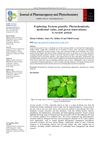
January 2024 in “Journal of Pharmacognosy and Phytochemistry” The study highlights Teak's (Tectona grandis) diverse applications beyond high-quality timber, emphasizing its bioactive compounds' pharmacological potential in cancer treatment and other uses across traditional medicine, cosmetics, and biodiesel production.
 2 citations
,
January 2023 in “International Journal of Dermatology Research”
2 citations
,
January 2023 in “International Journal of Dermatology Research” This study reported that C. procera leaf extracts showed antifungal activity against several dermatophytes, with ethanol extracts demonstrating slightly greater efficacy than aqueous extracts.
 2 citations
,
January 2018 in “International Journal of ChemTech Research”
2 citations
,
January 2018 in “International Journal of ChemTech Research” This study used phytochemical screening and FTIR spectroscopy with PCA to reveal slight chemical differences between two varieties of Eclipta alba, providing a method for their effective discrimination.
 1 citations
,
January 2020 in “Indo global journal of pharmaceutical sciences”
1 citations
,
January 2020 in “Indo global journal of pharmaceutical sciences” This article reviews the traditional uses of Citrullus colocynthis for various conditions like cancer and jaundice but reports no new clinical results, underscoring its role in folk medicine.
 September 2025 in “Journal of Phytonanotechnology and Pharmaceutical Sciences”
 This comprehensive review reports on the therapeutic potential and bioactive components of licorice (Glycyrrhiza glabra Linn), highlighting its diverse pharmacological properties and health benefits but also noting associated toxicity and adverse effects in medicinal and food applications.
 January 2024 in “International Journal of Environment Agriculture and Biotechnology”
 In this study, organic garlic was found to have higher levels of bioactive elements and stronger antimicrobial properties compared to chemically grown garlic, highlighting the benefits of organic cultivation for enhancing garlic's nutritional and health-promoting qualities.
This study investigated the phytochemicals in Phyla nodiflora leaf extracts and identified n-Hexadecanoic acid, stigmasterol, and beta-sitosterol as promising drug candidates for diabetes, alopecia, cancer, and anti-diuresis, advocating further research into these compounds.
 September 2023 in “Asian journal of beauty & cosmetology”
 In this review paper, the authors explored the composition and role of lipids in human hair, highlighting their importance for hair texture, moisture retention, and tensile strength, while noting that the understanding of hair lipids' functions remains controversial and requires further research.
 August 2025 in “Fabad Journal of Pharmaceutical Sciences”
 This review highlights the potential medicinal benefits of Cuscuta reflexa, a parasitic plant known for its bioactive compounds, while emphasizing the need for further research to fully understand its therapeutic mechanisms and integrate its use into mainstream medicine.
 8 citations
,
November 2024 in “Scientific Reports”
8 citations
,
November 2024 in “Scientific Reports” In this study, different drying methods for Hedychium spicatum rhizomes significantly affected the essential oil yield, antioxidant potential, and compound composition, with the HSOV30 method yielding the highest oil content, antioxidant activity, and specific compound levels such as 1,8-cineole and elemol.
 November 2025 in “Frontiers in Endocrinology”
 This review examines the potential of apigenin and ellagic acid as adjunct or alternative treatments for PCOS, but reports no new clinical results and highlights the need for further trials to confirm their efficacy and optimize dosing and delivery.
 October 2020 in “Journal of bio innovation”
 In this study, DanEra, an herbal hair tonic from Pomegranate and Beetroot extracts, showed equivalent effectiveness to the standard drug Ketoconazole in microbiological tests and provided significant relief from severe dandruff in all volunteers within 10 days.
 March 2012 in “Daehan hwajangpum hakoeji/Daehan hwa'jangpum haghoeji”
 This study observed that a cream containing functional compounds from medicinal plants increased collagen production in human skin, while a hair tonic enhanced hair growth in mice.
 10 citations
,
December 2019 in “International journal of medicinal chemistry”
10 citations
,
December 2019 in “International journal of medicinal chemistry” In this study, researchers found that flavonoid glycosides extracted from Dicerocaryum senecioides leaves significantly promoted hair growth in BalB/c mice, with the shortest hair growth completion time of 19 days compared to the control's 29 days, and dose-dependent results.
 1 citations
,
June 2023 in “Ethnobotany research and applications”
1 citations
,
June 2023 in “Ethnobotany research and applications” This review examined the medicinal properties of the Ziziphus plant species, highlighting their traditional use in treating various conditions and their bioactive compounds with potential anticancer, antimicrobial, and anti-diabetic effects. The authors concluded that Ziziphus species, particularly jujube, have promising pharmacological activities warranting further investigation.
 August 2023 in “International Journal of Science and Research (IJSR)”
 This review compiles insights from ancient texts and recent studies on Kadali (Musa paradisiaca), highlighting its potential medical use in treating various disorders, including bleeding, eye, menstrual, bronchitis, diabetes, and uraemia.
 2 citations
,
January 2025 in “Pharmaceutical Research”
2 citations
,
January 2025 in “Pharmaceutical Research” This article reviews the possible therapeutic activities of Angelica gigas Nakai root extracts and their components, noting their potential effects on neuro-cognitive, metabolic, and other health conditions, and reports no new clinical results.

This review of Lawsonia inermis L., or henna, details its bioactive compounds and historical uses in Unani medicine, including treatment for various conditions like ulcers and jaundice, while highlighting its potential for wound healing, hepatoprotective, and other effects, though further research is needed.
 November 2023 in “Hair transplant forum international”
 Results are not reported in this abstract, which raises the question of whether caffeine has a stimulating effect on hair growth both in laboratory settings and live subjects.
 1 citations
,
December 2022 in “Exploration of Medicine”
1 citations
,
December 2022 in “Exploration of Medicine” This review discusses the antioxidant and photoprotective potential of Polypodium leucotomos for use as a natural sunscreen ingredient and reports no new experimental results; further studies are recommended to evaluate its effectiveness.
 205 citations
,
September 2018 in “Nutrients”
205 citations
,
September 2018 in “Nutrients” This review summarizes the volatile components, biological activities, and potential safety concerns of essential oils from various Curcuma species, but reports no new clinical results.
10 citations
,
March 2005 in “International Journal of Cosmetic Science” This study found that photochemical and cosmetic chemical oxidation of hair causes surface damage by delipidation and acid formation, which can be characterized and quantified using microfluorometry and X-ray photoelectron spectroscopy.
 9 citations
,
June 2022 in “Reviews in Environmental Science and Bio/Technology”
9 citations
,
June 2022 in “Reviews in Environmental Science and Bio/Technology” This review discusses the industrial applications of maritime pine by-products, emphasizing their antioxidant and antimicrobial properties, and suggests innovation opportunities in a circular economy context; it reports no new results.
 2 citations
,
January 2023 in “Pharmaceuticals”
2 citations
,
January 2023 in “Pharmaceuticals” This review discusses factors affecting hair health, types of alopecia, and the potential of phytochemicals in managing hair loss but reports no new clinical results; it highlights the need for further studies.
 1 citations
,
November 2022 in “Research Society and Development”
1 citations
,
November 2022 in “Research Society and Development” This review highlights the effectiveness of medicinal plants in treating symptoms of hair disorders, emphasizing their antifungal and antioxidant properties as supported by 23 selected studies.
 May 2026 in “International Research Journal of Modernization in Engineering Technology and Science”
 This study developed an herbal shampoo using traditional plant ingredients, demonstrating its effective cleansing, conditioning, and protective properties while minimizing synthetic chemicals, aligning with consumer preferences for natural and sustainable personal care products.
 November 2023 in “South African journal of botany”
 This study found that Eclipta alba (L.) cultivated in France exhibited significant anti-inflammatory, antioxidant, and anti-collagenase activities, attributed mainly to compounds like wedelolactone and demethylwedelolactone, suggesting potential use as an anti-aging cosmetic ingredient.
 November 2023 in “International journal of Ayurveda and pharma research”
 This study prepared and evaluated a polyherbal hair oil using plant-based ingredients, finding that it met standard parameters and effectively addressed hair problems such as growth and dandruff, with FDA approval for clinical use.