11 citations
,
January 1977 in “Archives of dermatological research” Mouse tail skin has different keratinization near hair follicles and scales.
February 2025 in “Proceedings of the National Academy of Sciences” Only Deomyinae rodents can regenerate complex tissues.
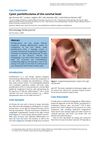 March 2026 in “Dermatology Online Journal”
 In this case report, the authors describe a rare cystic panfolliculoma in an 84-year-old man's right conchal bowl, noting its potential to mimic other tumors like basal cell carcinoma, which complicates diagnosis.
6 citations
,
January 2008 in “Indian Journal of Dermatology” This case report describes a rare autosomal dominant hair shaft disorder, monilethrix, observed in three consecutive generations of a family, with gradual improvement noted with age.
January 2022 in “Journal of clinical and diagnostic research” This case report describes an uncommon occurrence of trichofolliculoma in a 64-year-old male, which was easily treated through simple excision.
106 citations
,
February 2014 in “eLife” This study concluded that terminal Schwann cells are essential for the maintenance and regeneration of mechanosensory lanceolate complexes at hair follicles in adult mice.
 March 2022 in “Research Square (Research Square)”
 This study reported that pelage hair follicle mesenchymal stem cells isolated from mice using Ficoll Density Gradient Sedimentation can be obtained in large numbers and may promote hair growth via exosome secretion.
 January 2021 in “Journal of Entomology and Zoology Studies”
 This case report describes the effective treatment of psoroptic mange in Large White Yorkshire piglets using ivermectin, cefpodoxime, chlorpheniramine, povidone iodine, and Ascabiol lotion, resulting in full recovery and absence of mites.
11 citations
,
May 1998 in “Acta agriculturæ Scandinavica. Section A, Animal science” This study observed that pelage development in male blue foxes born in early June was more synchronized than those born in early May, with differences likely influenced by melatonin levels.
 November 2022 in “Nihon Nyuusankin Gakkaishi/Nihon Nyūsankin Gakkaishi”
 In a non-blinded study with 12 Japanese participants, applying a lotion containing Lactiplantibacillus plantarum N793 to the scalp for 24 weeks significantly increased hair density and reduced hair loss, with participants reporting improvements in hair thickness and volume, and the treatment deemed safe.
October 2024 in “Journal of Cutaneous Pathology” In this study of folliculitis decalvans, researchers found that compound follicular structures in scalp biopsies are primarily composed of terminal anagen follicles, surrounded by fibrosis and inflammatory cell infiltrate, which could enhance understanding of this condition.
January 2026 in “Frontiers in Animal Science” In this study, researchers assessed wool quality in sheep and found that the Gentile di Puglia breed, a Merino-derived Italian breed, exhibits finer wool through higher secondary follicle density compared to the non-merinized Sarda breed, suggesting its potential for sustainable wool production.
51 citations
,
May 2008 in “Mycoses” This study found that terbinafine HCl nail solutions with or without DDAIP HCl significantly outperformed ciclopirox nail lacquer in treating guinea pig dermatophytosis, suggesting potential effectiveness for human nail infections.
December 2024 in “JAAD International” January 2011 in “한국미용학회지” In this study, Fructus Ligustri Lucidi extract was found to promote the proliferation of human hair dermal papilla cells by activating the ERK and Akt pathways.
February 2022 in “Brazilian Journal of Health Review” In this study, researchers found that among women with frontal fibrosing alopecia and hyperpigmented facial lesions, most cases were diagnosed with lichen planus pigmentosus, while some were identified as melasma or drug-induced.
December 2021 in “Journal of pharmaceutical research international” This study found that trichoscopy can effectively differentiate female pattern hair loss from chronic telogen effluvium based on specific features like hair shaft diameter variability and density differences, aiding in targeted treatment planning.
 January 2025 in “International Journal of Veterinary Sciences and Animal Husbandry”
 In this case report, a domestic shorthair cat with Trypanosoma evansi infection fully recovered after treatment with diminazene aceturate and supportive therapies, with no Trypanosoma detected in the blood following the treatment course.
1 citations
,
December 2001 in “Linchuang pifuke zazhi” In this study, certain Chinese herbal medicines were found to significantly stimulate or inhibit hair growth in an in vitro organ culture model of mouse vibrissa follicles.
 August 2022 in “bioRxiv (Cold Spring Harbor Laboratory)”
 This study found that in mice, competition for hair follicles guides the organization of follicle-innervating LTMR neurons during early development, with different neuronal subtypes showing varying adaptive responses to increased neuron populations.
1 citations
,
January 2024 in “Journal of Feline Medicine and Surgery Open Reports” In this study, the researchers describe a case of feline demodicosis that presented with dermatological lesions but lacked the typical signs of pruritus or overgrooming, and they report successful off-label treatment using a single spot-on application of fluralaner.
6 citations
,
August 2022 in “International journal of molecular sciences” This study demonstrated that α-phellandrene promotes dermal papilla cell proliferation through a cAMP-mediated pathway and upregulates VEGF expression, suggesting its potential use in hair loss prevention.
 41 citations
,
January 2011 in “Nippon Ishinkin Gakkai Zasshi”
41 citations
,
January 2011 in “Nippon Ishinkin Gakkai Zasshi” This study identified the clinical aspects and dermatophyte types involved in tinea incognito in Iran, with Trichophyton verrucosum being the most frequently isolated species among affected patients.
1 citations
,
June 2016 in “Medicina” This article reviews monilethrix, a rare genetic hair disorder causing brittle hair and alopecia, and emphasizes the need for clinical diagnosis and characteristic tricoscopic findings.
43 citations
,
January 2016 in “Development” This study identified a critical NF-κB-LHX2-TGFβ2 signaling pathway essential for primary hair follicle development in mice, revealing new insights into the underlying mechanisms of morphogenesis.
74 citations
,
March 2013 in “Development” This study found that Hopx labels a long-lived progenitor population in hair follicles, which contributes to hair follicle stem cell homeostasis and has an alternative origin from previously thought progenitors.
 7 citations
,
August 2020 in “Animal biotechnology”
7 citations
,
August 2020 in “Animal biotechnology” This study found that lncRNA-599547 positively regulates the expression of the Wnt10b gene by interacting with miR-15b-5p, enhancing the inductive property of dermal papilla cells in cashmere goats.
 September 2022 in “Tropical grasslands-Forrajes tropicales”
 This study observed that smallholder cattle farmers in West Nusa Tenggara, Indonesia using leucaena as feed managed more cattle and focused more on fattening rather than breeding, but leucaena toxicity led to illnesses such as hair loss and, in a few cases, reproductive issues.
13 citations
,
June 2011 in “International Journal of Dermatology” This study found that a new lecithinized coal tar formulation did not stain different types of mammalian hair, suggesting it may be promising for treating scalp psoriasis without the drawback of staining.
 26 citations
,
December 2015 in “Journal of The European Academy of Dermatology and Venereology”
26 citations
,
December 2015 in “Journal of The European Academy of Dermatology and Venereology” This article introduces a new grading system called the FPHL Severity Index to better identify and monitor early stages of female pattern hair loss using clinical criteria.