8 citations
,
January 2014 in “Indian Dermatology Online Journal” This article presents a case of trichostasis spinulosa, a common but often unrecognized disorder, diagnosed through dermoscopic examination of black macules revealing bundled vellus hairs, with the patient declining treatment.
1 citations
,
September 2023 in “Portuguese Journal of Dermatology and Venereology” This case report describes a 50-year-old man with folliculotropic mycosis fungoides stage IB, noting trichoscopic findings like dilated follicular openings, black dots, and dystrophic hairs, which are less commonly documented in this condition, suggesting trichoscopy could aid in early diagnosis.
 5 citations
,
February 2004 in “Clinical and Experimental Ophthalmology”
5 citations
,
February 2004 in “Clinical and Experimental Ophthalmology” This study presents two cases correlating the clinical appearance of adult-onset foveomacular vitelliform dystrophy with optical coherence tomography findings, describing the location of the yellow vitelliform material.
40 citations
,
August 2005 in “JEADV. Journal of the European Academy of Dermatology and Venereology/Journal of the European Academy of Dermatology and Venereology” In this case report, a 3-year-old male with IFAP syndrome showed moderate improvement in skin symptoms and corneal erosions but no change in alopecia or photophobia after 6 months of acitretin therapy.
7 citations
,
January 2014 in “International Journal of Trichology” This article reviews five cases of primary idiopathic pseudopelade of Brocq and reports no histopathological changes indicative of any specific cicatricial alopecia.
 September 2019 in “Journal of Investigative Dermatology”
 This study found that polyamine levels were higher in the vertex hair than in occipital hair among patients with pattern baldness, suggesting a relation to hair loss development in the scalp's vertex region.
August 2016 in “Journal of the American Academy of Dermatology” This case study presents a 9-month-old male infant with symptoms suggesting a likely diagnosis of Hay–Wells syndrome, including severe scalp crusting, nail abnormalities, and partial syndactyly.
19 citations
,
October 1996 in “International Journal of Dermatology” This study concluded that pseudopelade is an autosomal dominant condition, distinct from other forms of alopecia, characterized by atrophic hair follicle loss and notable familial association.
 20 citations
,
February 2016 in “American Journal of Pathology”
20 citations
,
February 2016 in “American Journal of Pathology” This study indicates that the OVOL1-OVOL2 axis may play a significant role in hair follicle differentiation and growth, potentially serving as therapeutic targets for hair disorders like alopecia and in the tumorigenesis of pilomatricoma.
August 2025 in “Annals of African Medicine” April 2021 in “Authorea (Authorea)” In this case report, a woman with segmental vitiligo and hemifacial atrophy showed signs of stabilization after treatment with chloroquine and betamethasone pulse, suggesting a common underlying cause for these dermatoses.
 18 citations
,
July 2018 in “Skin appendage disorders”
18 citations
,
July 2018 in “Skin appendage disorders” This review discusses trichoscopic features of hair disorders in individuals with dark skin phototypes and reports no new clinical results; the authors emphasize the need for more specific diagnostic criteria for these populations.
 April 2023 in “World Journal Of Advanced Research and Reviews”
 This study in Morocco found that all women with frontal fibrosing alopecia presented frontotemporal hairline recession, with trichoscopic features such as perifollicular erythema and follicular hyperkeratosis being indicative of the condition, and suggested a potential link between cosmetic products or emotional factors and the disease.
 2 citations
,
June 2019 in “International Journal of Dermatology”
2 citations
,
June 2019 in “International Journal of Dermatology” This study found that while a modified BASP classification for pattern hair loss could classify previously unrecognized types, it was less accurate and harder to use than the existing BASP classification.
 4 citations
,
January 2014 in “Dermatology”
4 citations
,
January 2014 in “Dermatology” This case report details a woman with autoimmune primary ovarian insufficiency linked to hormonal contraception discontinuation, who achieved pregnancy through ovarian stimulation and in vitro fertilization despite typically low fertility in such conditions.
5 citations
,
October 2019 in “JAAD Case Reports” This case report describes a young man with rapidly progressive cicatricial alopecia that shows features overlapping several other types, suggesting these conditions may exist on a spectrum.
July 2026 in “Cosmoderma” In this case report, a 5-year-old boy presented with an itchy patch of hair loss in the frontotemporal region, with trichoscopy revealing specific hair shaft features, such as black dots and corkscrew hairs.
5 citations
,
August 2001 in “International Journal of Dermatology” This case study reports a 20-year-old laborer's progressive hair loss with scalp and body lesions, diagnosed as lichen planopilaris, leading to scarring alopecia resembling male-pattern baldness.
April 2026 in “Indian Journal of Dermatology” This case report documents an unusual instance of follicular vitiligo in a young woman, characterized by selective hair depigmentation on the forearms, distinctive dermoscopic and Wood's lamp findings, and histological evidence suggesting functional impairment rather than complete loss of follicular melanocytes.
26 citations
,
January 2009 in “Annals of Dermatology” This case report describes two instances of rare linear alopecia on the occipital scalp, associated histologically with lupus erythematosus profundus, despite resembling alopecia areata clinically.
 1 citations
,
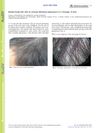
January 2018 in “Acta dermato-venereologica”
1 citations
,
January 2018 in “Acta dermato-venereologica” A teenager's hair with alternating white and dark bands, known as Pili annulati, is a genetic condition that is usually harmless and often considered attractive.
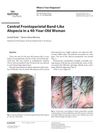 January 2018 in “Skin appendage disorders”
 A woman's hair loss was correctly diagnosed as Lichen planopilaris after initial misdiagnosis, highlighting the usefulness of trichoscopy in diagnosing hair disorders.
December 2014 in “Actas dermo-sifiliográficas/Actas dermo-sifiliográficas” Hair removal with intense pulsed light can cause rare skin lesions that are hard to fully treat.
January 2011 in “Journal of Diagnosis and Therapy on Dermato-venereology” This study found that female pattern hair loss may be influenced by genetic factors and hormonal changes, particularly in young adults, and identified specific dermoscopic features associated with the condition.
10 citations
,
October 1981 in “Archives of Dermatology” This case report describes a 36-year-old man with tinea incognito manifesting as asymptomatic, flat patches of alopecia, which did not improve with standard treatments.
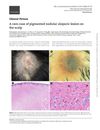
This study reported the case of a 30-year-old man with a bluish-grey scalp nodule that developed over a previously stable hairless plaque, revealing histopathological features consistent with epithelioid cell nests and spindle-shaped dermal melanocytes embedded in collagen.
May 2012 in “International Journal of Dermatology and Venereology” This article reviews definitions, classifications, and treatments for female pattern hair loss, including newer therapies like adenosine and phototherapy, but reports no new clinical findings.
2 citations
,
July 2019 in “Indian dermatology online journal” This report documents a rare case of familial eyelash trichomegaly and synophrys in three siblings, with one sister also having loose anagen hair syndrome, an unreported association.
 May 2022 in “Journal of Cosmetic Dermatology”
 This review discusses the characteristics and diagnostic challenges of fibrosing alopecia pattern distribution, proposing an algorithm for hair transplantation, but reports no new clinical results.
1 citations
,
November 2004 in “Hair transplant forum international” This article discusses distinguishing features of Diffuse Alopecia Areata and Fibrosing Alopecia in a Pattern Distribution, but reports no new clinical results.