 December 2023 in “Frontiers in endocrinology”
 This review explores the role of hyperandrogenism, including adrenal-derived 11-oxygenated androgen, in the development of polycystic ovarian syndrome and discusses potential therapeutic strategies targeting androgen excess, without reporting new clinical results.
 November 2023 in “Curēus”
 This study in Saudi Arabia found that psychological stress was strongly linked to skin symptoms, with conditions like psoriasis, eczema, acne, rash, and baldness showing significant associations, highlighting the importance of considering stress levels when diagnosing skin issues.
 October 2023 in “Frontiers in medicine”
 Targeted immunotherapy could be a promising new treatment for hair regrowth.
 September 2023 in “Curēus”
 This case study describes a 21-year-old male diagnosed with Becker's nevus, characterized by hyperpigmented and hypertrichotic lesions that developed over several years.
 November 2022 in “Gigascience”
 This study identified a 582-bp deletion upstream of LHX2 in cashmere goats, likely linked to hair follicle development and cashmere production, providing insights into genetic factors in cashmere trait selection.
 October 2022 in “Pakistan Journal of Medicine and Dentistry”
 This article discusses the skin's role as both a protective barrier and a major source of antioxidants, noting its vulnerability to infections and systemic manifestations, but reports no new clinical findings.
 October 2022 in “Boletín médico del Hospital infantil de México/Boletín médico del Hospital Infantil de México”
 This case report describes an 18-year-old male with a rare acquired smooth muscle hamartoma on his face, characterized by hyperpigmented plaques and increased hair growth, suggesting a histological overlap with folliculosebaceous cystic hamartoma.
 August 2022 in “International journal of research in pharmacy and chemistry”
 This review summarizes the chemical composition and pharmacological properties of Teak (Tectona grandis) but presents no new research findings, emphasizing its use in traditional medicine and therapeutic potentials.
This study found that liquid nitrogen cryotherapy significantly improved alopecia areata in 27.4% of treated patients after six weeks, with no association between treatment efficacy and factors like age or gender.
 March 2022 in “Marmara University Open Access System”
 This article critically examines the relationship between new media and digital games, emphasizing their cultural and historical contexts, but provides no new empirical findings.
 January 2022 in “Bio web of conferences/BIO web of conferences”
 This study concluded that the elemental composition of tail brush hair in newborn calves can indicate trace element supply to the fetus during the last months of pregnancy.
 January 2019 in “Analytical Science and Technology”
 This study developed a rapid method using advanced chromatography and mass spectrometry to detect hair-growth enhancing compounds, discovering synthetic drugs in about 21% of tested supplements.
 September 2018 in “International journal of biosciences”
 This study found that women with both PCOS and gingivitis had significantly higher levels of AMH in their saliva compared to those with only PCOS, gingivitis, or neither condition.

In this study, a clear pattern of selective sweep was observed for the SLC24A5 gene, with high linkage disequilibrium and low haplotype diversity, but no clear correlation with UV radiation intensity was found.
 January 2017 in “Springer eBooks”
 The document concludes that scalp health is influenced by complex factors affecting sebaceous glands, including hormones, aging, and various substances.
 January 2016 in “Springer eBooks”
 This review discusses the potential of superficial cryotherapy as an effective and safe treatment for alopecia areata in eyebrows, with a proposed mechanism involving improved follicular nutrition, but reports no new clinical results.
 September 2014 in “Aktuelle Dermatologie”
 This symposium review highlights past, present, and future developments in skin research, celebrating the work of Prof. Johanna Brandner and Dr. Peter Arne Gerber, without reporting new clinical results.
 October 2011 in “Journal of dermatology”
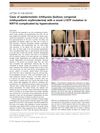
 A man with a rare skin condition and a new gene mutation developed high calcium levels due to his treatment.
This chapter reviews surgical management techniques for leukotrichia in vitiligo and presents no new clinical findings; it highlights various grafting and epilation methods.
 May 2026 in “International Journal of Homoeopathic Sciences”
 This study found that individualized homeopathic medicine can significantly improve outcomes in patients with alopecia areata, including complete hair regrowth and reduced SALT scores within 5 to 12 months, without relapse, and shows promise for alopecia universalis through targeted miasmatic and constitutional remedies.
 March 2026 in “Brazilian Journal of Microbiology”
 This study found that restoring the skin microbiome significantly improved hair growth and skin condition in androgenic alopecia model mice by modulating the immune-inflammatory balance, highlighting the potential of bacterial-based therapies for hair loss.
 December 2025 in “Clinical Cosmetic and Investigational Dermatology”
 This study highlights the potential of ZDHHC17 methylation as a biomarker or therapeutic target in addressing skin aging, offering new insights into its molecular mechanisms.
 September 2025 in “Frontiers in Genetics”
 This study developed a non-invasive, partially automated protocol for extracting high-quality DNA from hair follicles of marmosets, significantly reducing chimerism rates compared to blood, and proving reliable for whole genome sequencing in low-input DNA scenarios.
 January 2025 in “International Journal of Dermatology Research”
 This study found that patients with alopecia areata had a significantly higher mean platelet volume compared to healthy individuals, suggesting a potential link between hematological markers and the severity of the disease.
 January 2024 in “Institutional Repositories DataBase (IRDB)”
 This study developed a method to measure local steroid hormone concentrations in hair, providing new insights into hormone dynamics associated with androgenetic alopecia.
 December 2022 in “GS Publishing Services eBooks”
 This publication compiles scientific articles from diverse researchers and practitioners across Europe and other regions but provides no new research results.

This research concluded that the novel hydrogel PlacMA, derived from human placenta and curable by visible light, shows promise for cell culture and tissue engineering applications due to its tunable properties.

This Ph.D. project aims to evaluate the self-assembling potential of hair keratin extracts and study the cellular response to both crude and purified keratins, highlighting their potential applications from biomedical to water remediation.
 November 2019 in “Journal of Aesthetic Nursing”
 This article reviews the classifications and characteristics of androgenic alopecia and provides no new clinical results; it emphasizes the importance for aestheticians to understand current treatment evidence.
This study explored the structure and function of lipocalin prostaglandin D synthase, revealing its dual role in substrate catalysis and as a lipophilic ligand carrier, potentially informing future drug delivery design.