 4 citations
,
May 2007 in “Journal of Dispersion Science and Technology”
4 citations
,
May 2007 in “Journal of Dispersion Science and Technology” This study found that hinokitiol in cationic vesicles promoted hair growth in mice, potentially due to its high substantivity on the skin.
 37 citations
,
October 2015 in “Anais Brasileiros de Dermatologia”
37 citations
,
October 2015 in “Anais Brasileiros de Dermatologia” This study found diverse clinical presentations of lichen planopilaris, with classic lichen planopilaris being the most common, highlighting the importance of recognizing this variability for accurate diagnosis.
 May 2012 in “Research and reports in neonatology”
 This article presents a case of Klippel-Trénaunay syndrome with limb hypertrophy, port-wine stains, angiokeratoma, and venous varicosities, but reports no new findings beyond this case description.
 May 2025 in “Journal of Developmental Biology”
 This study reports that KRTAP-like proteins, which resemble keratin-associated proteins found in mammals, are also present in the cornified teeth of various lamprey species, suggesting these proteins may serve similar functions in skin appendages across different vertebrates despite independent evolutionary origins.
April 1977 in “Pediatric Research” 18 citations
,
February 1992 in “Molecular Biology Reports” This study identified and characterized a murine type II hair keratin, demonstrating its presence in specific cells of hair and tongue tissues.
22 citations
,
August 1999 in “Mechanisms of Development” This study identified two novel genes, pmg-1 and pmg-2, expressed in various skin and gland tissues and potentially involved in the differentiation of epithelial cells in epidermal appendages.
2 citations
,
September 1996 in “Journal of Applied Polymer Science” This study found that treating hair with aqueous KCN converts disulfide bonds to monosulfide crosslinks, affecting the elasticity and crosslink distribution in hair microstructures.
 68 citations
,
July 2011 in “Journal of Biochemistry/The journal of biochemistry”
68 citations
,
July 2011 in “Journal of Biochemistry/The journal of biochemistry” This review discusses newly identified non-Edg family lysophosphatidic acid receptors, detailing their roles in vascular development, platelet activation, and hair growth, and reports no clinical results.
3 citations
,
February 2018 in “Aesthetic plastic surgery” This study found that the locked cheek lift technique effectively corrects cheek gravitational migration and reduces the lid cheek distance with minimal complications, maintaining results for over a year.
28 citations
,
August 1992 in “Differentiation” This study identified a new 65 kD and 48 kD keratin pair expressed in specific mouse epithelial sites, suggesting a unique evolutionary branch of hair-related keratins.
28 citations
,
May 2015 in “Molecular Neurobiology” LSD1 is crucial for regenerating hair cells in zebrafish.
97 citations
,
March 2010 in “The American Journal of Human Genetics” A mutation in the KRT74 gene causes tightly curled hair.
 3 citations
,
June 2022 in “Dermatology and therapy”
3 citations
,
June 2022 in “Dermatology and therapy” This case report found that a novel botanical treatment halted disease progression and promoted hair regrowth in four patients with lichen planopilaris, indicating potential for use as a safe alternative therapy.
December 2021 in “Figshare” This study found that BBS7 downregulation in occlusal hypofunctional periodontal ligament tissue is associated with reduced Sonic hedgehog signaling activity, potentially playing a key role in maintaining PDL homeostasis.
 32 citations
,
January 2008 in “Journal of Microencapsulation”
32 citations
,
January 2008 in “Journal of Microencapsulation” In this study, nanocapsule-based preparations containing hinokitiol promoted hair growth in mice comparably to Minoxidil solution, as indicated by photographic and histological analysis.
 June 2026 in “Communications Biology”
 In this study, researchers found that the cornification process in the nuptial pads of Xenopus frogs involves the expression of the type II hair keratin homolog, krt59, and is regulated by the transcription factor hoxc13, showing similarities to mammalian hair evolution.
 26 citations
,
April 2019 in “Genes”
26 citations
,
April 2019 in “Genes” In this study, researchers identified novel long non-coding RNAs related to cashmere fineness in goats, highlighting a potential regulatory network involving lncRNA XLOC_008679 and its target gene KRT35.
18 citations
,
December 2010 in “Journal of analytical atomic spectrometry” This study demonstrated that using lead-doped keratin film as a calibration standard allows for accurate tracking of lead distribution along hair strands, revealing different exposure patterns among workers in a battery manufacturing factory in Thailand.
11 citations
,
November 2011 in “The Journal of Dermatology” This case report highlights the association of three CX26 gene mutations, particularly the D50N mutation, with keratitis–ichthyosis–deafness syndrome and its potential role in scalp squamous cell carcinoma and breast cancer development in a patient.
6 citations
,
April 2012 in “PloS one” This study used transgenic mice to show that disrupting TGF-β signaling in K14+ progenitor cells led to increased stem cell proliferation in the tongue.
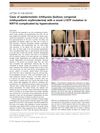 October 2011 in “Journal of dermatology”
 A man with a rare skin condition and a new gene mutation developed high calcium levels due to his treatment.
1 citations
,
June 2023 in “Journal of Visualized Experiments” This study describes a new intravital microscopy method for observing intestinal regeneration by tracking crypt dynamics in living mice after laser-induced tissue damage, revealing events like crypt fission, fusion, and disappearance over multiple weeks.
53 citations
,
June 2005 in “The journal of investigative dermatology/Journal of investigative dermatology” This article reviews extensive genetic polymorphisms in the keratin-associated proteins of human hair, indicating complexity but reporting no new clinical results and calls for further research on their potential impact on hair structure.
25 citations
,
June 2017 in “Journal of Investigative Dermatology” This study found that in a transgenic mouse model, β-HPV infection led to increased skin thickness and proliferation of specific keratinocyte stem cells, which may contribute to squamous cell carcinoma development.
9 citations
,
June 2014 in “Molecular biology reports” KAP9.2 and Hoxc13 genes are important for cashmere growth and vary in activity during different stages.
 6 citations
,
November 2018 in “Photodiagnosis and Photodynamic Therapy”
6 citations
,
November 2018 in “Photodiagnosis and Photodynamic Therapy” This study found that using a wearable low-level light therapy device for photodynamic therapy significantly reduced actinic keratosis lesions and improved quality of life in patients with AK of the scalp.
 2 citations
,
December 2021 in “Journal of Veterinary Medical Science”
2 citations
,
December 2021 in “Journal of Veterinary Medical Science” This case report found that adding lokivetmab to prednisolone treatment improved and maintained remission of pruritus in a dog with cutaneous epitheliotropic lymphoma.
52 citations
,
May 1997 in “Journal of Biological Chemistry” This study suggests that polyamines regulate CK2 enzyme activity and its subcellular distribution, as demonstrated in mouse models and cell cultures with elevated levels of ornithine decarboxylase.
6 citations
,
October 2023 in “Animal Biotechnology” This study found that a 22-bp InDel polymorphism in the FGF7 gene was significantly associated with growth traits in goats, with genotypes ID and/or II linked to better growth compared to genotype DD, indicating its potential as a molecular marker in breeding programs.