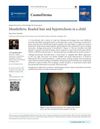
 January 2026 in “Cosmoderma”
 In this clinical case study, a 9-year-old girl was diagnosed with monilethrix, a hereditary hair shaft disorder characterized by weak, beaded hair, with management focusing on minimizing hair trauma.
 January 2025 in “Journal of Veterinary Medical Science”
 In this study, researchers observed that genetically identical cloned dogs, when exposed to different environments like an airport and a police station for two years, exhibited significant differences in toxic mineral concentrations and intestinal microbiota composition, suggesting that environment influences physiological traits even among clones.
January 2025 in “International Journal of Advancement in Life Sciences Research” This research found that crude leaf extracts of Calotropis gigantea caused significant oxidative stress and cellular damage in freshwater fish Danio rerio over 30 days, highlighting the toxicological risks of this plant despite its medicinal properties.
March 2024 in “Journal of functional biomaterials” This study demonstrated that a strain of lactic acid bacteria from kimchi, identified as Pediococcus inopinatus, showed antibacterial activity against certain oral pathogens and effectively bleached stained artificial teeth and inhibited biofilm formation, offering potential for addressing teeth discoloration and halitosis.
 January 2024 in “Wiadomości Lekarskie”
 In this report, a case of a large primary extradural solitary fibrous tumor in the sacrum of a 31-year-old woman is detailed, where surgical treatment led to remission and improved functionality, despite the patient opting out of adjuvant radiotherapy to preserve fertility potential.
 August 2023 in “International Journal of Molecular Sciences”
 This review highlights that liposomes offer a promising method for delivering CRISPR/Cas9 components for precise and efficient genetic modifications, with potential applications in correcting genetic diseases and enhancing immune cell function.
This study identified the Arabidopsis cation chloride cotransporter CCC1 as essential for regulating pH and function in the trans-Golgi network/early endosome, with its absence causing significant growth and stress response defects.
This study highlights the successful design of recombinant fortilin constructs for potential drug development targeting atherosclerotic plaque formation in cardiovascular disease.
June 2020 in “Zenodo (CERN European Organization for Nuclear Research)” This review discusses Robertsonian chromosomal translocations and their prevalence in the population, highlighting their association with infertility, and reports no new clinical results.
 May 2020 in “Research Square (Research Square)”
 This study found that trichilemmal carcinoma shares genetic changes with other skin cancers, suggesting a similar pathogenesis, particularly in those with aggressive clinical courses linked to TP53 mutations.
 April 2020 in “Research Square (Research Square)”
 This study reported genetic mutations in trichilemmal carcinoma similar to those found in other skin cancers, including TP53 mutations associated with aggressive disease.
 May 2017 in “bioRxiv (Cold Spring Harbor Laboratory)”
 This study found that the peach gene CTG134, involved in auxin-ethylene interactions, plays a role in hormonal regulation during root hair formation in Arabidopsis and tobacco.
This study introduces a new type of tissue micromodule, the micro tissue precursor (μTP), which can form complex 3D tissues, including lung stroma and skin models supporting hair viability.
 August 2013 in “Nature Reviews Drug Discovery”
 New cancer treatments show promise in reducing tumor growth and improving skin regeneration in mice.
January 2013 in “edoc (University of Basel)” This study found that TRF1 plays a crucial role in maintaining pluripotency and stem cell compartments, but it is not a suitable in vivo telomere length marker.
January 2012 in “Zhongguo nongye Kexue” This study concluded that transgenic somatic cell nuclear transfer technology can produce cashmere goat blastocysts carrying the K2.9 gene using specific fibroblast cells and activation methods.
 January 2009 in “Nihon Keshouhin Gijutsushakaishi/Journal of S C C./Nihon Keshouhin Gijutsushakai kaishi”
 This study found that the structural and chemical composition of human curly hair may resemble that of sheep wool, implying a shared characteristic among mammals with wavy hair.
January 2000 in “Zhongguo yixue wulixue zazhi” This study observed that human hair keratin showed distinct morphological features depending on the dissolution speed, which could have potential applications in clinical settings for developing self-tendons.
 February 1999 in “Analytical Sciences”
 A new antiandrogen compound was made and its detailed three-dimensional shape was described.
 October 2012 in “Faculty Opinions – Post-Publication Peer Review of the Biomedical Literature”
 Scientists used a special imaging technique to observe that hair follicle regeneration involves cell division and structural changes, mostly in the lower part of the follicle, and that the dermal papilla at the base is crucial for regrowth.
 9 citations
,
June 2001 in “International Journal of Cosmetic Surgery and Aesthetic Dermatology”
9 citations
,
June 2001 in “International Journal of Cosmetic Surgery and Aesthetic Dermatology” This paper describes a systematic approach to creating a natural hairline in one session using modern hairline design principles and reports no new clinical results.
 11 citations
,
October 2001 in “Dermatologic Clinics”
11 citations
,
October 2001 in “Dermatologic Clinics” In this study, subcutaneous recombinant human IL-12 showed a 43% partial response rate in early-stage mycosis fungoides patients refractory to previous treatments, with generally mild to moderate adverse events reported.
 48 citations
,
January 2003
48 citations
,
January 2003 In this study, researchers isolated and identified diverse endophytes from plants in Asia, finding that these microorganisms have significant potential for producing useful metabolites, including enzymes and antibiotics.
 38 citations
,
February 2009 in “Journal of The European Academy of Dermatology and Venereology”
38 citations
,
February 2009 in “Journal of The European Academy of Dermatology and Venereology” This study found that patients with severe vertex pattern androgenetic alopecia had significantly higher carotid intima-media thickness, suggesting an increased risk of subclinical atherosclerosis compared to other alopecia patterns and healthy controls.
34 citations
,
June 2022 in “Viruses” This study found that the natural alkaloid cepharanthine effectively inhibited porcine epidemic diarrhea virus infection in newborn piglets.
21 citations
,
September 2019 in “International Journal of Nanomedicine” RADA16-I can effectively deliver and release mangiferin, improving its solubility and bioavailability.
11 citations
,
April 1993 in “PubMed” In this study, trichocytes were shown to have potential for alternative differentiation, with mesenchymal cell influences playing a critical role in determining this process.
 9 citations
,
August 2013 in “PLOS ONE”
9 citations
,
August 2013 in “PLOS ONE” This study validated that the 20p11 genetic locus is associated with increased risk of androgenic alopecia in the Chinese Han population, suggesting shared genetic factors between Chinese and European populations.
 7 citations
,
June 1989 in “Steroids”
7 citations
,
June 1989 in “Steroids” In this study, the synthesis of C-4 and C-6 bridged haptens of 11 alpha-hydroxyprogesterone revealed an unexpected formation of a C-4 substituted product using a 6-bromo derivative, contrary to prior reports.
3 citations
,
May 1994 in “Journal of Pharmacology and Experimental Therapeutics” This study found that minoxidil sulfate stimulates Cl channels, potentially depolarization-activated and outwardly rectifying, in eccrine clear cells, while minoxidil itself stimulates Ca-insensitive K currents.