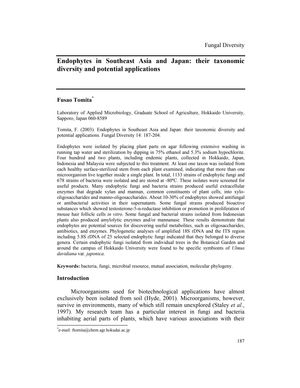
Endophytes in Southeast Asia and Japan: Their Taxonomic Diversity and Potential Applications
January 2003
Studysummary In this study, researchers isolated and identified diverse endophytes from plants in Asia, finding that these microorganisms have significant potential for producing useful metabolites, including enzymes and antibiotics.
Our plain-language summary. Not medical advice or a treatment recommendation. Consult a qualified healthcare professional before changing treatment. Full disclaimer
Researchers isolated endophytes from 402 plants in Japan, Indonesia, and Malaysia, identifying 1133 fungal and 678 bacterial strains. These endophytes were found to produce useful extracellular enzymes and bioactive substances, with 10-30% showing antifungal or antibacterial activities. Some fungal strains inhibited testosterone-5-α-reductase or promoted mouse hair follicle cell proliferation in vitro. The study highlighted endophytes as potential sources of valuable metabolites, such as oligosaccharides, antibiotics, and enzymes, and revealed diverse genera through phylogenetic analyses. Specific symbiotic relationships were noted, such as those with Ulmus davidiana var. japonica.