 1 citations
,
April 2017 in “Journal of Investigative Dermatology”
1 citations
,
April 2017 in “Journal of Investigative Dermatology” In this study, D-OCT imaging revealed distinct structural and vascular changes in patients with frontal fibrosing alopecia, highlighting the technique's potential for diagnosing and monitoring the condition's activity.
 153 citations
,
August 2002 in “Dermatologic Surgery”
153 citations
,
August 2002 in “Dermatologic Surgery” This paper introduces the Follicular Unit Extraction procedure and its accompanying FOX Test, finding that 60% of tested patients were suitable candidates for this minimally invasive hair transplantation method.
 1 citations
,
March 2019 in “Hair transplant forum international”
1 citations
,
March 2019 in “Hair transplant forum international” In this study, no significant differences in cellular stress response or growth capabilities were found between FUE and FUT hair restoration techniques.
 8 citations
,
July 2016 in “Hair transplant forum international”
8 citations
,
July 2016 in “Hair transplant forum international” This article discusses the increasing use of follicular unit extraction in hair transplant surgery and presents no new research findings.
 18 citations
,
April 2010 in “Actas Dermo-Sifiliográficas”
18 citations
,
April 2010 in “Actas Dermo-Sifiliográficas” This review discusses the current procedure for follicular unit hair transplantation, emphasizing its natural and reproducible results, but does not report new clinical findings.
 27 citations
,
November 2008 in “Facial Plastic Surgery”
27 citations
,
November 2008 in “Facial Plastic Surgery” This article outlines the technical aspects, benefits, and challenges of follicular unit extraction for hair transplantation, but it reports no new clinical findings.
 39 citations
,
May 2011 in “Movement Disorders”
39 citations
,
May 2011 in “Movement Disorders” Finasteride may help reduce symptoms in male Tourette syndrome patients.
 1 citations
,
January 2014 in “Hair therapy & transplantation”
1 citations
,
January 2014 in “Hair therapy & transplantation” This report describes benefits of advanced hair transplant techniques, micro-FUE and U-FUE, which may result in natural, undetectable hair restoration and discrete post-procedure appearance.
November 2013 in “Journal of clinical & experimental dermatology research” This article describes the follicular unit extraction method for hair transplantation, discussing its application, candidate selection, technique, outcomes, and the authors' experiences in over several hundred cases, without presenting new clinical results.
 11 citations
,
January 2018 in “Acta dermato-venereologica”
11 citations
,
January 2018 in “Acta dermato-venereologica” In this study, oral tofacitinib showed higher efficacy and tolerability in treating refractory alopecia totalis and universalis compared to traditional treatments, achieving a 50% improvement in severity scores for 44.4% of patients over six months, with fewer adverse effects.
 August 2023 in “Clinical, Cosmetic and Investigational Dermatology”
 In this article, researchers describe a novel FUE device designed to enhance follicular unit excision surgery by minimizing follicular injury and improving ergonomics with features such as Bluetooth functionality, fingertip touch sensors, and automated operation.
 1 citations
,
June 2017 in “Actas Dermo-Sifiliográficas”
1 citations
,
June 2017 in “Actas Dermo-Sifiliográficas” This review discusses the follicular unit extraction technique for hair transplantation, noting its rise in popularity due to patient demand and improved surgical skills, but reports no new clinical results.
March 2024 in “SVU- International Journal of Veterinary Sciences” This study suggests that fecal microbiota transplantation was effective in reducing symptoms of feline hyperesthesia syndrome, with most cats showing clinical remission or improvement and no observed side effects.
 77 citations
,
April 1999 in “Dermatologic Clinics”
77 citations
,
April 1999 in “Dermatologic Clinics” This article reviews how new observations have revolutionized surgical hair restoration and highlights the logical applications and prior illogical judgments that delayed this advancement, without reporting new results.
 46 citations
,
May 2011 in “Movement Disorders”
46 citations
,
May 2011 in “Movement Disorders” This article contains additional supporting information available online but presents no new research findings.
 1 citations
,
November 2009 in “Cambridge University Press eBooks”
1 citations
,
November 2009 in “Cambridge University Press eBooks” This article reports that follicular unit extraction is a minimally invasive hair restoration technique that avoids linear scarring and reduces donor-site pain compared to traditional strip harvesting methods.
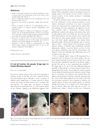 39 citations
,
July 2015 in “British Journal of Dermatology”
39 citations
,
July 2015 in “British Journal of Dermatology” This article discusses the pseudo 'fringe sign' in frontal fibrosing alopecia, highlighting that it is not solely related to traction, and it reports no new clinical results.
8 citations
,
May 2019 in “International Society of Hair Restoration Surgery” This review discusses the establishment of standard terminology for follicular unit extraction (FUE) by the ISHRS committee and reports no new results; the terminology is now widely accepted in hair restoration practices.
 February 2009 in “Journal of The American Academy of Dermatology”
 Most patients with Tuberous sclerosis had neurological or skin issues, and over half had psychiatric problems.
 30 citations
,
June 2008 in “Dermatologic Surgery”
30 citations
,
June 2008 in “Dermatologic Surgery” In this study, the SAFE System for follicular unit extraction demonstrated a favorable average follicle transection rate of 6.14% and is accessible for physicians with basic technical skills, showing promise for wider adoption.
 7 citations
,
November 2021 in “Clinical, Cosmetic and Investigational Dermatology”
7 citations
,
November 2021 in “Clinical, Cosmetic and Investigational Dermatology” This study describes a novel FUE device that may perform successfully across various patient scenarios, adapting to differences in skin firmness, thickness, and hair curliness.
8 citations
,
September 2023 in “Skin Research and Technology” This study found that combining high-frequency ultrasound with clinical examination significantly improved the diagnostic accuracy of invisible subcutaneous lesions from 47.3% to 80.8%, especially for conditions like epidermoid cysts and lipomas, although it was less effective for rarer lesions such as dermatofibromas.
 10 citations
,
January 2013 in “Journal of Cutaneous and Aesthetic Surgery”
10 citations
,
January 2013 in “Journal of Cutaneous and Aesthetic Surgery” This article discusses the unsightly scars left in the donor area after follicular unit transplantation and highlights the need for studies on cosmetic improvements, but it reports no new research findings.
 4 citations
,
June 2022 in “Clinical, cosmetic and investigational dermatology”
4 citations
,
June 2022 in “Clinical, cosmetic and investigational dermatology” In this study, researchers introduced the Sanusi FUE Score Scale to better predict and grade the difficulty of follicular unit excision hair transplantation by accounting for diverse hair and skin types, with further validation needed.
 September 2017 in “Springer eBooks”
 FUE hair transplants have improved to give more natural results with less scarring and pain.
3 citations
,
March 2016 in “Practical radiation oncology” This paper reviews total skin electron therapy for mycosis fungoides and reports no new results; the authors focus on dose de-escalation's impact on toxicity and response rates.
January 2020 in “Hair therapy & transplantation” This article reviews the evolution of hair transplantation techniques, focusing on the transition from follicular unit transplantation to follicular unit extraction, and reports no new clinical results.
4 citations
,
January 2025 in “Diagnostics” This article reviews the use of high-frequency ultrasonography to visualize nail units and scalps in dermatology, highlighting its potential benefits for disease assessment and treatment monitoring, but reports no new clinical results.
 January 2025 in “Dermatology and Therapy”
 This study found that ultraviolet-induced fluorescence trichoscopy can help differentiate between scarring and non-scarring alopecia and between psoriasis and seborrheic dermatitis.
 32 citations
,
April 2006 in “The Journal of Urology”
32 citations
,
April 2006 in “The Journal of Urology” Using finasteride with TIP extends time off period for prostate cancer patients.