 November 2023 in “Periodontology 2000”
 This narrative review examines the technological advancements and clinical applications of liquid injectable platelet-rich fibrin (i-PRF), discussing its use across regenerative periodontology, sports medicine, and more, as well as its potential as a drug delivery system.
4 citations
,
June 2022 in “ACS applied materials & interfaces” This study described a new wig coating technique using keratin and graphene oxide that significantly enhanced UV resistance, antistatic properties, and durability compared to traditional methods.
 14 citations
,
November 2020 in “International Journal of Biological Macromolecules”
14 citations
,
November 2020 in “International Journal of Biological Macromolecules” This study found that Flammulina velutipes polysaccharides-derived scaffolds greatly enhanced wound healing and hair follicle regeneration in a rat model, particularly with the FPS/NaOH variant showing the best results.
January 2024 in “Wiadomości Lekarskie” This study highlights the potential of cosmetic products combining fibroblast growth factors and antioxidants like thioproline, ergothioneine, silymarin, and rosmarinic acid, to mitigate skin aging by reducing oxidative stress and enhancing cellular protection in the skin.
June 2026 in “ChemistryOpen” In this study, researchers employed a modified coaxial electrospinning technique to create core-sheath nanofibers, which improved the transdermal delivery of finasteride compared to traditional monolithic nanofibers, showing enhanced penetration rates throughout the testing period.
January 2025 in “SSRN Electronic Journal” November 2022 in “Asian Journal of Pharmaceutical Research” In this study, the researchers developed a cellulose-based hydrogel that provides sustained drug release with improved bioavailability and stability over time.
 May 2024 in “Journal of Cosmetic and Laser Therapy”
 This study found that three sessions of injectable platelet-rich fibrin (i-PRF+) significantly improved hair follicle density, hair volume, and thickness, as well as patient satisfaction in women with female pattern hair loss, with only minor self-limited adverse effects reported.
15 citations
,
March 2021 in “Journal of Nanobiotechnology” This study developed a nanoscale biomimetic matrix that effectively and stably expands human hair follicle stem cells, offering a new tool for hair follicle reconstruction research.
5 citations
,
October 2020 in “Bioengineering & translational medicine” This study demonstrates the use of microscopy-guided laser ablation to create a highly structured 3D hydrogel-based organotypic skin model with folliculoid structures, potentially useful for studying hair follicle development or bioactive substance screening.
June 2026 in “ACS Nano Medicine” This study designed fibronectin nanogel microneedles, reporting their potential to enhance tissue repair by improving collagen organization, reducing inflammation, and promoting angiogenesis in both photoaged and diabetic wound models.
15 citations
,
March 2007 in “BioTechniques” This study introduced a new in vivo angiogenesis assay using Gelfoam implanted in ND-GFP transgenic mice to efficiently identify angiogenesis stimulators and inhibitors through GFP visualization.
April 2016 in “Studies in Conservation” This paper discusses the fabrication, exhibition, and treatment history of Robert Gober's beeswax leg sculptures, reporting no new results but detailing the artworks' preservation challenges like discoloration and hair loss.
January 2013 in “대한피부과학회지” This article presents a rare case of cicatricial alopecia in a 59-year-old woman after using the epidermal growth factor receptor inhibitor gefitinib.
15 citations
,
March 2022 in “Acta Biomaterialia” This study demonstrated that a 3D bioprinting technique using a gelatin/alginate hydrogel scaffold can regenerate entire hair follicles in mice, offering potential advancements in hair loss treatment.
October 2024 in “Applied Sciences” In this study, tubular 3D bioprinted structures made from sodium alginate and gelatin, containing NIH/3T3 fibroblast cells, demonstrated the ability for cell growth and network formation over 6 weeks, although structural tensile strength decreased with cell growth and polymer degradation.
5 citations
,
August 2011 in “Biotechnology and Bioprocess Engineering” 8 citations
,
May 2024 in “Regenerative Therapy” This study found that bioactive glass 1393 accelerates wound healing by promoting angiogenesis through the ROS/P53/MMP9 signaling pathway, enhancing granulation tissue formation and collagen deposition, as evidenced by both in vivo and in vitro experiments.

This study introduced fibronectin nanogel microneedles (FNG MNs) that demonstrated improved tissue penetration and transdermal delivery, restoring skin homeostasis in a photoaged mouse model and enhancing collagen deposition and angiogenesis in a diabetic wound rat model.
August 2021 in “Journal of the American Academy of Dermatology” This article reviews the use of hair filler fibers for improving the appearance of thinning hair and calls for more studies on patient satisfaction and side effects, without providing new clinical results.
50 citations
,
December 2017 in “British Journal of Dermatology” This study found that ECMs from papillary and dermal papilla fibroblasts support normal basement membrane formation, suggesting potential improvements for therapeutic biomaterials in skin engineering.

In this study, collagen type I, skin fibroblasts, and macrophages did not show remarkable changes in androgenic alopecia patients' scalp tissues after treatment with 1550 nm fractional Er:Glass laser, despite improved hair regrowth.
 March 2021 in “Research Square (Research Square)”
 This research observed that 3D electrospun micro/nanofibrous sponges, without using chemical crosslinking agents, supported enhanced cell growth, vascularization, and skin regeneration in diabetic rats compared to 2D fiber membranes, making them promising for 3D tissue regeneration.
30 citations
,
September 2024 in “Pharmaceuticals” This research highlights the potential of using bioactive silk-based nanofiber dressings to improve the healing of diabetic wounds, suggesting that further studies are needed to refine these formulations and confirm their effectiveness in larger clinical trials.
 4 citations
,
December 2017 in “International Journal of Biomedicine”
4 citations
,
December 2017 in “International Journal of Biomedicine” In this study, the introduction of autofibroblasts into ischemic wounds was found to be slightly less favorable for regenerative histogenesis compared to a dermal equivalent with heterofibroblasts, with minor differences in epidermis thickness, collagen fiber area, and blood vessel area.
 39 citations
,
July 2015 in “British Journal of Dermatology”
39 citations
,
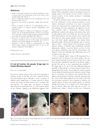
July 2015 in “British Journal of Dermatology” This article discusses the pseudo 'fringe sign' in frontal fibrosing alopecia, highlighting that it is not solely related to traction, and it reports no new clinical results.
 6 citations
,
January 2017 in “British Journal of Dermatology”
6 citations
,
January 2017 in “British Journal of Dermatology” This article reviews frontal fibrosing alopecia, exploring its characteristics, demographics, and associated conditions, and calls for controlled trials due to an increase in worldwide cases; it reports no new findings.
7 citations
,
July 2016 in “Journal of Biomedical Materials Research Part A” This study found that a novel hydrogel scaffold, cGEL, significantly increased melanin production and melanotic gene expression in human melanocytes compared to other graft materials, suggesting its potential as a superior carrier for skin grafting.
This study reported that prompt diagnosis and treatment with 5-alpha-reductase inhibitors and topical immunomodulators are key to mitigating the effects of frontal fibrosing alopecia and preventing permanent hair loss.