August 2012 in “Faculty Opinions – Post-Publication Peer Review of the Biomedical Literature” This study found that FGF18 is crucial for regulating hair follicle rest and growth phases, as its absence in mice leads to a shorter resting phase and rapid hair cycling.
2 citations
,
March 2011 in “Veterinary Dermatology” This study identified fibroblast growth factor 18 in various components of canine hair follicles and other tissues, but found no significant differences in its presence across seasons, body regions, or sexes in beagle dogs.
 1 citations
,
June 2013 in “Science-business Exchange”
1 citations
,
June 2013 in “Science-business Exchange” In this study, researchers at the University of Pennsylvania found that increasing FGF9 levels in wounded mouse skin can lead to the growth of hair follicles.
 May 2022 in “Journal of Immunology”
 In this study, a TGF-β mimic molecule from Heligmosomoides polygyrus was observed to enhance wound healing in mice, with improved tissue regeneration and specific immune cell recruitment without increased scarring.
10 citations
,
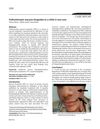
May 2007 in “British Journal of Dermatology” This case report describes the first known instance of congenital follicular mucinosis in a newborn, diagnosed through histopathological examination of a scalp lesion.
 December 2021 in “Research Square (Research Square)”
 This study found that repeatedly collecting hair follicles from individuals with fragile X syndrome is feasible for measuring FMR1 and FMRP levels in both home and office settings.
 1 citations
,
October 2023 in “Journal of the Pakistan Medical Association”
1 citations
,
October 2023 in “Journal of the Pakistan Medical Association” This source describes a case of a 12-year-old male diagnosed with folliculotropic mycosis fungoides, presenting with an asymptomatic, erythematous plaque. Histology and immunohistochemistry confirmed FMF, which is typically rare in children and marked by follicular infiltration by CD4+ lymphocytes.
 1 citations
,
April 2017 in “Journal of Investigative Dermatology”
1 citations
,
April 2017 in “Journal of Investigative Dermatology” In this study, D-OCT imaging revealed distinct structural and vascular changes in patients with frontal fibrosing alopecia, highlighting the technique's potential for diagnosing and monitoring the condition's activity.
1 citations
,
September 2023 in “Portuguese Journal of Dermatology and Venereology” This case report describes a 50-year-old man with folliculotropic mycosis fungoides stage IB, noting trichoscopic findings like dilated follicular openings, black dots, and dystrophic hairs, which are less commonly documented in this condition, suggesting trichoscopy could aid in early diagnosis.
2 citations
,
October 2024 in “Indian Journal of Orthopaedics” September 2023 in “JEADV Clinical Practice” This study identified key dermoscopic features in folliculotropic mycosis fungoides patients, showing that dilation of follicular openings and spiky follicular keratosis are specific indicators of follicular involvement, potentially aiding in diagnosis, classification, and treatment decisions.
 37 citations
,
August 2012 in “European Journal of Obstetrics & Gynecology and Reproductive Biology”
37 citations
,
August 2012 in “European Journal of Obstetrics & Gynecology and Reproductive Biology” In this study, a modified Ferriman-Galwey score greater than 4 was found to be effective for diagnosing hirsutism in Asian women, highlighting key areas such as the upper lip, thighs, and lower abdomen.
 6 citations
,
August 2014 in “Sri Lanka Journal of Diabetes Endocrinology and Metabolism”
6 citations
,
August 2014 in “Sri Lanka Journal of Diabetes Endocrinology and Metabolism” This study concluded that the modified Ferriman-Gallwey score was more effective in detecting hyperandrogenism in PCOS patients compared to serum testosterone and free androgen index in Sri Lankan women.
August 2025 in “Biomolecules” This review explores the role of FGF signaling in hair follicle development and highlights its potential as a new therapeutic target for hair loss, which could surpass existing treatments in terms of efficacy and safety.
 2 citations
,
June 2021 in “Research Square (Research Square)”
2 citations
,
June 2021 in “Research Square (Research Square)” This study identified a novel missense mutation in the FGF5 gene associated with the longhair phenotype in about 3% of Maine Coon cats, suggesting it may be a breed-specific variant.
 January 2024 in “ACS Biomaterials Science & Engineering”
 In this study, researchers developed a microfluidics-based method to generate hair follicle germs on a large scale for potential hair regeneration therapies, demonstrating efficient hair follicle regeneration following transplantation into mice.
 10 citations
,
November 2017 in “Journal of Investigative Dermatology”
10 citations
,
November 2017 in “Journal of Investigative Dermatology” In this study, researchers identified a novel homozygous variant in the FAM83G gene responsible for autosomal recessively inherited palmoplantar keratoderma with curly hair in a consanguineous Pakistani family, suggesting FAM83G plays a crucial role in skin and hair homeostasis.
 1 citations
,
February 2017 in “The American journal of dermatopathology/American journal of dermatopathology”
1 citations
,
February 2017 in “The American journal of dermatopathology/American journal of dermatopathology” This case report presented a 52-year-old man with cutaneous focal mucinosis, exhibiting rare follicular induction of the epidermis, underscoring the importance of recognizing this association in differential diagnoses.
22 citations
,
August 2020 in “Cells” This review discusses the role of TGM3 in skin and hair follicle biology, human tumor pathology, and genetic abnormalities, and reports no novel results; the authors highlight its potential as a cancer diagnostic biomarker.
39 citations
,
July 1993 in “The journal of investigative dermatology/Journal of investigative dermatology” This study found that daily injections of basic and acidic fibroblast growth factor in newborn mice significantly delayed hair follicle development within the treatment area, while epidermal growth factor affected the entire body coat and caused skin hyperkeratinization.
 1 citations
,
September 2023 in “Baghdad Journal of Biochemistry and Applied Biological Sciences”
1 citations
,
September 2023 in “Baghdad Journal of Biochemistry and Applied Biological Sciences” In this study, among Iraqi women with hirsutism, researchers found no significant differences in hormonal markers compared to healthy controls, but identified a strong association between the modified Ferriman-Gallwey (mFG) score and hirsutism, highlighting the mFG score's utility in diagnosing the condition.
 September 2013 in “Hair transplant forum international”
 This abstract describes frontal fibrosing alopecia, a type of cicatricial alopecia identified in post-menopausal women, and reports no new clinical findings.
73 citations
,
June 2006 in “Animal genetics” This study found that a missense mutation in the FGF5 gene is associated with hair-length differences among various dog breeds.
 April 2018 in “Journal of Investigative Dermatology”
 This study found that Fgf20 signaling facilitates fibroblast migration and influences dermal condensate cell development during hair follicle morphogenesis by supporting cellular activities such as cell cycle exit and specific cell shape adoption.
 45 citations
,
November 2017 in “Biomaterials”
45 citations
,
November 2017 in “Biomaterials” This study demonstrated a method for large-scale preparation of self-sorted hair follicle germs in vitro, which successfully generated hair follicles when transplanted into the skin of nude mice.
 46 citations
,
December 2001 in “Journal of Endocrinology/Journal of endocrinology”
46 citations
,
December 2001 in “Journal of Endocrinology/Journal of endocrinology” This study found that mouse FLRG protein, a secreted glycoprotein, is expressed in certain tissues and plays a role distinct from follistatin during wound healing, suggesting different functions in vivo.
 5 citations
,
June 2023 in “BMC genomics”
5 citations
,
June 2023 in “BMC genomics” This study found that a specific genetic mutation in the Fgf5 gene may contribute to the long-hair trait in Angora rabbits by reducing the binding capacity of the FGF5 protein.
 1 citations
,
September 2022 in “Evidence-based Complementary and Alternative Medicine”
1 citations
,
September 2022 in “Evidence-based Complementary and Alternative Medicine” In this study, Gardenia florida fruit extract promoted hair growth in vitro and in vivo by enhancing hair growth-promoting gene expression and increasing hair follicle number, size, and depth in mice.
 6 citations
,
January 2017 in “British Journal of Dermatology”
6 citations
,
January 2017 in “British Journal of Dermatology” This article reviews frontal fibrosing alopecia, exploring its characteristics, demographics, and associated conditions, and calls for controlled trials due to an increase in worldwide cases; it reports no new findings.
 179 citations
,
December 2004 in “Journal of The American Academy of Dermatology”
179 citations
,
December 2004 in “Journal of The American Academy of Dermatology” This study observed that frontal fibrosing alopecia in postmenopausal women involves selective follicular inflammation, and finasteride treatment may slow disease progression, suggesting a potential androgen-related component.