2 citations
,
June 2024 in “Skin Appendage Disorders” This study identifies specific trichoscopic features such as empty follicles and perifollicular erythema in Caucasians with frontal fibrosing alopecia, which may assist in diagnosis and monitoring, but stresses the need for further research due to limited demographic data.
 November 2023 in “Indian Journal of Dermatology”
 This study from North-East India analyzed 21 cases of frontal fibrosing alopecia, noting a high prevalence in post-menopausal women and distinct histological features such as perifollicular lymphocytic infiltrate and hydropic degeneration.
 45 citations
,
August 1994 in “Journal of Chromatography B: Biomedical Sciences and Applications”
45 citations
,
August 1994 in “Journal of Chromatography B: Biomedical Sciences and Applications” Method detects finasteride in plasma and semen with high sensitivity and accuracy.
 January 2022 in “Дерматологія та венерологія”
 This paper presents two cases of frontal fibrosing alopecia in postmenopausal women, noting challenges in monitoring due to the invasive nature of the diagnostic process.
 April 2018 in “Journal of Investigative Dermatology”
 In a clinical phase I/IIa study, subcutaneous injections of the peptide FOL-005 increased hair growth by 8% and were safe for treating alopecia.
 April 2018 in “The journal of investigative dermatology/Journal of investigative dermatology”
 This study found that treating human skin explants with TPA increased the number of certain melanocyte phenotypes in the interfollicular epidermis, suggesting that this ex vivo model can effectively replicate human skin's pharmacologic responses for studying potential treatments.
 7 citations
,
March 2024 in “Scientific Reports”
7 citations
,
March 2024 in “Scientific Reports” This study reports that the new neighborhood face index (NFI) demonstrates a remarkably high correlation with the physiochemical properties of benzenoid hydrocarbons, highlighting its potential as a predictive tool.
 1 citations
,
December 2017 in “JAMA Facial Plastic Surgery”
1 citations
,
December 2017 in “JAMA Facial Plastic Surgery” This study found that both PHDPE and ePTFE hair-bearing scaffolds were well tolerated in a rat model, with minimal infection or extrusion, though artificial hair showed progressive loss over time.
 July 2011 in “Facial Plastic Surgery”
 The document provides a quiz for physicians to earn continuing medical education credits in facial plastic surgery.
 April 2017 in “The journal of investigative dermatology/Journal of investigative dermatology”
 This study reports that 71% of patients treated with the gamma-secretase inhibitor PF-03084014 for desmoid tumors experienced dermatologic side effects, such as follicular lesions and pruritic eruptions, which were managed with topical or systemic treatments.
 39 citations
,
July 2015 in “British Journal of Dermatology”
39 citations
,
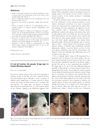
July 2015 in “British Journal of Dermatology” This article discusses the pseudo 'fringe sign' in frontal fibrosing alopecia, highlighting that it is not solely related to traction, and it reports no new clinical results.
 5 citations
,
May 2023 in “Science of the total environment”
5 citations
,
May 2023 in “Science of the total environment” This study observed that higher PFAS concentrations during adolescence were linked to later pubertal development and lower estradiol levels in females, but not in males, potentially due to PFAS excretion with menstrual fluid.
November 2024 in “Siriraj Medical Journal/San Sirirat” In this study, a single platelet-rich plasma injection for facial rejuvenation improved patient satisfaction and skin elasticity, with the most notable effects occurring 1-2 weeks post-treatment.
24 citations
,
August 2023 in “International Journal of Molecular Sciences” This review discusses the use of platelet-rich fibrin (PRF) in musculoskeletal, oral, and maxillofacial surgeries and dermatology, but reports no new clinical results; further trials are needed.
32 citations
,
August 1982 in “Journal of the American Academy of Dermatology” This study reports two cases of follicular lichen planus, suggesting that GLPLS and LPP may be variants of this condition based on clinical and immunofluorescent findings.
 12 citations
,
July 2017 in “Journal of cosmetic dermatology”
12 citations
,
July 2017 in “Journal of cosmetic dermatology” This study suggests that infrared thermography may be a useful noninvasive tool for diagnosing active phases of frontal fibrosing alopecia when combined with dermoscopy.
 14 citations
,
August 2018 in “Journal of Pharmaceutical and Biomedical Analysis”
14 citations
,
August 2018 in “Journal of Pharmaceutical and Biomedical Analysis” This study found that finasteride maintained chemical and physical stability in various excipient mixtures, which may guide the development of stable topical delivery systems.
 80 citations
,
April 2018 in “Trends in Molecular Medicine”
80 citations
,
April 2018 in “Trends in Molecular Medicine” This review discusses the roles of interferon-γ and PPAR-γ-mediated signalling in scarring alopecia, suggesting these pathways as potential therapeutic targets, but it reports no new empirical results.
 3 citations
,
July 2018 in “Biomedicine & pharmacotherapy”
3 citations
,
July 2018 in “Biomedicine & pharmacotherapy” This study suggests that paeoniflorin's protective effects on brain astrocytes may be mediated by TSPO and neurosteroids biosynthesis.
 2 citations
,
January 2022 in “Hair transplant forum international”
2 citations
,
January 2022 in “Hair transplant forum international” This article introduces the Follicular Unit Excision-Linear Ellipse (FUE-LE) technique, which integrates both FUE and the linear ellipse method for optimal hair restoration, but presents no new clinical results.
4 citations
,
March 2024 in “Forensic Sciences Research” This review found that current forensic DNA phenotyping panels for biogeographical ancestry and visible traits face significant limitations due to inconsistencies in terminology, genetic understanding, and genotyping technologies, highlighting the need for harmonization and further research.
October 2012 in “Sax's Dangerous Properties of Industrial Materials” 29 citations
,
September 2020 in “Polymers” This study found that electrospun poly(ε-caprolactone)/poly(3-hydroxybutyrate) blend fibers demonstrated nanometric dimensions and promising properties for drug delivery, with curcumin release linked to fiber morphology and processing parameters.
November 2025 in “Journal of Investigative Dermatology” April 2026 in “JURNAL FARMASI DAN ILMU KEFARMASIAN INDONESIA” In this study, the researchers successfully developed a Spanlastic gel containing EGCG for transdermal application, significantly increasing EGCG skin permeability with optimal entrapment efficiency, zeta potential, and vesicle size.
3 citations
,
May 2014 in “PubMed” This study used a newly developed RP-HPLC method to accurately measure finasteride distribution in human cadaver skin after applying different vesicular drug delivery systems.
11 citations
,
August 2025 in “Journal of Periodontal Research” This review highlights that autologous platelet concentrates, particularly platelet-rich fibrin, have shown potential to enhance healing and outcomes in both dental and medical applications, including injury recovery and aesthetics.
 October 2023 in “Spectrochimica acta. Part A, Molecular and biomolecular spectroscopy”
 This study introduces three spectrophotometric techniques for accurately determining finasteride and tadalafil in their combined pharmaceutical form, demonstrating their sustainability, sensitivity, and suitability for quality assurance, alongside a dissolution study following FDA guidelines.
 January 2025 in “Indian Journal of Dermatology”
 This review discusses the various factors implicated in the etiology of frontal fibrosing alopecia and notes the need for effective treatments, reporting no new clinical findings.
September 2017 in “The journal of investigative dermatology/Journal of investigative dermatology” This study found that while 450nm blue light can inhibit collagen and induce oxidative stress in dermal fibroblasts, 850nm near-infrared light may enhance metabolic activity without causing oxidative damage, suggesting potential for tailored light therapies in skin treatments.