June 2010 in “Journal of Cosmetic Dermatology” This article reviews the concept of caloric restriction and its potential anti-aging effects, highlighting animal studies and a human experiment in Biosphere II, but notes significant challenges for its application in humans.
3 citations
,
February 2017 in “The American journal of medicine” This case report highlights that repletion of various micronutrients, including thiamine, significantly improved heart failure symptoms and cardiac function in a malnourished patient with vitamin deficiencies.
In this correspondence, the authors reported that patients on a 500-calorie crash diet with rapid weight loss experienced significant hair loss, which began months after dieting and gradually improved.
 32 citations
,
December 1969 in “The Lancet”
32 citations
,
December 1969 in “The Lancet” This study found a significant shift to the telogen phase in the hair growth of children with classical marasmus compared to normal children, suggesting a connection to the chronicity of the condition.
 5 citations
,
April 2007 in “Expert Review of Dermatology”
5 citations
,
April 2007 in “Expert Review of Dermatology” This abstract is incomplete and does not provide new research findings or conclusions.

In this study, the average force required to pluck hair was significantly lower in malnourished adults, especially those with kwashiorkor, compared to well-nourished individuals.
 53 citations
,
October 1978 in “Archives of dermatology”
53 citations
,
October 1978 in “Archives of dermatology” This study reports two cases of acquired zinc deficiency presenting with skin symptoms such as hair loss and acrodermatitis, suggesting these manifestations may help in diagnosing zinc deficiency in humans.
4 citations
,
October 2003 in “PubMed” This study in a rat model found that dietary rehabilitation with a high protein diet reversed symptoms of kwashiorkor, suggesting a role for free radicals in its development.

This letter discusses the inadequacies of current fiber analysis methods and definitions, highlighting the significant differences between crude fiber and dietary fiber but does not provide new research findings.
43 citations
,
January 1970 in “Acta Medica Scandinavica” This study found that obese patients experienced similar weight loss on a very low-calorie diet and total fast, but the diet was associated with fewer complications.
 4 citations
,
June 1976 in “JAMA”
4 citations
,
June 1976 in “JAMA” This study reported that patients experienced significant hair loss, attributed to telogen effluvium, after rapid weight loss from a vigorous diet, but hair regrowth occurred within several months.
 April 2020 in “Journal of evolution of medical and dental sciences”
 This report reviews the clinical presentation and genetic aspects of a case of acrodermatitis enteropathica in a one-year-old child but provides no new clinical findings.
1 citations
,
October 2014 in “Journal of the American Geriatrics Society” This report describes a case of a 75-year-old woman whose diagnosis of hypopituitarism led to significant weight gain and improved physical function with treatment, highlighting the potential for overcoming frailty when investigating underlying causes in elderly patients.
 April 2026 in “Journal of Clinical Medicine”
 This review summarizes recent research into the effects of GLP-1 receptor agonists on skin processes, noting potential benefits for wound healing but also potential cosmetic concerns like facial fat loss and decreased collagen, highlighting the need for more clinical studies to clarify their dermatological impact.
 3 citations
,
November 2020 in “Cleveland Clinic Journal of Medicine”
3 citations
,
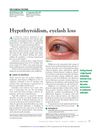
November 2020 in “Cleveland Clinic Journal of Medicine” Eyelash loss can be a sign of thyroid problems.
In this case report, researchers observed that a malnourished male patient developed pseudoglucagonoma syndrome, characterized by necrolytic migratory erythema and diffuse hair loss, following Frey's surgery, which rapidly improved with enhanced nutrition.
4 citations
,
November 2019 in “Harper's Textbook of Pediatric Dermatology” This article reviews the skin, hair, nail, and mucosal changes linked to various pediatric endocrine disorders but provides no new clinical findings.
 February 2010 in “Journal of the American Academy of Dermatology”
 This case report describes a 4-month-old boy with anhidrotic ectodermal dysplasia and immunodeficiency who showed minimal improvement with initial treatments but significant improvement after an umbilical cord blood transplantation.
 December 2023 in “Journal of nutritional science and vitaminology”
 This study in mice found that a zinc-deficient diet suppressed body weight gain and increased kidney and cecum tissue weight without decreasing serum alkaline phosphatase activity. Additionally, zinc deficiency caused alopecia and intestinal changes in C57BL/6J mice, potentially affecting nutritional status.
 February 2024 in “Pediatrics in review”
 This study details a 15-year-old girl with secondary amenorrhea and other symptoms who was found to have a pituitary mass causing multiple hormonal deficiencies, diagnosed as lymphocytic hypophysitis.
 54 citations
,
September 1972 in “British journal of nutrition”
54 citations
,
September 1972 in “British journal of nutrition” Malnutrition severely harms growth and development in young baboons.
 October 2024 in “Hippocrates Medical Journal”
 In this review, dermatological symptoms associated with various eating disorders, such as anorexia nervosa, bulimia nervosa, binge eating disorder, and pica, were examined, highlighting the potential role of dermatologists and psychiatrists in early diagnosis and interdisciplinary treatment approaches.
1 citations
,
June 2025 in “Journal of Veterinary Internal Medicine” In this case study, a miniature donkey with multisystemic eosinophilic epitheliotropic disease was euthanized due to laminitis despite treatment for pruritus, inappetence, hypertriglyceridemia, and alopecia.
 August 2008 in “European Neuropsychopharmacology”
 This study identified significant correlations between self-esteem, psychiatric symptoms, and health-related quality of life in peritoneal dialysis patients.
30 citations
,
May 2008 in “International Journal of Dermatology” This case report describes a 52-year-old black woman with diffuse scalp swelling and thinning hair attributed to a large increase in the thickness of scalp subcutaneous fatty tissue.
 8 citations
,
August 2016 in “Annales de Dermatologie et de Vénéréologie”
8 citations
,
August 2016 in “Annales de Dermatologie et de Vénéréologie” This case report details a rare instance of scurvy linked to anorexia nervosa in a 48-year-old woman, characterized by atypical symptoms and successfully treated with vitamin C supplements.
September 2016 in “Ege tıp dergisi/Ege tıp dergisi :” In this case report, an 11-year-old girl was diagnosed with lipedematous scalp, a condition typically observed in adult women, based on clinical features and histopathological findings.
1 citations
,
October 2010 in “Pediatrics in review” This article discusses the integration of complementary and alternative medicine (CAM) therapies in the treatment of eating disorders but presents no new clinical findings.
 35 citations
,
March 2014 in “British Journal of Dermatology”
35 citations
,
March 2014 in “British Journal of Dermatology” This study found that in androgenic alopecia, the arrector pili muscle degenerates and is replaced by fat, unlike in normal skin or telogen effluvium.
 4 citations
,
March 2013 in “Neuropsychiatric Disease and Treatment”
4 citations
,
March 2013 in “Neuropsychiatric Disease and Treatment” This case report describes a rare instance of a patient with anorexia nervosa who was subsequently diagnosed with Cushing's syndrome, highlighting diagnostic challenges due to overlapping symptoms.