 July 2016 in “Dermatologie pro praxi”
 This article discusses the use of Espumil foam base in pharmacies for preparing dermatological medications and reports no new clinical results.
 January 2026 in “Lithuanian University of Health Sciences”
 This study reported that gels containing methyl cellulose exhibited the highest consistency factor and optimal homogeneity compared to those made with hydroxypropyl cellulose or its combination with pullulan, indicating the significant impact of gelling agents on gel properties.
3 citations
,
January 2013 in “Türk veterinerlik ve hayvancılık dergisi/Turkish journal of veterinary and animal sciences” This report describes the first documented case of cutaneous asthenia in a crossbred spayed cat from Turkey, characterized by hyperelastic skin, alopecia, and an ulcerative wound.
2 citations
,
January 2024 in “BioMed Research International” This study found that alopecia areata patients with eosinophilia were more likely to have severe hair loss, atopia, and nail abnormalities compared to those without eosinophilia.
16 citations
,
September 2015 in “International Journal of Molecular Sciences” In this study, a genetic analysis identified a pathogenic variant in the ALOXE3 gene associated with non-bullous congenital ichthyosiform erythroderma, and the patient's response to antifungal treatment highlights the risk of cutaneous fungal infections.
4 citations
,
October 2025 in “Journal of Cosmetic Dermatology” This study reported severe and persistent skin reactions, including inflammation and scarring, after intradermal injections of unregulated exosome-based products, highlighting potential risks in aesthetic dermatology.
5 citations
,
January 2016 in “International Journal of Trichology” This case report describes two patients who experienced loose anagen hairs and pili torti, resulting in nonscarring alopecia, potentially linked to erlotinib treatment for solid tumors.
3 citations
,
January 2019 in “Indian Journal of Drugs in Dermatology” This study reports two cases of PRIDE complex in nonsmall cell lung cancer patients treated with erlotinib and gefitinib, highlighting cutaneous reactions like papulopustules and paronychia.
 2 citations
,
January 2024 in “Pakistan Journal of Life and Social Sciences (PJLSS)”
2 citations
,
January 2024 in “Pakistan Journal of Life and Social Sciences (PJLSS)” This study examines the use of emulgel-based systems as drug delivery vehicles for hydrophobic medications, noting their potential benefits in dermatological applications due to properties like easy spreadability, non-greasy texture, and prolonged shelf life.
 June 2023 in “International Journal for Research in Applied Science and Engineering Technology”
 This research highlights the potential of emulgel as an advanced topical drug delivery system, offering improved efficacy for hydrophobic medications in treating dermatological conditions and a range of ailments with its dual release control mechanism of gel and emulsion.
January 2026 in “British Journal of Dermatology” This study suggests that ELF5 plays a crucial role as a regulator and maintainer of stem/progenitor cell functions, impacting normal skin development and homeostasis.
6 citations
,
March 2021 in “Journal of the American Academy of Dermatology” This study found that the Brigham Eyelash Tool for Alopecia (BELA) is a reliable measure for assessing eyelash loss in alopecia areata patients, demonstrating high inter- and intrarater reliability.
14 citations
,
July 2007 in “Therapy” This review discusses ethosomes as potential carriers for delivering drugs into deeper skin layers and provides no new clinical results, suggesting a need for further studies on their efficiency in dermal therapies.
 February 2026 in “MedBA Medicine”
 This study identified potential new adverse drug reaction signals for erlotinib, used in lung and pancreatic cancer treatment, by analyzing a large dataset of case reports, indicating further clinical studies are necessary to confirm these findings.
 30 citations
,
August 2010 in “American Journal of Clinical Dermatology”
30 citations
,
August 2010 in “American Journal of Clinical Dermatology” This article reviews eyelash elongation as a side effect of EGFR inhibitors in cancer treatment, finding that the condition is typically not severe and may be managed by trimming.
This review emphasizes the importance of accurately distinguishing between diffuse alopecia areata and telogen effluvium in dermatological practice due to differing treatment implications and long-term patient expectations, but reports no new clinical results.
 February 2026 in “SHILAP Revista de lepidopterología”
 This study demonstrated that engineered exosomes loaded with growth factors, EGF and FGF, could successfully repair the hair follicle microenvironment in an androgenetic alopecia mouse model, enhancing hair growth without causing adverse immune reactions or toxicity.
 October 2014 in “Journal of skin and stem cell”
 This study found that combining Elidel with tretinoin was more effective for treating alopecia areata than using Elidel alone.
4 citations
,
November 2015 in “The journal of investigative dermatology. Symposium proceedings/The Journal of investigative dermatology symposium proceedings” This case study highlights a patient with alopecia areata who also has eosinophilic esophagitis, suggesting it may be considered an atopic disease and a potential trigger for alopecia areata in affected patients.
18 citations
,
January 2018 in “BMC dermatology” This paper describes a case of epidermolysis bullosa simplex with muscular dystrophy associated with a novel PLEC mutation and diffuse alopecia, highlighting a potential genetic link that remains uncertain.
 February 2026 in “Cosmetics”
 This review examines the clinicopathologic features of perifollicular elastolysis and indicates that, while its presentation is consistent, there is a lack of high-certainty evidence for effective treatments.
1 citations
,
November 2025 in “Molecules” This review highlights the potential of ellagic acid for treating various skin conditions due to its antioxidant, anti-inflammatory, and depigmenting properties, but notes that novel formulations are needed to overcome its poor solubility and skin permeability to enhance clinical efficacy.
5 citations
,
March 2016 in “CRC Press eBooks” This article explores the mechanisms of female hirsutism and highlights the effectiveness of eflornithine in reducing hair growth, with further removal requiring physical methods.
3 citations
,
January 2020 in “The journal of investigative dermatology/Journal of investigative dermatology” This study found that epidermolysis bullosa simplex keratinocytes had impaired mitochondrial activity and more dispersed mitochondrial distribution compared to normal human keratinocytes.
8 citations
,
June 2024 in “Pharmaceutics” This study found that using elastic nano-liposomes to deliver palmitoylethanolamide improved its transdermal delivery and enhanced its skincare effects, with minimal cytotoxicity and no allergic reactions observed.
 14 citations
,
July 2012 in “Journal of the American Academy of Dermatology”
14 citations
,
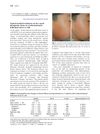
July 2012 in “Journal of the American Academy of Dermatology” This study found that topical tacalcitol improved roughness and scaling in erythromelanosis follicularis faciei et colli, although it was less effective for facial erythema.
January 2020 in “Revista Dermatológica Centro Uraga” This article describes how recognizing distinct trichoscopic features aids in diagnosing various dermatological conditions and hair loss, but it reports no new clinical findings.
 December 2002 in “Archives of Dermatology”
 This text does not provide a research abstract or study findings but outlines a website's use of cookies and offers access to medical publications and articles.