4 citations
,
November 2017 in “PubMed” This study found that Synsepalum dulcificum seed oil hair treatment significantly reduced hair breakage and improved hair health indices in women, outperforming both placebo and argan oil treatments.
3 citations
,
June 2024 in “Journal of Cosmetic Dermatology” This study investigated the effects of UV rays and particulate matter on hair porosity, finding that UV exposure increased porosity over time, and when combined with particulate matter, this effect was significantly enhanced in bleached hair.
2 citations
,
July 2012 in “PubMed” In this study, the use of internal wool lipid liposomes was shown to improve the lipid composition and increase the resistance to breaking in both untreated and chemically treated hair fibers.
 1 citations
,
January 2013 in “Chronicles of young scientists”
1 citations
,
January 2013 in “Chronicles of young scientists” This article discusses the characteristics of human hair, its damaging processes, and the potential repair effects of immuno-cosmeceuticals, but it reports no new clinical results.
 August 2026 in “International Journal of Stem Cells”
 In this study, Korean adults with damaged hair who took 3g/day of low-molecular-weight collagen peptide GT for 24 weeks showed significant improvements in hair gloss, elasticity, and scalp elasticity compared to placebo, without any adverse events.

This chapter explores the causes and management of hair damage, highlighting effective repair strategies such as protein and lipid replenishment with keratin peptides and citric acid, and identifies social media's role in consumer preferences for protective and conditioning products.
December 2025 in “Asian Journal of Beauty and Cosmetology” This study found that applying soybean oil extract to damaged hair significantly improved brightness, tensile strength, absorbance, and gloss, suggesting its potential in enhancing hair condition. Further research is needed to explore how different natural extracts affect damaged hair.
 April 2024 in “Research Square (Research Square)”
 This study found that bioconjugating 16-methylheptadecanoic acid (16-MHA) to damaged hair can mimic the protective properties of 18-methyleicosanoic acid (18-MEA), restoring the hair's structural integrity and moisture homeostasis, even after washing.
January 2018 in “프로그램북(구 초록집)” This study found that ceramide-based essence cream, particularly those with stearyl and stearyl-cholesterol, improved the ultrastructure of damaged hair cuticles.
 January 2011 in “Journal of Society of Cosmetic Chemists of Japan”
 This study found that a conditioner containing 18-MEA and SPDA can improve hair's smoothness and reduce flyaways, enhancing hair manageability.
 January 2011 in “Yearbook of Dermatology and Dermatologic Surgery”
 Hair relaxers are linked to reduced cystine levels and potential hair damage.
 June 2017 in “University of the Arts London Research Online (University of the Arts London)”
 This study compared the effects of three compounds on structural and sensory benefits for bleached hair when applied with or after bleaching, observing that their application may mitigate bleaching-induced damage.
 59 citations
,
January 2013 in “Annals of Dermatology”
59 citations
,
January 2013 in “Annals of Dermatology” In this study, researchers found that Asian hair contains more integral lipids than European or African hair, which may protect it better from UV-induced damage.
28 citations
,
June 2012 in “International Journal of Molecular Medicine” This study observed that while X-ray radiation did not alter major hair keratin composition in mice, it decreased hair follicle stem cell markers and increased Krt5, suggesting potential as a radiation biomarker.
26 citations
,
April 2010 in “The American journal of dermatopathology/American journal of dermatopathology” This study developed an objective standard grading system for evaluating hair damage using scanning and transmission electron microscopy.
8 citations
,
January 2016 in “Skin research and technology” This study found that a new 12-point scale provided a more precise measurement system for evaluating hair damage and improvement after hair care product use compared to a 5-point scale.
 1 citations
,
January 2017 in “Clinical approaches and procedures in cosmetic dermatology”
1 citations
,
January 2017 in “Clinical approaches and procedures in cosmetic dermatology” This chapter reviews the anatomy and structure of hair, discusses hair damage and analyses, and explores methods for processing hair changes, but presents no new research findings.
 July 2025 in “Scientific Reports”
 This study reported that fermented grapeseed oil may enhance hair permeability and improve strength and color retention in chemically treated hair compared to regular grapeseed or silicone oils.
March 2025 in “Digital Library of Theses and Dissertations (Universidade de São Paulo)” In this study, the researchers observed that ferulic acid and resveratrol effectively protected chemically treated hair from oxidative damage, particularly against protein loss and color degradation, but not cisteine oxydation prevention, and these antioxidants also offered protection against sun-induced damage when used in conditioners.
 June 2020 in “Journal of Investigative Dermatology”
 This study reported that a treatment serum containing ingredient blends with panthenol, licorice extract, and red clover extract significantly improved hair volume, scalp coverage, and reduced hair breakage over 6 months in individuals with thinning or damaged hair.
 January 2017 in “Nihon Keshouhin Gijutsushakaishi/Journal of S C C./Nihon Keshouhin Gijutsushakai kaishi”
 This study found that hair damage from sunlight and chemical processes like perms and bleaching varies in internal microstructure changes, suggesting that protective techniques should be tailored to the type of chemical treatment used.
 January 2015 in “Springer eBooks”
 Hair damage shows as fragility, dullness, and discoloration, varies by ethnicity, and is worsened by cosmetic procedures and diseases.
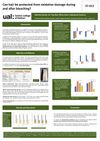 September 2018 in “University of the Arts London Research Online (University of the Arts London)”
 This study assessed three materials—L-arginine, hydrolysed keratin, and cystine-silanol copolymer—ex vivo for their potential to reduce undesirable effects of hair bleaching, such as damage to hair proteins.
7 citations
,
January 2020 in “International Journal of Trichology” This study observed that regular coconut oil users have significantly reduced hair irregularities compared to non-oil users, as quantified by a new "hair protection factor" metric, highlighting coconut oil's potential in minimizing hair damage.
10 citations
,
January 2011 in “Skin research and technology” This study found that procyanidin oligomers bind to keratin and inhibit oxidative hair damage, suggesting their potential use in protective hair care products.
 7 citations
,
October 2019 in “Klinická onkologie”
7 citations
,
October 2019 in “Klinická onkologie” This review discusses the impact of oncological therapy on hair loss, highlighting that while most alopecia is reversible, it can be permanent depending on treatment type and factors.
5 citations
,
November 2003 in “PubMed” This study found that chemical and photochemical oxidative processes modify the main classes of proteins in hair, confirmed through microspectrophotometric, fluorescence microscopy, and electrophoretic methods.
4 citations
,
August 2016 in “PubMed” This study analyzed how oxidative hair dye leaches from pigmented and nonpigmented hair during wash cycles, finding that melanin influences the dye deposition and leaching processes.
 May 2026 in “Archives of Dermatological Research”
 This study found that treating human hair with vitamin E and γ-oryzanol significantly reduced UV-B-induced structural damage, with γ-oryzanol providing greater protection, especially in female hair samples. The findings highlight these compounds' potential as cost-effective solutions for preserving hair integrity against UV damage.
 September 2025 in “International Journal of Cosmetic Science”
 This study observed that exposing human hair keratins to heat or UV treatments led to modifications in cysteine residues, disrupting crucial disulphide bonds and potentially reducing the structural integrity of hair similar to prolonged styling or sunlight exposure.