 May 2021 in “British Small Animal Veterinary Association eBooks”
 This review discusses various causes and patterns of canine alopecia, noting that symmetrical and diffuse hair loss often indicates an endocrinopathy, and reports no new clinical results.
March 2021 in “Der Hautarzt” This review covers the clinical features, pathophysiology, differential diagnoses, and therapeutic options for neuroendocrine paraneoplastic syndromes affecting the skin but reports no new clinical findings.
November 2020 in “Universal Journal of Pharmaceutical Research” In this study, tacrolimus-based treatment was found to result in fewer overall side effects compared to cyclosporine among Yemeni kidney transplant patients, although tacrolimus was associated with a higher incidence of diabetes.
July 2020 in “Endocrine practice” This case report details a 13-year-old boy with Cushing syndrome, where BIPSS identified the pituitary gland as the cortisol excess source and hormonal tests showed suppressed puberty markers.
April 2020 in “Journal of the Endocrine Society” In this case study, the use of somatostatin analogues was effective in localizing and confirming a neuroendocrine lung tumor as the source of ectopic ACTH syndrome, leading to marked clinical improvement in a patient unable to undergo surgery.
This study found that a hair growth rate of 0.75 cm/month better matches retrospective cortisol timelines and identified factors influencing hair cortisol content in children and adolescents.
April 2018 in “Blackwell's Five‐Minute Veterinary Consult Clinical Companion” This chapter discusses atypical endocrinopathies affecting the hair and skin in small animals and provides treatments but does not present new research results.
This review discusses fungal skin diseases in goats, highlighting rare vitamin E-, selenium-, and zinc-responsive dermatoses without reporting new clinical results.
August 2017 in “ARSHI Veterinary Letters” This case report describes a 10-year-old Shih Tzu diagnosed with hyperadrenocorticism, leading to the management of skin issues which initially improved but was followed by neurological symptoms, prompting euthanasia.
 August 2017 in “Companion animal”
 This article discusses the diagnostic approach to focal alopecia in dogs, focusing on distinguishing between pruritic skin disease and inflammatory or non-inflammatory causes; it presents no new experimental results.

This article explores whether Melampus, a mythological healer, may have intentionally caused the madness of Proetus' daughters through the use of herbs, despite being credited with their cure.
 September 2016 in “Elsevier eBooks”
 Different types of hair loss in dogs and cats have various causes and treatments, with outcomes ranging from good to uncertain.
 August 2016 in “CRC Press eBooks”
 This article highlights various endocrine disorders and other etiologies linked to alopecia and emphasizes the importance of diagnosing treatable conditions before starting hair loss treatment.
June 2016 in “Annals of the Rheumatic Diseases” This study found that glucocorticoid use in rheumatoid arthritis patients is associated with dose-dependent risk of Cushingoid habitus, easy bruising, skin atrophy, and impaired wound healing, while other skin adverse effects are rare at lower doses.
June 2016 in “Journal of Coastal Life Medicine” This case report describes a 10-year-old terrier with pituitary-dependent hyperadrenocorticism successfully treated with mitotane.
 January 2016 in “Springer eBooks”
 This article reviews causes and treatments of hyperandrogenism, including hirsutism and acne, but presents no new clinical findings.
 January 2016 in “Dermatology Review”
 This review details various skin manifestations linked to different endocrine disorders but does not report any new clinical results.
November 2015 in “Bulletin of University of Agricultural Sciences and Veterinary Medicine Cluj-Napoca Veterinary Medicine” This article discusses the complexities of diagnosing pituitary dependent hyperadrenocorticism in dogs and reports no new clinical findings, highlighting issues with varied symptoms and episodic hormone secretion complicating diagnosis.

This study of hirsutism in Chennai found idiopathic causes most common and reported that both Nd YAG and IPL lasers had a 70% good response rate in hair removal across different skin types.
 January 2011 in “Elsevier eBooks”
 Alopecia in animals can be hereditary, congenital, or acquired, with treatments and outcomes varying widely.
 September 2010 in “Companion Animal”
 This article reviews a clinician's approach to diagnosing and managing canine alopecia and reports no new clinical findings.
August 2004 in “Veterinary Dermatology” This case series described opportunistic skin conditions in three diabetic cats with additional immunosuppressive diseases, highlighting various treatments and outcomes, including a notable demodicosis recovery.
 July 1996 in “Trends in Endocrinology and Metabolism”
 The book is a valuable reference on androgenic disorders for professionals but not suitable for laypeople or medical students.
This review discusses the clinical forms and causes of androgenization in women, as well as therapeutic options, reporting success with antiandrogens like cyproterone acetate and spironolactone for skin symptoms, though results are not permanent.
 January 1987 in “Journal of steroid biochemistry/Journal of Steroid Biochemistry”
 This review discusses hormonal therapies for acne related to endocrine disorders and provides practical guidelines for managing hormonally influenced acne in clinical practice, but reports no new clinical results.
January 1985 in “Clinical research” This study found that topical alpha-terthienyl combined with UVA radiation rapidly induced dose-dependent cutaneous photosensitization in guinea pigs, suggesting potential for photochemotherapy in skin disorders without future carcinogenic risks.
December 1990 in “PubMed” This article discusses the role of androgens in causing hirsutism and male pattern baldness in women and emphasizes the need for antiandrogen treatment to manage these conditions, without reporting new clinical results.
37 citations
,
September 2005 in “Australasian Journal of Dermatology” This case report describes a 27-year-old man with a unique association of keratosis follicularis spinulosa decalvans and acne keloidalis nuchae, successfully treated with oral isotretinoin.
16 citations
,
November 1998 in “Fertility and sterility” This article discusses the fragmented approach to PCOS treatment, highlighting the recent recognition that insulin resistance is a common, intrinsic feature in most women with PCOS.
 11 citations
,
June 2005 in “Journal of Cosmetic Dermatology”
11 citations
,
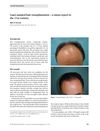
June 2005 in “Journal of Cosmetic Dermatology” Lasers in hair transplantation show promise but are not yet standard, with current methods causing some side effects and needles still being preferred for creating recipient sites.