 September 2019 in “Asian Pacific journal of health sciences”
 This study identified tinea capitis as the most common cause of alopecia in children, with a higher prevalence in boys than girls.
 June 2018 in “International Review of Intellectual Property and Competition Law”
  April 2026 in “Preprints.org”
 This review discusses the potential of cold atmospheric plasma as a selective antitumor therapy for breast cancer but reports no clinical results, emphasizing its promise and the challenges to its use in precision oncology.
 March 2022 in “Berkala Ilmu Kesehatan Kulit dan Kelamin/Berkala ilmu kesehatan kulit dan kelamin (Periodical of dermatology and venerology)”
 This study found that nearly half of the tinea capitis patients at a Surabaya hospital had cat contact, with the most common symptoms being crust and hair loss.
 5 citations
,
January 2010 in “International journal of trichology”
5 citations
,
January 2010 in “International journal of trichology” This report describes two cases of alopecia totalis treated with turban psoralen and sunlight exposure, but it provides no clinical outcome results.
125 citations
,
May 2010 in “Pediatric dermatology” This review presents European guidelines for treating tinea capitis, noting systemic antifungals are essential, with griseofulvin preferred for Microsporum infections and newer antifungals viable for Trichophyton but often costlier.
2 citations
,
January 1983 in “Archives of Dermatology” This case report describes a 3-year-old boy with tinea capitis, suggesting that Penicillium may have been the causative agent.
 February 2024 in “Jurnal Kesehatan Yamasi Makassar”
 This study in South Sulawesi Province developed a shampoo using ethanol extract from Pondoh salak fruit peel, which met physical stability tests and demonstrated strong inhibitory effects against Staphylococcus epidermidis and Candida albicans, with formulations ranging from 10% to 20% concentrations.
July 2026 in “Journal of the American Academy of Dermatology” 9 citations
,
November 2024 in “Journal of Wound Management Official journal of the European Wound Management Association” Cold Plasma shows promise for healing wounds by killing bacteria and helping tissue grow.
April 2021 in “Cermin Dunia Kedokteran” This report describes two cases of tinea capitis in young siblings, with cultures showing M. canis and Rhodotorulla, and notes improvement after treatment with ketoconazole lotion and shampoo for two months.
 3 citations
,
January 2015 in “Sen i Gakkaishi”
3 citations
,
January 2015 in “Sen i Gakkaishi” This study reported that keratin films lacking keratin-associated proteins showed different appearance, structure, and color deposit properties compared to conventional keratin films, suggesting potential for evaluating hair damage.
13 citations
,
December 2012 in “Medical mycology case reports” In this case report, an atypical form of tinea favosa in an 11-year-old girl was initially misdiagnosed, highlighting the importance of mycological examination for accurate diagnosis, especially when diffuse scalp scaling is present.
 March 2026 in “Dermatology Online Journal”
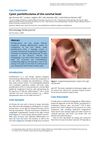
 In this case report, the authors describe a rare cystic panfolliculoma in an 84-year-old man's right conchal bowl, noting its potential to mimic other tumors like basal cell carcinoma, which complicates diagnosis.

The document cannot be summarized as it is not provided or is unclear.
May 2025 in “JEADV Clinical Practice” This study found that using calcipotriene and betamethasone dipropionate cream in a real-world setting significantly improved clinical outcomes and patient quality of life for adults with mild-to-moderate scalp psoriasis, especially among those with higher adherence, demonstrating high treatment satisfaction.
26 citations
,
October 2019 in “JNCI Cancer Spectrum” This clinical study observed that in patients with advanced breast cancer and BRCA1/2 mutations, talazoparib provided significantly better progression-free survival, objective response, clinical benefit, and patient-reported outcomes compared to physician’s choice chemotherapy, despite common side effects like anemia and fatigue.
 3 citations
,
September 2000 in “Hair transplant forum international”
3 citations
,
September 2000 in “Hair transplant forum international” This article shares the story of Mr. Chung Ki Paek, as presented at the Japan Society of Hair Restoration Surgery's annual meeting, and reports no new clinical results.
 2 citations
,
January 2019 in “Indian Dermatology Online Journal”
2 citations
,
January 2019 in “Indian Dermatology Online Journal” This paper summarizes the foundation and proceedings of the first International Congress of SAARCUM, which addressed the growing issue of antifungal therapy failures in South Asia but reports no new research findings.
25 citations
,
September 2014 in “SpringerPlus” This study found that sheep possess a polymorphic KAP8-2 gene that shares high sequence identity with the KAP8-2 gene in goats and reindeer.
 February 2024 in “Infection and drug resistance”
 This study presented a case of tinea capitis in a 4-year-old without typical symptoms and traced the infection to Microsporum canis carried by domestic cats, highlighting the need for accurate diagnosis and appropriate treatment, especially in households with pets.
9 citations
,
July 2022 in “Journal of Clinical Oncology” This study found that oral paclitaxel combined with encequidar improved tumor response rates compared to intravenous paclitaxel in women with metastatic breast cancer, while also reducing neuropathy but increasing certain gastrointestinal and neutropenic side effects.
11 citations
,
March 2012 in “Actas Dermo-Sifiliográficas” This report describes cases of tinea capitis in women over 65, an age group where it is rare, highlighting the need for fungal culture in atypical scalp dermatoses to avoid diagnostic delays.
 2 citations
,
January 2022 in “Eduvest”
2 citations
,
January 2022 in “Eduvest” This report of a 90-year-old girl with tinea capitis indicates that griseofulvin remains the main treatment, showing improvement after eight weeks of therapy.
41 citations
,
January 1981 in “Journal of Clinical Medicine” In this study, trichoscopy highlights that hair diameter variability, vellus hairs, and the peripilar sign are key indicators for diagnosing androgenetic alopecia.
48 citations
,
February 2010 in “Molecular biology reports” This study found that KAP7.1 and KAP8.2 genes were significantly more expressed in secondary hair follicles than primary follicles, suggesting their role in regulating cashmere fiber diameter.
12 citations
,
October 2022 in “Facial Plastic Surgery” This study found that polycaprolactone gel injections were significantly more effective than sodium hyaluronate gel in improving nasolabial fold severity for Chinese patients over 12 months, with similar rates of mild injection-related adverse events between the groups.
1 citations
,
June 2023 in “Turkish Journal of Surgery” This case report described a rare combination of synchronous gallbladder and pancreatic cancers with an unusual initial symptom of complete loss of facial and scalp hair, marking a unique presentation never previously documented for abdominal malignancies in medical literature.
52 citations
,
May 2006 in “Journal of Structural Biology” This study identified two key pentapeptide quasi-repeats in human keratin-associated proteins, which are similar to motifs found in sheep wool.
22 citations
,
October 2007 in “JDDG Journal der Deutschen Dermatologischen Gesellschaft” In this case study, combination therapy with dapsone and isotretinoin significantly improved perifolliculitis capitis abscedens et suffodiens, with the patient remaining symptom-free for six months on reduced medication.